

Key points
- Instead, with less than a month remaining before the opening match, hotels in numerous host cities across the United States are reporting booking levels that are far below projections, while thousands of match tickets remain unsold despite repeated assurances from FIFA that demand remains exceptionally strong.
- This Hotel News report finds that a growing number of international travelers appear reluctant to visit the United States due to concerns over immigration policies, rising travel costs, political tensions, and what many perceive as an increasingly hostile environment for foreign visitors.
- The decision by FIFA to award the majority of World Cup matches to the United States is now facing renewed criticism from some observers who believe the organization underestimated the impact of political and social issues on international tourism.
Hotel News: Hotels Across the United States Facing Unexpected Booking Slump Ahead of 2026 FIFA World Cup
The 2026 FIFA World Cup, widely promoted as the biggest football tournament in history, was expected to trigger an unprecedented tourism boom across North America. Instead, with less than a month remaining before the opening match, hotels in numerous host cities across the United States are reporting booking levels that are far below projections, while thousands of match tickets remain unsold despite repeated assurances from FIFA that demand remains exceptionally strong.
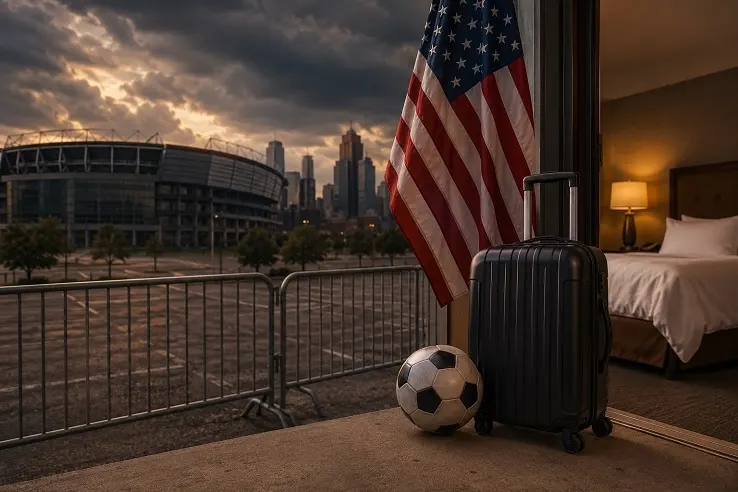
Image Credit: Thailand Hotel News
The tournament, which will be staged across 16 cities in the United States, Canada, and Mexico, features an expanded format of 48 national teams competing in 104 matches. Organizers anticipated millions of international visitors would travel to North America to witness the historic competition.
However, this Hotel News report finds that a growing number of international travelers appear reluctant to visit the United States due to concerns over immigration policies, rising travel costs, political tensions, and what many perceive as an increasingly hostile environment for foreign visitors.
Growing Concerns Over U.S. Immigration Policies
A significant factor being discussed among tourism industry observers is the reputation of U.S. immigration procedures under the Trump administration. Many travelers from Europe, Asia, Latin America, Africa, and the Middle East have increasingly voiced concerns online about their experiences entering the United States.
Travel forums, social media platforms, and tourism discussion groups contain numerous complaints from foreign visitors who claim they were subjected to aggressive questioning, lengthy inspections, and unfriendly treatment despite possessing valid visas and legitimate travel documentation and funds. Critics argue that immigration authorities have become excessively strict and, in some cases, openly hostile toward visitors.
Many international travelers now view the United States as a destination requiring significant scrutiny and uncertainty at entry points. Tourism analysts say this perception alone can discourage visitors from booking holidays, especially when alternative destinations offer more welcoming experiences.
Some critics have gone even further, describing U.S. immigration practices as discriminatory and racially biased. Such perceptions have generated negative publicity abroad and have contributed to growing calls among some international communities for reciprocal treatment of American travelers overseas. Whether justified or not, these sentiments are increasingly influencing travel decisions.
FIFA’s Gamble on the United States Under Scrutiny
The decision by FIFA to award the majority of World Cup matches to the United States is now facing renewed criticism from some observers who believe the organization underestimated the impact of political and social issues on international tourism.
While FIFA President Gianni Infantino has stated that more than five million tickets have already been sold and that over 500 million ticket requests were submitted worldwide, actual sales data in several host cities suggest a more complicated picture.
Reports indicate that many group-stage matches still have substantial numbers of tickets available. In some cases, ticket prices have fallen below US$100, yet thousands of seats remain unsold. Atlanta reportedly leads the list of venues with unsold inventory, followed by Philadelphia, Los Angeles, and the San Francisco Bay Area.
The situation has sparked debate about whether FIFA made a major calculation error by assuming that football fans would overlook broader concerns about travel to the United States.
Hotels Feeling the Impact
The lodging sector has become one of the clearest indicators of softer-than-expected demand.
According to surveys conducted by the American Hotel and Lodging Association, approximately 80 percent of hotels questioned reported booking levels below expectations. Many hoteliers had anticipated near-capacity occupancy weeks before kickoff but are instead seeing considerable room availability.
Houston hotels have experienced occupancy increases of only around 9 to 11 percent compared to normal periods, far below what would typically be expected for a mega-event of this scale. Some hotel operators admitted they had expected to be completely sold out by now.
Seattle has experienced similar challenges. One hotel reported occupancy levels in June that were seven percent lower than during the same period last year, a surprising outcome given the city’s role as a World Cup host.
In Atlanta, disappointment has extended beyond traditional hotels. Some Airbnb property owners have publicly expressed frustration that accommodations located near stadiums remain unbooked despite the approaching tournament.
Rising Prices Creating Additional Barriers
Another major obstacle appears to be cost. Hotel room rates have surged dramatically throughout the tournament’s host cities. Research by FCM Consulting found that 13 of the 16 host cities experienced room price increases of at least 80 percent compared to the same period a year earlier.
Guadalajara in Mexico recorded one of the sharpest increases, with rooms that previously sold for around US$90 per night now commanding more than US$500.
In the United States, Boston has emerged as the most expensive World Cup accommodation market, with average nightly rates reaching approximately US$611. Even Houston, considered among the most affordable host cities, still averages above US$200 per night.
The ticketing situation has generated similar criticism. FIFA’s introduction of dynamic pricing means ticket costs fluctuate according to demand. While some group-stage tickets begin at around US$60, premium tickets for the final can exceed US$6,700.
Many football supporters argue that the World Cup is becoming increasingly inaccessible to average fans and is evolving into an event primarily catering to wealthier travelers.
Political Climate Influencing Tourism Decisions
Beyond immigration concerns, broader dissatisfaction with U.S. foreign policy and trade measures is also being cited by some international travelers.
The Trump administration’s aggressive tariff policies affecting multiple countries, combined with controversial diplomatic positions, have contributed to negative perceptions of the United States among certain foreign populations. While political disagreements do not always affect tourism patterns, industry experts acknowledge that sustained negative sentiment can influence destination choices, especially when travelers have alternatives.
For some football fans, attending matches in Canada or Mexico has become a more attractive option than entering the United States. Canadian tourism operators remain optimistic despite lower-than-expected bookings, while Mexican host cities continue to report growing interest even though occupancy levels have not yet reached anticipated targets.
Hope Remains for a Late Booking Surge
Despite current concerns, tourism experts caution against writing off the tournament prematurely.
Historically, major sporting events often experience significant last-minute booking activity, particularly if popular teams advance deep into the competition. Nations such as Argentina, England, France, Brazil, and Portugal possess enormous global fan bases capable of generating sudden surges in travel demand.
The presence of global stars such as Cristiano Ronaldo, should Portugal advance successfully, could also stimulate additional interest and increase attendance figures in later rounds.
Industry analysts suggest that knockout-stage matches may ultimately produce stronger tourism numbers than currently indicated by early booking trends.
As the opening match between Mexico and South Africa approaches on June 11 and the tournament prepares to run through July 19, hotels, tourism authorities, and FIFA officials will be closely monitoring whether demand accelerates or whether concerns over costs, immigration policies, and political perceptions continue to discourage large numbers of international visitors. The coming weeks may ultimately determine whether the largest World Cup ever staged becomes a tourism triumph or a cautionary tale about the risks of overestimating global travel demand in a rapidly changing world.
For the latest on hotel bookings in the United States for the coming World Cup 2026, keep on logging to Thailand Hotel News.