

Key points
- The current administration under Anutin has launched one of the most comprehensive clean-up campaigns the island has seen in decades, aiming to restore legal order, protect legitimate investors, and rebuild trust in Thailand’s tourism economy.
- The current Anutin led government should be praised and supported for their efforts to clean up Phuket and the rest of Thailand and their efforts to reclaim and return the country back to decent Thais after previous corrupted political parties had indirectly sold off the country to lots of foreigners and mafia.
- One large property form and a construction firm is owned by Chinese mafia specializing in money laundering and illegal crypto exchanges and even has an Indian as a front.
Thailand Hotel News: A Deepening Crackdown on Phuket’s Shadow Economy
Phuket, long celebrated as one of Thailand’s crown jewels in global tourism, is now facing an intense and highly visible reckoning. Beneath the island’s pristine beaches, luxury villas, and thriving hospitality sector lies a complex web of illicit businesses, nominee ownership structures, and alleged mafia-linked operations that authorities are now aggressively dismantling. The current administration under Anutin has launched one of the most comprehensive clean-up campaigns the island has seen in decades, aiming to restore legal order, protect legitimate investors, and rebuild trust in Thailand’s tourism economy. The current Anutin led government should be praised and supported for their efforts to clean up Phuket and the rest of Thailand and their efforts to reclaim and return the country back to decent Thais after previous corrupted political parties had indirectly sold off the country to lots of foreigners and mafia.
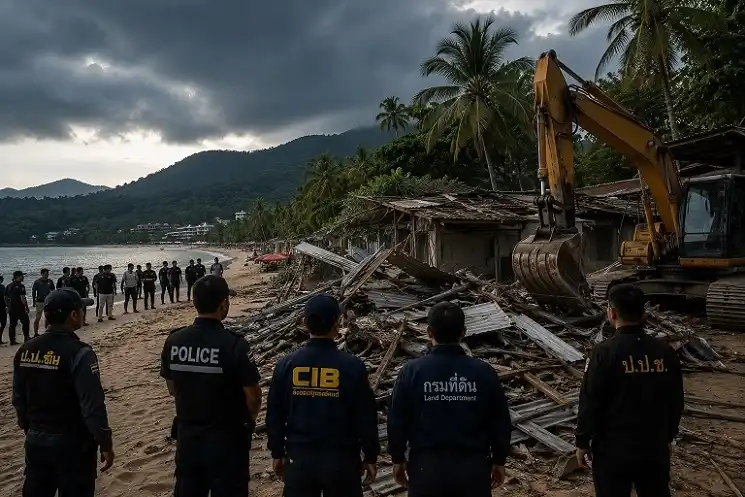
Image Credit: Thailand Hotel News
Midway through this unfolding transformation, this Thailand Hotel News report highlights a stark reality: despite Phuket’s global appeal, the scale of illegal operations embedded within its hospitality and property sectors has raised serious concerns for both regulators and responsible travelers. The government’s push is not merely symbolic; it is backed by coordinated enforcement, legal proceedings, and a growing list of closures, demolitions, and asset seizures.
Illegal Hotels, Nominee Ownership, and Rising Safety Concerns
At the center of the crackdown is the widespread use of Thai nominees to conceal foreign ownership of businesses. Authorities are currently investigating 391 companies suspected of operating under such arrangements. Legal action has already been initiated against 39 firms, with 34 closures enforced, while more than 600 additional entities remain under scrutiny.
The implications for the hotel industry are particularly severe. Thousands of small accommodation providers—estimated between 3,000 and 4,000—are operating without proper licenses. Historically, at least 1,295 unlicensed hotels were identified during earlier enforcement campaigns, many clustered in high-density tourist zones such as Patong.
For travelers, this presents tangible risks. Unlicensed hotels often fall outside regulatory oversight, meaning they may lack proper fire safety systems, structural compliance, or insurance coverage. In the event of accidents, fires, or criminal incidents, guests may find themselves without legal protection or compensation pathways. The issue extends beyond legality into fundamental concerns about personal safety and financial security.
Compounding the problem is the legal gray area faced by smaller operators. Many claim they are unable to meet strict licensing requirements due to building code constraints. However, authorities have made it clear that non-compliance—especially when linked to concealed foreign ownership—will not be tolerated.
Expanding Investigations into Foreign-Controlled Enterprises
The crackdown extends far beyond hotels. Investigators are targeting a wide spectrum of businesses, including restaurants, cannabis shops, property firms, and tourism-related enterprises suspected of operating illegally or under nominee structures. One large property form and a construction firm is owned by Chinese mafia specializing in money laundering and illegal crypto exchanges and even has an Indian as a front!
Foreign nationals from multiple regions—including China, Russia, Spain, Germany, Denmark, Britain, Sweden Europe, India and Malaysia—have been identified as key players in illegal operations in Phuket. While not all foreign involvement is illicit, authorities allege that many businesses are effectively controlled by foreign interests while using Thai nationals as legal fronts.
Enforcement teams are now cross-referencing corporate registry data with land ownership records to identify ultimate beneficial owners. This forensic approach has already led to the examination of nearly 1 billion baht in assets, including land plots, luxury properties, and financial accounts believed to be linked to illicit operations.
Unlicensed businesses found to be in violation face severe penalties, including license revocation, substantial fines, asset seizure, and potential imprisonment.
Demolitions and Land Reclamation Efforts Intensify
One of the most visible aspects of the crackdown is the demolition of illegal structures. Authorities have begun dismantling dozens of properties found to be encroaching on protected land, including state forests and national parks.
Key enforcement zones include:
-Nui Beach, where 39 illegal shops and structures are slated for removal
-Bang Tao Beach, with 37 buildings targeted for encroachment violations
-Freedom Beach, where demolition notices and land title revocations are underway.
-Sirinat National Park, where improperly issued land titles are being revoked from hotels and resorts.
These actions signal a broader commitment to environmental protection and legal land use, areas that have long been compromised by unchecked development and corruption.
Allegations of Organized Crime and Financial Laundering
Beyond regulatory violations, authorities are also confronting allegations of organized crime networks operating within Phuket. Reports suggest that certain foreign groups have established significant influence across sectors such as real estate, hospitality, and entertainment.
There are claims of illicit financial flows by British and Australian boiler room scammers being funneled into property developments, restaurants, media ventures and IT businesses often through complex nominee arrangements. Some individuals are alleged to have acted as intermediaries, facilitating payments to officials in exchange for regulatory leniency.
Additionally, concerns have been raised about illegal labor practices. Foreign workers from Russia, Britain, Australia, Spain, Colombia, Brazil , India, Pakistan Philippines and Myanmar are reportedly employed in roles that do not align with their work permits, while others operate entirely outside the legal employment framework.
Phuket has also been described by some observers as a refuge for individuals engaged in criminal activities, further complicating the island’s regulatory landscape.
There are many Brits and Australians controlling the sex bars and sex trade in Phuket. There are old Singaporean and Malaysian Chinese individuals who were once in the hospitality trade acting as consultants for the Chinese mafia on the island and being the middle parties for the Chinese mafia to pay off the Thai officials to look the other way.
Social Tensions and Local Resistance
While many support the government’s efforts, the crackdown has not been without resistance. Certain local groups, including those with alleged ties to entrenched interests, have expressed opposition to the sweeping enforcement measures.
However, officials remain resolute. The administration has emphasized that restoring Phuket’s integrity requires confronting deeply rooted issues, even in the face of pushback. The broader objective is to ensure that Thailand’s tourism industry benefits lawful operators and aligns with national interests.
Implications for Travelers and the Tourism Industry
For international visitors, the current situation presents a complex dilemma. Phuket remains a globally recognized destination, but the scale of ongoing investigations and enforcement actions raises legitimate questions about where tourism revenue is ultimately flowing.
There is growing sentiment that ethical and safety-conscious travelers should exercise caution when choosing accommodations and services on the island. Without rigorous due diligence, visitors may inadvertently support illicit enterprises or expose themselves to avoidable risks.
At the same time, the government’s actions could pave the way for a more transparent and sustainable tourism environment in the long term. By eliminating illicit operators and enforcing regulatory compliance, authorities aim to create a level playing field for legitimate businesses.
A Turning Point for Phuket’s Future
Phuket stands at a critical juncture. The island’s reputation, economic stability, and long-term viability as a premier tourists destination depend on the success of these reforms.
The current administration’s efforts represent a decisive attempt to reclaim control from networks that have operated in the shadows for years. While the process is likely to be lengthy and complex, the direction is clear: a move toward accountability, legality, and national sovereignty over key economic sectors.
The coming months will be crucial in determining whether these initiatives can deliver lasting change or whether entrenched interests will adapt and persist in new forms.
The Road Ahead for Thailand’s Tourism Integrity
As enforcement continues, the broader implications extend beyond Phuket. The island has become a test case for how Thailand addresses illegal business practices, foreign ownership loopholes, and regulatory enforcement in its tourism industry.
If successful, the model could be replicated in other tourists hubs such as Pattaya and Mae Hong Sorn, facing similar challenges. For now, Phuket remains under intense scrutiny, with authorities signaling that no sector is beyond investigation.
Travelers, investors, and industry stakeholders alike are watching closely as one of Southeast Asia’s most iconic destinations undergoes a profound transformation.
In the final analysis, the situation in Phuket reflects both a warning and an opportunity. On one hand, it exposes the vulnerabilities that can emerge when rapid tourism growth outpaces regulatory oversight. On the other, it demonstrates the capacity of a determined administration to confront systemic issues head-on. The clean-up effort is not merely about enforcement; it is about redefining the standards of Thailand’s tourism economy. Ensuring that businesses operate legally, transparently, and safely is essential for maintaining international confidence. For travelers, this moment calls for heightened awareness and more deliberate choices. For the industry, it is a chance to rebuild on stronger foundations. If the current momentum is sustained, Phuket could emerge not weakened, but strengthened—an example of how a destination can correct course and reclaim its identity. The stakes are high, but so too is the potential for meaningful, lasting reform that benefits both Thailand and the global tourism community.
For the latest on the hospitality industry in Phuket, keep on logging to Thailand Hotel News.