

Key points
- Wealthy Chinese and Russian demographics, facing restricted travel access, banking frictions, or shifting geopolitical alignments with traditional European medical strongholds in Switzerland, Germany, and Austria, are looking to Southeast Asia for discretion, luxury, and advanced healthcare.
- While a traditional spa guest might spend a few hundred dollars per stay on facials and massages, a single clinical longevity guest often spends tens of thousands of dollars on customized biomarker testing, organ-specific peptide protocols, and regenerative cellular therapies.
- Adapting to this new elite demographic requires a thorough restructuring of resort operations, going far beyond adding new machines to a fitness center or hiring a visiting practitioner.
For decades, the blueprint for Thailand’s luxury wellness sector was highly predictable. High-end sanctuaries across Phuket, Koh Samui, Hua Hin, and Chiang Mai catered primarily to affluent Western travelers seeking holistic escapes.
The guests at these hotels and resorts filled their itineraries with mindfulness meditation, vinyasa yoga, organic juice cleanses, sound baths, and traditional Thai massages. It was a market driven by the pursuit of mindfulness, mental decompression, and spiritual realignment—a lifestyle aesthetic heavily marketed toward British, German, American, and Australian demographics.
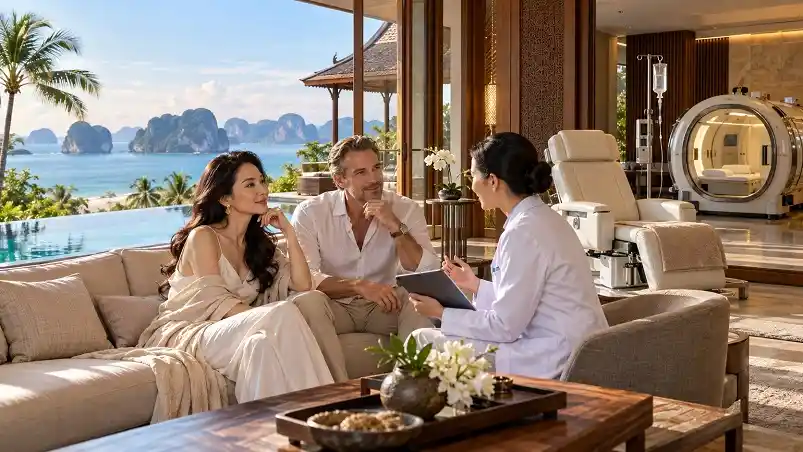
Image Credit: Thailand Hotel News
Today, that traditional model is undergoing a radical, quiet transformation. A sharp economic deceleration in Western Europe, combined with soaring long-haul airfares, inflation, structural airline capacity cuts, and persistent global flight disruptions, has softened demand from historic Western feeder markets. In response, elite hospitality operators are abandoning conventional leisure paradigms. According to the latest market intelligence from Thailand Hotel News, premier resorts are aggressively pivoting toward an entirely different demographic: ultra-high-net-worth individuals (UHNWIs) and high-net-worth individuals (HNWIs) from Russia, China, and the broader Commonwealth of Independent States (CIS) region. This shift is not merely a surface-level change in guest nationalities or flag displays; it represents a complete structural overhaul of the luxury resort business model, permanently transitioning properties from places of transient relaxation into advanced, cross-border biomedical safe havens.
The Death of the Standard Spa: Upgrading to Clinical Longevity
The modern affluent traveler bypassing Western medical hubs does not want standard aromatherapy, hot stone treatments, or generic wellness retreats. Instead, they are driving a massive influx of capital into cutting-edge cellular, metabolic, and genetic therapies. Wealthy Chinese and Russian demographics, facing restricted travel access, banking frictions, or shifting geopolitical alignments with traditional European medical strongholds in Switzerland, Germany, and Austria, are looking to Southeast Asia for discretion, luxury, and advanced healthcare. Many are influenced by Wellness News articles about the latest Longevity protocols or research discoveries.
To capture this exceptionally high-margin market, Thailand’s leading hotels and resorts are constructing entirely new, dedicated clinical wings tailored to aggressive longevity treatments. Properties are partnering with licensed, top-tier international medical institutions to offer on-site autologous stem cell therapies, hyperbaric oxygen chambers (HBOT), advanced intravenous (IV) cellular cocktails, exosome therapies, and full-body cryogenic therapy. These treatments are integrated into the guest’s stay, allowing them to undergo intensive medical protocols within a private, five-star resort environment rather than a sterile hospital room.
The financial incentive for hotels to make this pivot is extraordinary. While a traditional spa guest might spend a few hundred dollars per stay on facials and massages, a single clinical longevity guest often spends tens of thousands of dollars on customized biomarker testing, organ-specific peptide protocols, and regenerative cellular therapies. The revenue per available room (RevPAR) is being completely eclipsed by Total Revenue Per Available Room (TRevPAR), driven directly by the revenue generated per wellness consumer. This shift ensures that even if occupancy percentages dip, gross operating profits remain remarkably high.
Redesigning the Resort Blueprint: Language, Luxury, and Privacy
Adapting to this new elite demographic requires a thorough restructuring of resort operations, going far beyond adding new machines to a fitness center or hiring a visiting practitioner. Hotels are heavily investing in specialized human capital. Front-of-house teams, medical liaisons, translators, and elite concierge staff are increasingly staffed by fluent Russian and Mandarin speakers who deeply understand the cultural nuances, complex medical terminologies, and privacy expectations of these specific high-net-worth clienteles.
This operational shift extends deeply into the culinary, structural, and physical layout of the properties:
Medicalized Gastronomy: Standard wellness menus featuring generic vegan, gluten-free, or raw food options are being replaced by highly individualized, biomarker-driven diets. Resorts now employ clinical nutritionists and metabolic chefs who design menus based on a guest’s specific blood work, genetic mapping, and gut microbiome analysis. These menus cater heavily to the protein-rich preferences and specific metabolic requirements favored by Eastern European and East Asian clienteles, moving away from Western-style low-calorie fasting trends.
Enhanced Architectural Seclusion: Privacy mapping has become a core element of modern resort design. Wealthy individuals undergoing medical procedures require complete discretion and physical isolation. Properties are reconfiguring layouts to include private elevator banks, underground medical wing access, and enclosed villa clusters. These spaces allow guests to receive in-room medical treatments, IV infusions, and post-procedure care completely shielded from the public eye.
Integrated Diagnostics: On-site laboratories capable of processing advanced genetic screens, heavy metal toxicity tests, and hormone panels are becoming standard features. This shortens the loop between check-in diagnostics and targeted clinical intervention, allowing a guest to receive their personalized longevity roadmap within hours of arrival.
The Regulatory Advantage: Thailand’s Ascent as a Medical Hub
Thailand has uniquely positioned itself to capitalize on this intersection of geopolitics and healthcare. The Royal Thai Government’s proactive, multi-year push to position the country as a global medical hub—backed by flexible medical visa frameworks, the extension of long-term resident (LTR) visas, and structural tax incentives for elite wellness developments—has given local resorts a significant competitive edge over regional rivals.
By removing the traditional regulatory hurdles associated with advanced biomedical treatments in other jurisdictions, Thailand allows its ultra-luxury resorts to function as legal, highly regulated laboratories for life extension. For wealthy citizens of countries navigating complex international sanctions or capital controls, the ability to transact smoothly in non-dollar-denominated assets or utilize alternative luxury payment rails directly at a resort front desk removes immense operational friction. Furthermore, the integration of traditional Thai hospitality standards with western-trained medical boards provides a level of comfort and psychological safety that traditional clinical settings simply cannot replicate.
A New Class of Asset Class: The Institutional Shift
This pivot is also fundamentally altering the real estate and investment landscape of Thai hospitality. Institutional investors, sovereign wealth funds, and private equity firms are recognizing that wellness-integrated resorts offer far greater yield resilience than pure-play leisure hotels. Properties that boast a fully certified medical wellness component attract a sticky, non-seasonal demographic that is less sensitive to macroeconomic shocks, global inflation, or fluctuating fuel prices.
Consequently, new luxury hotel pipelines in Bangkok, Phuket, and Pattaya are prioritizing the inclusion of medical wellness centers right from the architectural blueprint stage. Rather than treating the spa as a secondary amenity tucked away in a basement, developers are positioning the “Longevity Lab” as the primary anchor tenant of the property. This structural evolution is driving up property valuations and attracting joint ventures between global hotel management companies and multinational healthcare conglomerates.
The Future Look: Decoupling from Western Travel Cycles
As the global geopolitical landscape becomes increasingly fragmented, Thailand’s luxury hospitality sector is successfully decoupling its financial health from traditional Western vacation seasons. The industry is no longer dependent on the winter holiday patterns, summer breaks, or economic stability of European and North American travelers.
Instead, it is building a resilient, year-round economy anchored by an elite class of international travelers who view wellness not as a seasonal luxury or a temporary escape, but as an essential, non-negotiable investment in their personal biological longevity and longevity optimization. As these geopolitical and economic shifts solidify, the resorts that successfully blend elite hospitality with advanced medical science will continue to redefine the global luxury landscape, turning Thailand into the definitive capital of the global longevity economy.
For hotels and resorts interested to learn more about how to incorporate longevity and medical protocols and strategies into their hotel or resort operations, contact us at drnikhil@thailandmedical.news for more details.