

Key points
- Thailand’s long-running partnership with the MICHELIN Guide has put the country’s restaurants and hotels on the international tourism map, but it has also raised questions about how much public money has been committed to the French guide and what taxpayers ultimately receive in return.
- Official government records show that the Tourism Authority of Thailand (TAT) entered into a five-year arrangement for the MICHELIN Guide Thailand covering 2022 to 2026, with a budget of about 4.
- In the midway of the second paragraph, this Thailand Hotel News report examines the public funding, what the partnership actually pays for, and how it relates to the latest hotel and restaurant selections.
Thailand’s Michelin Bill Raises Questions About Public Money
Thailand’s long-running partnership with the MICHELIN Guide has put the country’s restaurants and hotels on the international tourism map, but it has also raised questions about how much public money has been committed to the French guide and what taxpayers ultimately receive in return.
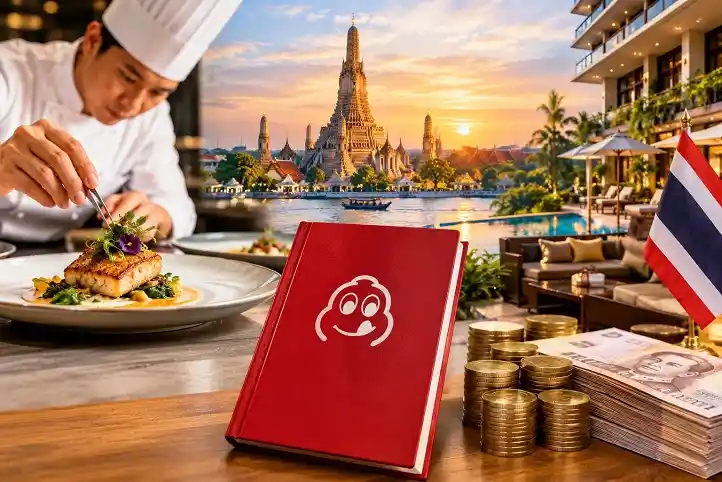
Image Credit: Thailand Hotel News
Official government records show that the Tourism Authority of Thailand (TAT) entered into a five-year arrangement for the MICHELIN Guide Thailand covering 2022 to 2026, with a budget of about 4.1 million U.S. dollars, or approximately 135.3 million baht. In the midway of the second paragraph, this Thailand Hotel News report examines the public funding, what the partnership actually pays for, and how it relates to the latest hotel and restaurant selections.
Two Five-Year Funding Arrangements
The current arrangement was not Thailand’s first financial commitment to Michelin. Thailand initially agreed to support the creation and expansion of the MICHELIN Guide Thailand in 2017, with the first five-year project also reported at around US$4.1 million.
In October 2021, the Cabinet approved another five-year commitment for the 2022-2026 period. Government information stated that TAT would pay approximately US$820,000 annually to Michelin Travel Partner France, the company responsible for producing the guide. The arrangement was intended to promote Thai gastronomy and tourism while expanding Michelin’s coverage beyond Bangkok.
When the two five-year commitments are viewed together, the commonly cited total is roughly US$8.2 million. Depending on the exchange rates and baht figures used at different stages of the contracts, reports can produce totals around 276 million baht or somewhat higher. The exact baht equivalent therefore depends on the exchange rate applied.
The 114 Properties Behind the Headline
The number 114 has an interesting connection to Michelin’s latest Thailand results. The 2026 selection includes 43 restaurants awarded Michelin Stars, while the hotel program recognizes 71 hotels with Michelin Keys. Together, those categories account for 114 properties.
The 43 starred restaurants consist of two Three-Michelin-Star establishments, eight Two-Star restaurants and 33 One-Star restaurants. Michelin also lists 137 Bib Gourmand establishments and 288 other Michelin Selected venues in the wider 2026 restaurant selection.
For hotels, Thailand’s 2026 MICHELIN Key selection contains six Three-Key hotels, 22 Two-Key hotels and 43 One-Key hotels, for a total of 71. The distinction is Michelin’s hotel equivalent of its restaurant recognition system and is based on inspectors evaluating hotel experiences.
What Does TAT Actually Pay for?
The Thai government-backed agreement supports Michelin’s production and promotion of the Thailand guide.
The 2022-2026 agreement also required Michelin to expand its surveying activity into additional Thai provinces, helping bring destinations outside Bangkok into the international culinary spotlight. Government documents describe the project as a tourism-promotion initiative intended to strengthen Thailand’s image as a food destination.
This distinction matters because Michelin maintains that its selections are made by its inspectors rather than being directly purchased by individual businesses. The existence of government funding does not, by itself, establish that a particular restaurant or hotel received an award because of that funding.
A Tourism Investment with a Bigger Debate
Supporters of the arrangement view Michelin as an international marketing platform capable of encouraging food tourism, raising visibility for Thai cuisine and directing visitors toward destinations and businesses they might otherwise overlook. Reports have also cited economic benefits associated with Michelin-related tourism activity.
Critics, however, can reasonably question whether hundreds of millions of baht in public resources should be committed to an internationally known private publishing and hospitality brand, particularly when Thailand already possesses a globally recognized culinary culture. Furthermore, it only benefits a group of select hotels and restaurants that have already been getting other awards and recognition without additional budgets or fees.
The debate is therefore larger than the Michelin stars themselves. It concerns how governments measure the return on tourism marketing, whether public funding should support internationally branded guides, and whether the resulting economic benefits can be demonstrated clearly enough to justify the expenditure.
While certain Thai government and TAT officials spew unverified figures about the benefits of investments with Michelin, none of these figures can be really audited nor validated and many seem exaggerated.
Thailand’s Michelin Era Continues
Whatever view taxpayers take of the spending, Michelin has become a significant part of Thailand’s modern tourism landscape. The 2026 results show a dining sector with 468 recognized venues and a hotel program covering 71 Michelin Key properties, illustrating how substantially the guide has expanded since its arrival in Thailand.
However the question lies as to whether modern day travelers and patrons really care about Michelin Stars or Keys and are they still relevant in today’s travel hotel and fine dining industry.
The key issue going forward is transparency. Publicly funded tourism partnerships are easier to evaluate when governments clearly disclose the contracts, annual payments, measurable visitor impacts and economic returns. For Thailand, the Michelin relationship has generated international attention, but the continuing question is whether that attention produces enough additional tourism and economic activity to warrant the public investment.
Thailand’s experience demonstrates how tourism authorities can use prestigious international brands to promote national hospitality and gastronomy, while also showing why taxpayers deserve clear information about costs and measurable results. As the current 2022-2026 agreement reaches its final year, future decisions on extending the partnership will likely depend not only on Michelin’s global reputation but also on evidence of the tourism value generated for Thailand.
Stay tune as this is part of a developing story as we have uncovered other juicy revelations.
References:
https://www.prd.go.th/th/content/category/detail/id/37/iid/46185
https://www.ryt9.com/s/iq03/2600685