

Key points
- A Buddhist monk has said he plans to take a discrimination complaint to Thailand’s National Human Rights Commission after allegedly being refused accommodation at a hotel near Chiang Mai International Airport, despite having already booked and paid for his room.
- A B2 hotel near Chiang Mai Airport has been named in an allegation involving the refusal of accommodation to a Buddhist monkImage Credit.
- In the middle of the dispute described in this Thailand Hotel News report, he said hotel staff informed him that monks were not permitted to stay at the property, even though his reservation had already been paid.
A Buddhist monk has said he plans to take a discrimination complaint to Thailand’s National Human Rights Commission after allegedly being refused accommodation at a hotel near Chiang Mai International Airport, despite having already booked and paid for his room. Phra Maha Naphant Santipatthato said the incident occurred after travel disruption left him needing somewhere to stay late at night.
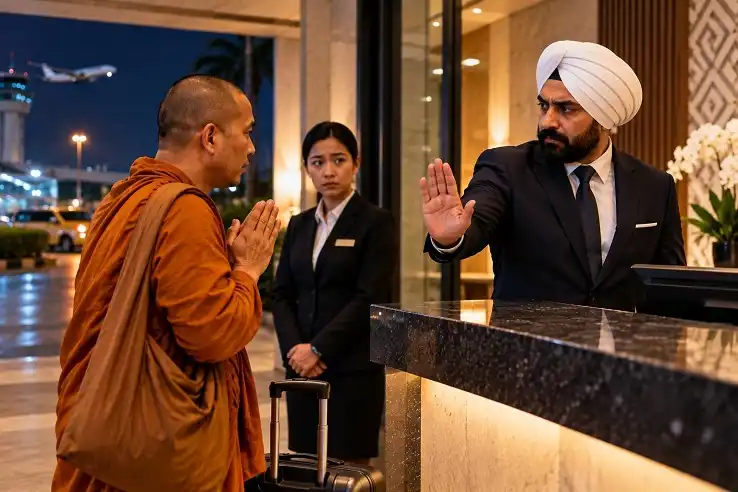
Image Credit: Thailand Hotel News (AI-Generated)
According to the monk’s account, his journey was disrupted after a thunderstorm in Bangkok contributed to delays that caused him to miss a 10:55 p.m. flight. With the hour approaching midnight and a nearby temple difficult to arrange at such short notice, he sought accommodation near Chiang Mai Airport. In the middle of the dispute described in this Thailand Hotel News report, he said hotel staff informed him that monks were not permitted to stay at the property, even though his reservation had already been paid.
Hotel Policy Challenged
Phra Maha Naphant said he questioned the restriction and asked staff to show him written documentation establishing such a hotel policy. According to his account, no document was produced. Staff subsequently contacted a manager, who allegedly confirmed that the monk could not check in.
The monk initially reported being told that the restriction existed because the hotel owner was a devout Muslim. He later updated his account, saying a manager had referred to the owner as Sikh. Phra Maha Naphant stressed that the owner’s actual faith was not the central issue and urged people not to direct anger toward any religion.
Instead, he argued that accommodation providers should not discriminate against guests because of religion or religious status. He also called on booking platforms to prevent discriminatory practices by properties using their services.
B2 Hotel Chain Named
The material supplied for this report identifies the establishment as part of the B2 Hotel network and specifically references B2 Airport Boutique & Budget Hotel near Chiang Mai Airport. Phra Maha Naphant reportedly updated his social media post to identify the B2 network as being involved. The hotel group is owned and managed by Sikhs from the Namdhari community (They typically wear white turbans)
The monk said hotel representatives told him that the restriction applied across the chain. That assertion remains an allegation attributed to his account of the conversation with hotel personnel.
Human Rights Complaint Planned
Phra Maha Naphant, who has publicly promoted human rights, respect for diversity and nonviolent approaches, said he would file a complaint with the National Human Rights Commission. He characterized the refusal as religious discrimination and said businesses providing public accommodation should respect fundamental rights regardless of the beliefs of their owners, managers or employees.
After the dispute, the monk eventually found alternative accommodation and thanked people who had expressed concern. He again urged the public not to blame any particular faith, saying the focus should remain on eliminating discrimination peacefully and ensuring that businesses respect people of different religious backgrounds.
The incident raises significant questions for Thailand’s hospitality industry about how internal property rules are formulated, communicated and applied when they affect guests because of religious status. It also highlights the importance of clear written policies, staff training and complaint procedures. Any subsequent response from B2 management or findings by the National Human Rights Commission will be important in establishing the facts surrounding the dispute and determining whether the alleged refusal breached applicable protections.
References:
https://www.facebook.com/groups/1582595316282265/posts/1773211300553998
https://www.dailynews.co.th/news/6222510
https://today.line.me/th/v3/article/wJve3xp
https://www.khaosod.co.th/special-stories/news_10413899