

Key points
- Almost 96% of hotels in Bangkok are not utilizing comprehensive clean-air strategies against both airborne pathogens and dangerous pollutants, raising questions about whether the hospitality industry has forgotten some of the most important lessons of the COVID-19 pandemic.
- 5 problems and the enormous disruption respiratory disease caused to tourism, clean indoor air has yet to become a widely visible priority across the capital’s hotel sector.
- Travelers may sleep for eight hours or longer in an enclosed space, making the quality of the air inside that room an important but frequently overlooked element of hospitality.
Almost 96% of hotels in Bangkok are not utilizing comprehensive clean-air strategies against both airborne pathogens and dangerous pollutants, raising questions about whether the hospitality industry has forgotten some of the most important lessons of the COVID-19 pandemic. Despite Bangkok’s recurring PM2.5 problems and the enormous disruption respiratory disease caused to tourism, clean indoor air has yet to become a widely visible priority across the capital’s hotel sector.
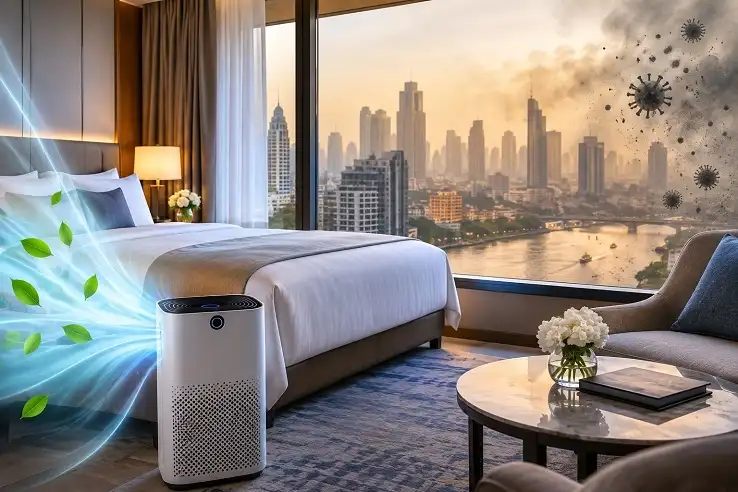
Image Credit: Thailand Hotel News
Bangkok has witnessed another wave of hotel development, including properties opening during 2025 and 2026, while established hotels have invested heavily in renovations, restaurants, wellness concepts, sustainability and sophisticated guest technology. Yet this Thailand Hotel News report finds that almost 96% of Bangkok hotels are still not utilizing or publicly demonstrating comprehensive clean-air strategies designed to tackle both pathogens and pollutants. Among the notable exceptions are Sindhorn Midtown Hotel Bangkok and Sukosol Hotels, which have taken steps toward addressing indoor-air quality rather than treating conventional air-conditioning as sufficient protection.
Sindhorn Midtown Makes Clean Air Visible
Sindhorn Midtown Hotel Bangkok stands out because it has made air purification a clearly identifiable component of the guest experience.
The hotel has equipped its guestrooms and serviced residences with air-purification technology. According to information contained in the source material, 393 guestrooms and serviced residences were equipped with Sharp Plasmacluster air purifiers incorporating HEPA filtration and ion technology.
This is significant because the strategy recognizes that hotel guests spend prolonged periods inside guestrooms. Travelers may sleep for eight hours or longer in an enclosed space, making the quality of the air inside that room an important but frequently overlooked element of hospitality.
The approach also provides protection extending beyond ordinary dust removal. HEPA filtration is designed to capture very small airborne particles, while dedicated purification technologies can supplement a building’s primary ventilation and air-conditioning systems.
Sukosol Hotels Also Recognizes the Problem
Sukosol Hotels is another important Bangkok hospitality name associated with measures to address air-quality concerns.
The source material points to hotel-industry practices including HVAC maintenance and the deployment of portable air purifiers as measures used in response to Bangkok’s pollution conditions. Such actions demonstrate that hotels can take practical steps to reduce guest exposure instead of regarding outside pollution as a problem beyond their control.
Sukosol’s inclusion is particularly relevant because clean-air strategies should not be confused with simply placing one machine inside a room. Effective indoor-air management involves the building itself: ventilation, air-conditioning, filtration, maintenance, pollutant control and operational procedures all influence what guests and employees ultimately breathe.
Sindhorn Midtown and Sukosol therefore provide useful examples of an issue that the broader Bangkok hotel industry needs to address much more systematically.
Air-Conditioning Is Not a Clean-Air Strategy
A hotel can have powerful air-conditioning and still have poor indoor-air quality.
Air-conditioning primarily controls temperature and, depending on the system, humidity. A comprehensive clean-air strategy goes considerably further by controlling pollution sources, managing ventilation, filtering recirculated air, removing fine particles, monitoring conditions and maintaining HVAC systems correctly.
For pathogen control, the objective also includes reducing concentrations of infectious respiratory aerosols.
Modern strategies can combine outdoor-air ventilation with high-efficiency filtration, portable HEPA purification and, where appropriate, ultraviolet germicidal technologies. Humidity management and continuous monitoring can provide additional layers of protection.
Carbon-dioxide monitoring is particularly useful as an indicator of ventilation conditions in occupied spaces. PM2.5 sensors can simultaneously tell hotel engineering teams whether fine-particle pollution is penetrating supposedly protected indoor environments.
Bangkok’s PM2.5 Makes Clean Air More Urgent
Bangkok’s recurring PM2.5 episodes make indoor-air protection especially relevant for the hotel industry.
Fine particles can enter hotels through doors, building leakage and ventilation systems. This means simply increasing outdoor ventilation during severe pollution can be counterproductive unless incoming air is adequately filtered.
Hotels consequently need strategies capable of responding to two very different threats. When outdoor pollution is severe, buildings need to prevent excessive particulate infiltration while maintaining suitable ventilation. When respiratory pathogens are circulating, operators need sufficient clean-air delivery to dilute and remove infectious aerosols generated indoors.
This is where properly engineered filtration becomes crucial. High-efficiency filtration can remove airborne particles from recirculated air, while portable HEPA units can increase the amount of clean air delivered to particular guestrooms, conference rooms or other enclosed spaces.
Pathogens Remain Part of the Equation
COVID-19 demonstrated that respiratory pathogens cannot be addressed solely through surface cleaning.
ASHRAE Standard 241, Control of Infectious Aerosols, reflects the increased engineering focus on reducing exposure to infectious aerosols inside buildings. One important concept is equivalent clean airflow, which recognizes that ventilation, filtration and air-cleaning technologies can work together to reduce airborne contaminants.
For hotels, this approach is highly relevant. A ballroom hosting hundreds of delegates has different requirements from an individual guestroom. Restaurants, elevators, fitness centers, spas, staff areas and meeting rooms also experience different occupancy patterns and ventilation demands.
A comprehensive hotel strategy should therefore assess individual spaces instead of assuming one building-wide air-conditioning setting solves every problem.
Have New Hotels Forgotten the Pandemic?
Perhaps the biggest question concerns Bangkok hotels opened in 2025 and 2026.
These properties were conceived or completed with the COVID-19 experience still fresh in institutional memory. Unlike much older hotels, new developments had an opportunity to consider advanced filtration, sensors, airflow management and enhanced ventilation during design and construction.
Yet clean-air performance remains conspicuously absent from the marketing and publicly available operating information of most properties.
Hotels routinely advertise sustainability credentials, water-saving measures, plastic reduction, energy efficiency, organic amenities and wellness programs. Detailed information explaining how indoor air is monitored and cleaned remains far more difficult to find.
That disparity is striking because guests continuously consume one hotel resource without ordering it, purchasing it or even consciously thinking about it: air.
Clean Air Could Become Bangkok’s Next Hotel Standard
The almost 97% figure should encourage Bangkok’s hotel industry to examine whether indoor-air protection deserves the same attention now given to sustainability, hygiene and wellness. Sindhorn Midtown Hotel Bangkok and Sukosol Hotels demonstrate that operators can take practical action, but clean-air protection needs to become considerably more widespread, transparent and measurable.
Bangkok hotels have an opportunity to publish filtration specifications, monitor CO2 and PM2.5, establish enhanced operating procedures during pollution and respiratory-disease periods, and introduce clean-air guestrooms where appropriate. After COVID-19 and amid continuing PM2.5 concerns, treating indoor air as an invisible background utility is increasingly difficult to justify. The technology exists, the risks are understood, and guests may eventually begin demanding evidence that the air inside their hotel is genuinely cleaner than the air outside.
References on Clean Air Strategies:
https://www.cdc.gov/respiratory-viruses/prevention/air-quality.html
https://pmc.ncbi.nlm.nih.gov/articles/PMC7116925
https://www.burnet.edu.au/our-work/health-themes/clean-indoor-air
https://uvmedico.com/news/cleanroom-compliance-with-uvc-light