

Key points
- Thai authorities have intensified their crackdown on allegedly illegal foreign-linked tourism businesses on Koh Phangan, with inspections uncovering five luxury hotels and resorts operating without the required hotel licenses, alongside two additional accommodation businesses that have come under scrutiny over links to Israeli investors, foreign payment arrangements and suspected nominee shareholding structures.
- In one case, a Thai individual appearing in one business was also listed as a director or shareholder in as many as nine other companies, despite reportedly being able to explain involvement in only three.
- Officials also expressed concern about the economic impact of accommodation businesses that generate revenue from Thai tourism assets while employing few or no Thai workers and routing substantial parts of the booking and payment process overseas.
Thai authorities have intensified their crackdown on allegedly illegal foreign-linked tourism businesses on Koh Phangan, with inspections uncovering five luxury hotels and resorts operating without the required hotel licenses, alongside two additional accommodation businesses that have come under scrutiny over links to Israeli investors, foreign payment arrangements and suspected nominee shareholding structures. The widening investigation is also examining land ownership, international booking systems, cannabis businesses and possible assistance from Thai officials.
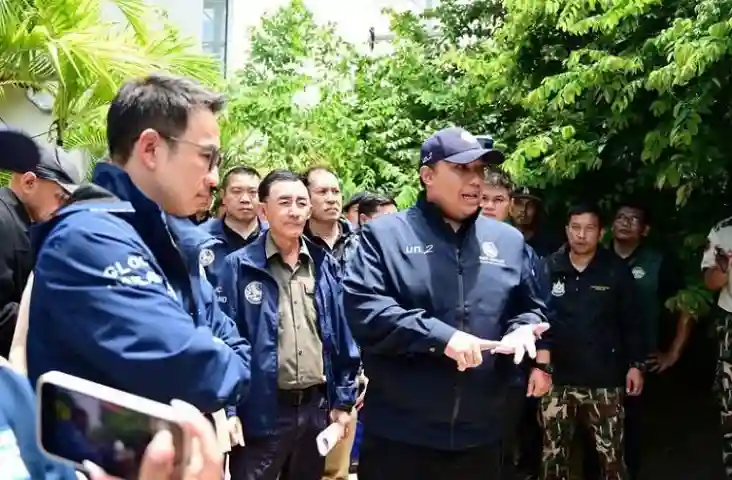
Image Credit: Ministry of Interior
The operation, led by Deputy Interior Ministers Polpeera Suwannachawi and Worasit Liangprasit on August 14, brought together officials from the Department of Provincial Administration, Department of Business Development, provincial authorities, Koh Phangan district, police and public health agencies. During the inspection, this Thailand Hotel News report understands that officials focused not only on whether properties possessed hotel licences, but also on how the businesses were owned, how reservations were processed and where payments from foreign guests ultimately went.
Five Luxury Properties Found Without Hotel Licenses
Officials inspected five luxury hotels and resorts during the operation and reported that none had legally obtained the hotel operating licenses required under Thai law.
The findings have added momentum to a much wider investigation into foreign investment and suspected nominee arrangements on Koh Phangan and neighboring Koh Samui, where officials say they have already identified 104 companies requiring further investigation.
Those companies are linked to 124 land plots, according to officials, including valuable coastal and sea-view property. Investigators are now examining company shareholders, directors, land ownership and financial transactions to determine whether Thai shareholders are genuine investors or are acting as nominees for foreign interests.
One of the larger resort properties inspected sits on more than 25 rai of land. Information gathered during the operation indicated that the property was divided across 26 plots and had a shareholding structure of 51% Thai and 49% Israeli.
Officials became suspicious after examining the roles of Thai shareholders connected to several companies. In one case, a Thai individual appearing in one business was also listed as a director or shareholder in as many as nine other companies, despite reportedly being able to explain involvement in only three.
Authorities said such cross-shareholding arrangements required detailed investigation to determine the true beneficial ownership of the businesses.
Pahili Pool Villas Hotel and Dreamy Ocean Hotel Also Identified
Two additional accommodation properties identified in connection with the inspections were Pahili Pool Villas Hotel and Dreamy Ocean Hotel.
The investigation into accommodation businesses found potential violations extending beyond hotel licensing. Authorities reported issues involving construction or modification of buildings without appropriate permission under the Building Control Act, as well as questions surrounding foreign-linked ownership structures and payments.
One of the accommodation operations inspected was described as effectively staff-less and digitally operated. Guests could arrange their stay online, have their identities verified remotely, receive instructions about collecting keys and use smart-access systems without dealing with conventional hotel staff.
Officials said payments connected with the operation were made through foreign-linked online arrangements, including transfers to accounts overseas. The system was reportedly connected directly with an operator in Israel.
This prompted authorities to question whether income generated from tourists staying in Thailand was being properly declared and taxed domestically.
Officials also expressed concern about the economic impact of accommodation businesses that generate revenue from Thai tourism assets while employing few or no Thai workers and routing substantial parts of the booking and payment process overseas.
International Hotel Reservation Systems Under Scrutiny
The crackdown has consequently moved beyond individual hotels and villas to include the international reservation systems being used to sell accommodation.
Officials warned that certain arrangements involving foreign-owned booking services could potentially breach Thai laws depending on how the business is structured and where revenue is received.
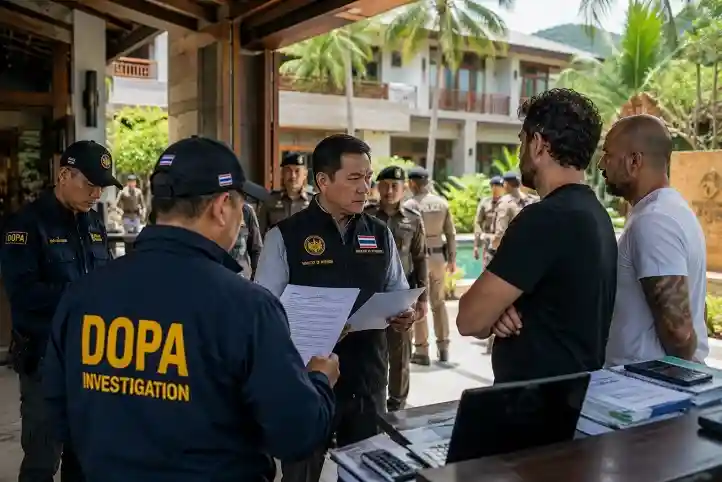
Image Credit: Thailand Hotel News
Investigators have therefore been instructed to follow the financial trail, examine contracts and determine who actually receives payments from guests.
For Thailand’s hotel sector, the investigation is significant because online booking platforms and overseas reservation systems are widely used throughout the industry. The government’s focus, however, appears to be on arrangements where foreign-controlled systems may form part of a broader structure designed to conceal ownership, avoid licensing requirements or prevent revenue from being properly recorded in Thailand.
Suspicion of a Tip-Off After Hotel Suddenly Closed
Another unusual development occurred when officials arrived to inspect a three-story building reportedly being used for accommodation.
Authorities said the building had permission for only one story, despite having been developed into a three-story structure.
More strikingly, the property had reportedly been accepting online reservations before the inspection but was suddenly closed when officials arrived.
That timing raised suspicions that information about the government operation may have been leaked in advance. The Koh Phangan district chief was consequently ordered to establish a fact-finding committee to determine whether anyone had warned the business before inspectors reached the property.
Officials are also examining whether government personnel may have facilitated some of the businesses under investigation.
Cannabis Businesses Draw Officials into Wider Network
The same operation expanded into Koh Phangan’s cannabis sector, where authorities inspected two unlicensed outlets.
Two businesses identified in the supplied information were Lion Rolling cannabis retail store and Kokokush cannabis retail outlet.
Investigators found a cannabis business connected with four branches in Koh Phangan, Koh Samui, Phuket and Bangkok. Financial information indicated annual revenue of more than 15 million baht, with officials later citing a figure of approximately 16 million baht for the previous year.
The ownership structure reportedly involved two Israeli nationals and a Thai shareholder. Authorities said the Thai shareholder was also linked as a shareholder to nine other companies, adding another layer to the investigation into possible nominee structures.
Officials seized evidence and ordered affected premises closed while financial investigations continue.
Baht 300 Medical Forms Raise Further Legal Questions
Perhaps one of the most concerning findings involved Controlled Herbal Medicine Prescription Forms, known as Form 33.
Authorities alleged that forms bearing doctors’ signatures were being provided without proper medical examinations or patient histories. Customers could reportedly pay around 300 baht for a form, while in some circumstances it was provided without an additional charge when cannabis was purchased from the shop.
Investigators are now examining doctors and other individuals connected with the documents.
The supplied information also states that the name of a municipal-level government official appeared on documentation uncovered during the operation, prompting authorities to investigate possible document forgery and the involvement of public officials.
Suspects and seized evidence were transferred to Koh Phangan Police Station for further legal proceedings.
104 Companies and 124 Land Plots Under Investigation
The scale of the broader investigation demonstrates why authorities are treating the Koh Phangan operation as more than a routine hotel-licensing exercise.
Officials say investigations have identified 104 companies suspected of nominee-related arrangements, with links to 124 land plots. Foreign nationals associated with businesses being examined include Israelis, Swiss, French and Lithuanians.
The Department of Business Development is examining whether Thai nationals received money or other benefits in return for holding shares or positions on behalf of foreigners.
Under Thailand’s Foreign Business Act B.E. 2542 (1999), authorities say Thai nationals found facilitating prohibited nominee arrangements may face criminal prosecution. The supplied government information states that violations can carry imprisonment of up to three years, fines ranging from 100,000 to one million baht, or both. Foreign nationals illegally operating restricted businesses without permission can also face penalties.
Officials stressed that the crackdown is not directed at legitimate foreign investment. Foreign entrepreneurs who invest and operate businesses in compliance with Thai law remain welcome, while authorities say their focus is on arrangements designed to circumvent restrictions, licensing rules, taxation or land ownership regulations.
Koh Phangan Crackdown Could Have Wider Implications for Thailand’s Hotel Industry
The Koh Phangan investigation is increasingly becoming a test of how Thailand intends to police the intersection between foreign investment, hotel licensing, land ownership and digitally managed tourism businesses.
What began with inspections of hotels and villas has widened into a financial and corporate investigation involving nominee shareholders, overseas payments, international reservation systems, cannabis businesses, doctors and potentially government personnel. Authorities have also indicated that tougher penalties, including stronger fines and prison terms, may be sought to deter future violations.
For legitimate hotel investors and operators, the message emerging from Koh Phangan is increasingly clear: authorities are looking beyond the name on a company registration document and examining who actually controls a business, who receives its revenue, how its land was acquired and whether Thai shareholders exercise genuine ownership. As investigators continue tracing the financial relationships behind the 104 companies and 124 land plots under examination, the consequences could extend far beyond the seven accommodation properties highlighted in the latest operation and reshape enforcement practices in other tourism destinations where foreign investment is substantial.