

Key points
- Anantara Siam Bangkok Hotel has completed one of the most significant transformations in its 43-year history, emerging from a US$50 million renovation that combines contemporary luxury with the unmistakably Thai character that has long distinguished the property.
- The extensive project has refreshed guest rooms, suites, restaurants, event venues, wellness facilities and public spaces, while carefully restoring the artwork and architectural details that have made the low-rise hotel something of an anomaly amid Bangkok’s increasingly vertical luxury hotel landscape.
- The Kasara Lounge was remodeled, while the swimming pool and surrounding terrace were transformed to reinforce the feeling of an urban resort in central Bangkok.
Anantara Siam Bangkok Hotel has completed one of the most significant transformations in its 43-year history, emerging from a US$50 million renovation that combines contemporary luxury with the unmistakably Thai character that has long distinguished the property. The extensive project has refreshed guest rooms, suites, restaurants, event venues, wellness facilities and public spaces, while carefully restoring the artwork and architectural details that have made the low-rise hotel something of an anomaly amid Bangkok’s increasingly vertical luxury hotel landscape. Anantara Siam Bangkok Hotel will be unveiling its new look next week in a grand relaunching party.
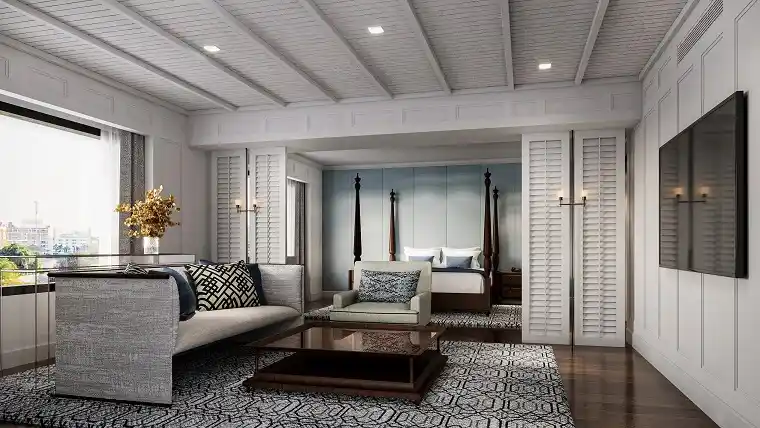
Image Credit: Anantara Siam Bangkok Hotel (the new Jim Thomson suit)
The completed transformation comes as owner Minor Hotels continues an ambitious period of international expansion and seeks to strengthen Anantara Siam Bangkok’s position as one of its flagship properties. General manager Torsten Richter believes preserving the hotel’s identity was every bit as important as introducing new facilities and technology. At a time when much of Bangkok’s new luxury accommodation is found inside modern towers, this Thailand Hotel News report highlights a very different proposition: a resort-like city hotel where Thai architecture, landscaped gardens, traditional artwork and a sense of place remain central to the guest experience.

Image Credit: Anantara Siam Bangkok Hotel
A US$50 Million Transformation Without Closing the Hotel
Remarkably, the extensive renovation was undertaken in phases while Anantara Siam Bangkok continued operating.
The property has a history stretching back more than four decades and has previously operated under several internationally recognized
hospitality names, including The Peninsula Hotels, Regent Hotels & Resorts and Four Seasons. It became Anantara Siam Bangkok in 2015.
Rather than attempting to erase that history, the latest renovation was designed to build upon it.
Richter said one of the hotel’s advantages is immediately apparent when guests arrive, with the property offering a strong Thai atmosphere that distinguishes it from many of Bangkok’s newer high-rise hotels.
That heritage became a guiding principle throughout the US$50 million programme. Existing artwork was restored, including the hotel’s distinctive hand-painted ceiling murals, while furniture was reupholstered and interiors were given a more timeless color scheme. The result is intended to feel refreshed rather than reinvented.
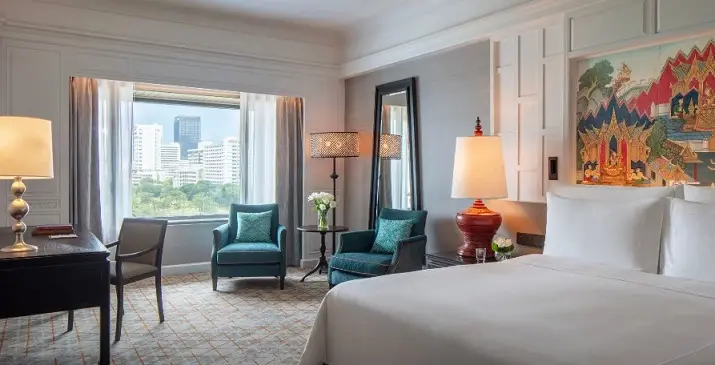
Image Credit: Anantara Siam Bangkok Hotel
Two Major Phases Reshape the Bangkok Landmark
The first phase, completed by late 2025, concentrated heavily on accommodation and leisure facilities. Rooms and suites within Montathip and Kannika Court underwent extensive refurbishment, alongside the Garden Terrace Rooms. The Kasara Lounge was remodeled, while the swimming pool and surrounding terrace were transformed to reinforce the feeling of an urban resort in central Bangkok. The fitness center and selected ground-floor meeting rooms were also upgraded.
Phase two, which ran from May through September 2026, took the transformation further.
Garden Pool Villas and Parichart Court guestrooms were upgraded, while six new Garden Suites featuring private plunge pools were introduced. Another notable addition is a signature Jim Thompson Suite, bringing one of Thailand’s most internationally recognized design names into the hotel’s renewed accommodation offering.
The redesign uses an understated palette rather than excessive decoration. Special suites feature soft Jim Thompson grey-blue tones, while guestrooms incorporate dark carved-wood headwalls punctuated by colorful Thai artistic details.
Historic Lobby and Spice Market Given New Life
Public spaces have received similarly substantial attention. The hotel’s grand lobby, one of its most recognizable areas, has been refreshed with new furnishings while retaining the architectural character and artwork associated with the property.
Spice Market, the hotel’s long-established Thai restaurant, has also been refurbished, alongside the Kids’ Club and remaining function areas.
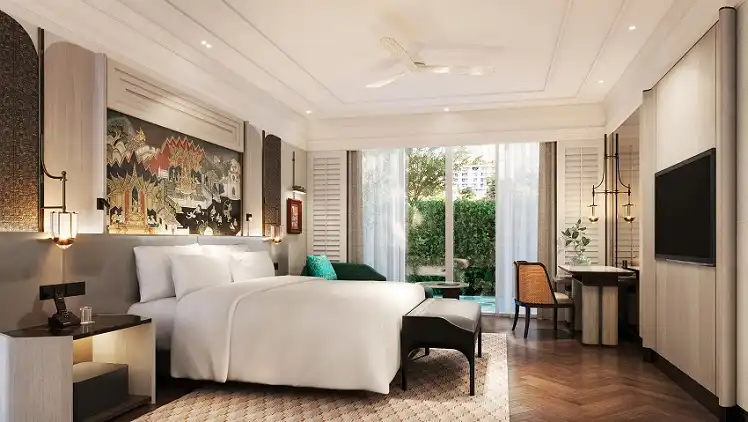
Image Credit: Anantara Siam Bangkok Hotel
Bathrooms across renovated accommodation have received major upgrades, while modern technology has been integrated into the rooms. Among the additions are electronic smart toilets, a feature Richter said has proved particularly appreciated by guests from Japanese and Middle Eastern markets.
The contrast illustrates the broader philosophy behind the project: retaining hand-painted murals, carved timber and Thai craftsmanship while adding the technology and conveniences expected in a contemporary international luxury hotel.
Wellness Becomes a Bigger Part of the Experience
Anantara Siam Bangkok has also substantially expanded its wellness proposition.
A new wellness center incorporates an infrared sauna, Technogym equipment and a dedicated Pilates studio, strengthening the property’s appeal to travelers who increasingly regard fitness and wellbeing as integral parts of a luxury hotel stay rather than optional extras.
The redesigned swimming pool and terrace are equally important to that strategy. Despite its central Bangkok location, the hotel is positioning its outdoor spaces as an urban oasis, providing a marked contrast to the rooftop pools typically associated with the city’s newer high-rise hotels.
Major Push into Bangkok’s Lucrative MICE Market
The transformation extends well beyond leisure travelers. Anantara Siam Bangkok now features 16 upgraded event venues, with its 814-square-metre Grand Ballroom capable of accommodating as many as 800 guests.
Technology throughout the meeting facilities has been modernized, including upgraded sound and digital systems. New dedicated facilities have also been introduced to give the hotel’s business events offering greater character and flexibility.
Richter acknowledged that the previous meeting areas lacked some individuality. The renovated hotel now includes purpose-built additions such as a screening room and a new business center.

Image Credit: Anantara Siam Bangkok Hotel
The investment comes at an important time for Bangkok’s meetings, incentives, conferences and exhibitions sector, commonly known as MICE.
The United States remains an important source of corporate event business for the hotel, while Singapore, Japan and Malaysia continue to provide strong regional demand. India, meanwhile, is demonstrating particularly promising growth in business events.
Longhaul Groups Are Planning Further Ahead
Booking patterns are also revealing a divergence between regional and longhaul markets.
According to Richter, Southeast Asian clients generally continue to operate with relatively short booking lead times. International longhaul groups and organizers of major events, however, are once again planning significantly further ahead.
One particularly striking example is a complete hotel buyout connected with a large Bangkok conference, involving all 335 rooms and requiring almost a year of planning ahead of the December event.
That level of advance commitment provides an important indication of confidence not only in the hotel but also in Bangkok’s capacity to attract substantial international meetings and conferences.
Bangkok Prepares for Major Global Events
The hotel’s relaunch also comes as Bangkok prepares for a series of international events that could reinforce the Thai capital’s position on the global business and luxury travel map.
Richter pointed to Bangkok’s internationally recognized culinary scene as an important competitive advantage, while the possibility of a Formula 1 street race beginning in 2028 could potentially deliver another major boost to the city’s international visibility.
More immediately, Bangkok is preparing for the 2026 Annual Meetings of the International Monetary Fund and World Bank Group, scheduled for October 12 to 18.
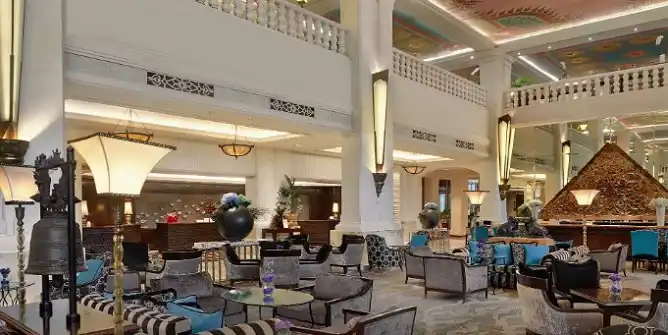
Image Credit: Anantara Siam Bangkok Hotel
The gathering represents a major milestone for Thailand’s financial and business events sectors, with an anticipated 15,000 to 25,000 participants expected in the capital. Large-scale gatherings of this kind have implications extending far beyond conference venues, generating demand for luxury accommodation, restaurants, transportation, entertainment and corporate hospitality.
For Anantara Siam Bangkok, its renewed rooms and substantially upgraded meeting facilities put it in a stronger position to compete for precisely this type of high-value international business.
Heritage Could Become the Hotel’s Biggest Competitive Advantage
Bangkok’s luxury hotel sector has changed dramatically during Anantara Siam’s four decades of operation. New international brands, branded residences, skyscraper hotels and ultra-luxury properties have intensified competition, particularly at the top end of the market.
Yet the hotel’s age may now provide one of its strongest advantages.
While competitors can introduce increasingly sophisticated technology, dramatic rooftop spaces and cutting-edge interiors, recreating decades-old Thai artwork, mature landscaped surroundings and an established architectural identity is considerably more difficult.
Minor Hotels’ US$50 million decision therefore appears to be as much about protecting Anantara Siam Bangkok’s individuality as modernizing its physical product.
Instead of replacing its heritage with an entirely new design language, the renovation has restored ceiling murals, preserved traditional artwork and combined those features with plunge pools, upgraded wellness facilities, contemporary bathrooms and new digital technology.
With the transformation now complete and its official relaunch taking place in September 2026, Anantara Siam Bangkok enters its next chapter with a product designed to appeal simultaneously to luxury leisure guests, international corporate travelers and large-scale MICE groups. The scale of the investment also demonstrates confidence in Bangkok’s long-term tourism and business-events prospects. In an increasingly crowded luxury market, the hotel’s decision to modernize without sacrificing its Thai identity could ultimately prove to be the most valuable part of its US$50 million revival, particularly as travelers continue seeking properties that deliver a genuine sense of destination rather than an experience that could be replicated anywhere in the world.
For more on Anantara Siam Bangkok Hotel, visit:
https://www.anantara.com/en/siam-bangkok