

Key points
- 7 billion baht, potentially giving investors an opportunity to acquire one of the Vietnamese capital’s most recognizable hospitality properties at a price well below some earlier valuations.
- According to Bong Sen Corporation’s financial disclosures for the first half of 2026, the company recorded a net loss equivalent to roughly 400 million baht, pushing accumulated losses to around 4.
- While there is no indication at this stage that any of the interested parties has reached a definitive agreement to acquire the Hanoi Daewoo Hotel, the level of reported interest highlights the strategic appeal of securing a landmark hospitality asset in Hanoi and the growing appetite among Thai groups for hotel and real estate investments beyond the domestic market.
One of Hanoi’s best-known five-star hotels has been placed on the market as financial pressure intensifies around its corporate owner. The Hanoi Daewoo Hotel, together with the adjoining Daeha Office Building, is being offered for approximately 7.4 billion to 7.7 billion baht, potentially giving investors an opportunity to acquire one of the Vietnamese capital’s most recognizable hospitality properties at a price well below some earlier valuations.
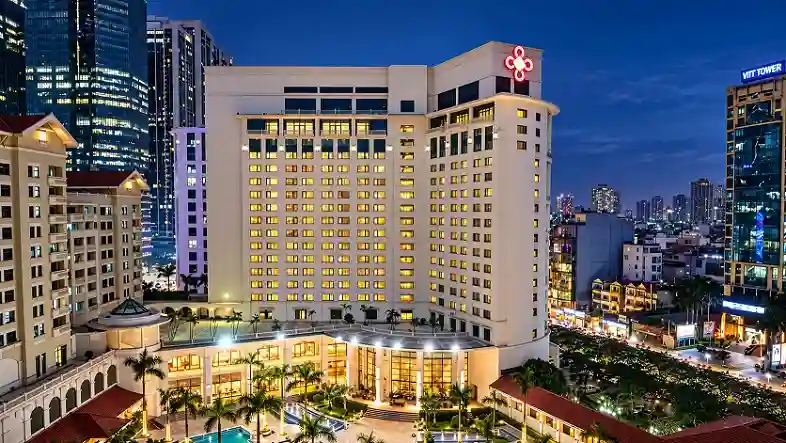
Image Credit: Thailand Hotel News
The proposed sale comes as Bong Sen Corporation faces mounting financial difficulties, including heavy accumulated losses and substantial bond obligations. The company reported another loss during the first six months of 2026, and this Hotel News report finds that its accumulated losses have now reached approximately 4.8 billion baht. More critically, bonds with outstanding principal equivalent to approximately 6.1 billion baht are due to mature on October 15, 2026, putting considerable pressure on the company to generate liquidity.
Financial Pressure Mounts at Bong Sen
According to Bong Sen Corporation’s financial disclosures for the first half of 2026, the company recorded a net loss equivalent to roughly 400 million baht, pushing accumulated losses to around 4.8 billion baht.
Its financial position is further complicated by substantial liabilities. As of the end of June, total liabilities were equivalent to approximately 12.5 billion baht, compared with shareholders’ equity of about 4.9 billion baht. That left the company with a debt-to-equity ratio of approximately 2.56 times.
Of particular concern is the BSECH2126003 bond issue. Launched in October 2021 with a five-year term, the bonds carry an annual interest rate of 15.75%. Outstanding principal is approximately 6.1 billion baht, while reported short-term debt was equivalent to another 3.9 billion baht.
The company has said frozen bank accounts prevented it from meeting some short-term payment obligations. At a 15.75% annual interest rate, the outstanding bond principal alone implies annual interest costs approaching 970 million baht, adding further urgency to efforts to monetize major assets.
There is also uncertainty surrounding the financial statements themselves. A&C Auditing and Consulting said it was unable to obtain sufficient appropriate audit evidence and therefore declined to express an opinion on Bong Sen Corporation’s interim consolidated financial statements.
A Landmark Hanoi Hotel Hits the Market
The Hanoi Daewoo Hotel and Daeha Office Building occupy a prominent site on Kim Ma Street. Developed during the 1990s, the complex covers nearly three hectares and has long been associated with Hanoi’s emergence as an international business and diplomatic destination.
The Daewoo Hotel became one of the Vietnamese capital’s landmark luxury hotels, hosting international political leaders, business delegations and other high-profile visitors over the years.
Its prestige, however, does not eliminate the financial realities associated with an approximately 30-year-old luxury property. Maintaining five-star standards can require extensive spending on guestrooms, public areas, building systems, restaurants, technology and other facilities, particularly when competing against newer luxury hotels entering Hanoi.
The complex was reportedly marketed in July 2026 for around 7.7 billion baht before subsequently being offered at closer to 7.4 billion baht.
Thai Hotel and Investment Groups Express Interest
The proposed sale is also attracting attention from Thailand, with confidential industry sources indicating that at least four Thai groups have expressed interest in the property. Those understood to be examining the opportunity include one major Thai hotel brand, two Thai investment groups and another major group that has already been aggressively expanding its hotel portfolio across Thailand.
While there is no indication at this stage that any of the interested parties has reached a definitive agreement to acquire the Hanoi Daewoo Hotel, the level of reported interest highlights the strategic appeal of securing a landmark hospitality asset in Hanoi and the growing appetite among Thai groups for hotel and real estate investments beyond the domestic market.
Asking Price Highlights Dramatic Valuation Shift
The current asking price is particularly notable when compared with historical estimates. The broader Daewoo-related property interests were reportedly valued at more than 13.7 billion baht in 2012.
Historical transactions involving Daeha Corporation also suggested considerably higher valuations, although those figures cannot be directly compared with today’s proposed sale because ownership structures, asset composition, market conditions and valuation methodologies have changed.
A lower asking price does not necessarily mean the hotel itself has suffered an equivalent collapse in underlying commercial value. The age of the complex, potential refurbishment requirements, financing conditions and legal complications surrounding associated assets could all affect what investors are prepared to pay.
Legal issues connected with the wider Van Thinh Phat case may represent another complication for prospective buyers. During court proceedings in March 2024, Truong My Lan said her family held a majority interest in Bong Sen and referred to interests connected with the Hanoi Daewoo Hotel. She also requested that the hotel and other assets be sold to help address financial consequences arising from the case.
Sale Could Attract Opportunistic Hotel Investors
For hotel investors, the offering presents an unusual combination: a landmark five-star property in one of Southeast Asia’s important capital cities, but one surrounded by financial and legal complexity.
A buyer with sufficient capital could potentially reposition or extensively renovate the hotel, particularly as Hanoi continues developing its international tourism, corporate travel and meetings markets. However, any transaction would likely require intensive due diligence covering ownership, collateral arrangements, land rights, legal restrictions, renovation requirements and existing financial obligations.
The approaching October bond maturity makes timing especially important. Even a successful disposal of the Daewoo-related assets may not automatically resolve all of Bong Sen Corporation’s financial problems, given the scale of its liabilities, accumulated losses and other obligations.
A High-Stakes Sale with Wider Implications
The proposed sale is therefore about considerably more than one famous hotel changing hands. It illustrates how valuable hospitality real estate can become central to corporate debt restructuring when liquidity disappears and major obligations approach maturity. For Hanoi, a new owner could eventually bring substantial investment and a fresh direction to an aging but historically significant luxury property. For Bong Sen Corporation, however, securing a buyer at an acceptable price could be crucial as billions of baht in financial obligations continue to weigh on its balance sheet. The coming weeks could determine whether the Hanoi Daewoo Hotel becomes the centerpiece of a successful asset sale or remains caught in a much larger financial restructuring story.
For more on the Daewoo Hotel, visit: