

Key points
- For readers following the sector through Thailand Hotel News, this evolution is particularly relevant in Thailand and the wider Asia-Pacific region, where international hotel groups continue competing aggressively for guests, owners and development opportunities.
- A company might operate an economy brand, a midscale brand, an upscale business hotel and a luxury flag.
- A traveler might choose an inexpensive hotel for one journey, an extended-stay property during a work assignment, a lifestyle hotel for a weekend and a luxury resort for a holiday.
The global hotel industry already has hundreds of recognizable brands covering almost every combination of price, service level, design style and traveler type. Yet in 2026, the world’s biggest hotel groups are still creating new brands, acquiring others and assembling ever-larger collections of independent hotels. If anything, brand proliferation has accelerated since 2019.
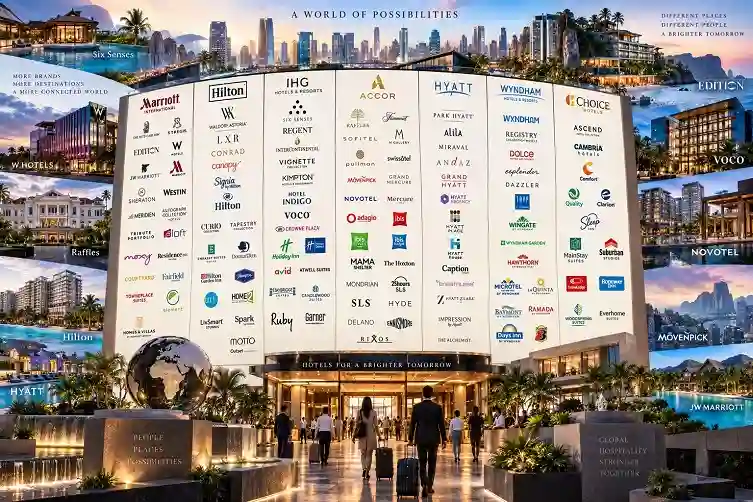
Image Credit: Thailand Hotel News
Marriott International, Hilton, IHG Hotels & Resorts, Accor, Hyatt, Wyndham Hotels & Resorts and Choice Hotels continue to widen their portfolios, increasingly through acquisitions, conversion-friendly collections, extended-stay concepts and partnerships that can rapidly bring existing properties into their reservation and loyalty systems.
The scale is remarkable.
Marriott ended 2025 with more than 9,800 properties and nearly 1.78 million rooms, while its development pipeline approached 610,000 rooms. By the end of the second quarter of 2026, its pipeline had increased to approximately 629,000 rooms.
Hilton had grown to more than 9,400 properties and nearly 1.4 million rooms by early 2026. Its development pipeline reached 520,500 rooms at the end of 2025 and expanded to 541,300 rooms by June 2026.
IHG reached 7,109 hotels and almost 1.05 million rooms by June 2026, with another 347,691 rooms in development. Accor, meanwhile, operates more than 5,800 hotels and over 45 hotel brands across more than 110 countries.
So, why does the industry still need more brands?
The answer is no longer simply about creating a different hotel for every price point. Increasingly, hotel brands are gateways into much larger loyalty, distribution and technology ecosystems.
For readers following the sector through Thailand Hotel News, this evolution is particularly relevant in Thailand and the wider Asia-Pacific region, where international hotel groups continue competing aggressively for guests, owners and development opportunities.
From Hotel Companies to Hospitality Platforms
Twenty years ago, hotel segmentation was relatively straightforward. A company might operate an economy brand, a midscale brand, an upscale business hotel and a luxury flag.
Today, the gaps between those categories have been filled with lifestyle hotels, soft brands, extended-stay concepts, collections, select-service properties, serviced apartments, all-inclusive resorts and conversion brands.
The objective is to offer something for almost every travel occasion.
A traveler might choose an inexpensive hotel for one journey, an extended-stay property during a work assignment, a lifestyle hotel for a weekend and a luxury resort for a holiday. The major groups increasingly want all those bookings to remain within the same corporate ecosystem.
That is where loyalty becomes crucial.
Loyalty Is Becoming the Real Mega-Brand
The scale of today’s hotel loyalty programs helps explain why companies can support so many individual brands.
Marriott Bonvoy finished 2025 with nearly 271 million members, having added approximately 43 million during the year. By the end of the first quarter of 2026, membership had already climbed to nearly 283 million.

Hilton Honors had more than 260 million members by early 2026. IHG One Rewards has surpassed 160 million, Wyndham Rewards had more than 122 million enrolled members at the end of 2025, and ALL Accor has passed 120 million members.
Those numbers fundamentally change the purpose of a hotel brand.
The individual flag still matters, particularly in luxury. Names such as St. Regis, Waldorf Astoria, Raffles and Six Senses have powerful identities of their own.
But for many frequent travelers, the parent loyalty ecosystem can be equally important.
Guests do not necessarily need to remember every Marriott or Hilton brand. They need to know that they can earn points, redeem rewards, receive status benefits and manage their reservation through a familiar platform.
The individual hotel provides the experience; increasingly, the loyalty program owns the broader customer relationship.
Owners Are Driving New Brands Too
Travelers are only half the story. Hotel companies also need brands that owners and developers want.
The world’s biggest groups increasingly operate asset-light business models. Rather than owning most of their hotels, they generate revenue through franchise, management, reservation and other fees.
That makes hotel owners customers of the brand companies too.
A developer may have a building that does not meet the physical requirements of an established brand. An independent hotel may want global distribution without surrendering its identity. Another owner may need a conversion that costs considerably less than rebuilding a property to rigid brand specifications.
This has helped fuel the extraordinary rise of soft brands and collections.
These collections allow independently styled hotels to access major reservation systems, loyalty programs, corporate accounts and revenue-management technology while maintaining more individuality than a conventional standardized chain hotel.
Conversions Have Become a Major Growth Engine
Conversions are now among the industry’s most important development strategies.
High construction and financing costs have made converting existing hotels increasingly attractive. Instead of waiting years for a new hotel to be constructed, a company can bring an existing property into its network much faster.
Marriott said conversions represented roughly one-third of its organic room signings and gross room additions in 2025. In the first quarter of 2026, conversions represented more than 35 percent of signings and more than 40 percent of openings.
Hilton launched Outset Collection by Hilton in 2025 as an upscale conversion brand for independent hotels. More than 60 hotels were already in development at launch, while Hilton sees potential for more than 500 properties in the United States and Canada over time.
IHG followed in February 2026 with Noted Collection, targeting upscale and upper-upscale conversions. IHG believes the brand could exceed 150 hotels during the next decade.
Collections are, therefore, more than a branding trend. They are a way for major hotel companies to recruit thousands of independent properties that might otherwise remain outside their systems.

Hotel Brands Are Becoming More Specialized
The traditional economy-to-luxury ladder has also splintered into specific travel occasions.
Hotel companies increasingly ask whether guests are staying for several weeks, working remotely, attending conventions, traveling with families, seeking nightlife, prioritizing wellness or wanting apartment-style accommodation.
Each need can potentially support another brand.
Hilton provides a striking example. Its portfolio has expanded to 28 brands. Newer concepts include Spark by Hilton in premium economy, LivSmart Studios for longer stays, Outset Collection for independent upscale hotels and Apartment Collection for furnished apartment-style accommodation.
The lines between hotel, serviced apartment and temporary residence are becoming increasingly blurred.
Extended Stay Is a Major Battleground
Extended stay has become particularly competitive. Longer-stay hotels serve business travelers on temporary assignments, relocating employees, construction workers, medical travelers and guests between permanent homes. Their economics can also appeal to owners because longer stays can reduce some operating costs associated with frequent room turnover.
Choice Hotels opened a record 66 U.S. extended-stay hotels in 2025 and awarded 93 franchise agreements across its four extended-stay brands. Its U.S. extended-stay pipeline stood at approximately 30,600 rooms at the end of 2025.
By June 2026, Choice’s U.S. extended-stay portfolio had grown to 598 hotels and more than 60,000 rooms.
Hilton’s LivSmart Studios and Apartment Collection, alongside Marriott’s apartment products, demonstrate that longer-stay accommodation is no longer a niche corner of the hotel business.
Buying Brands Can Be Faster Than Building Them
Hotel companies do not always create brands themselves. Sometimes buying one is faster.
Marriott completed its acquisition of citizenM in 2025, bringing 37 hotels and nearly 8,800 rooms into its system by the fourth quarter. The acquisition gave Marriott an established technology-led lifestyle product and an existing customer following.
Hyatt has similarly used acquisitions to expand in lifestyle and all-inclusive hospitality. In 2025, it completed its acquisition of Playa Hotels & Resorts, strengthening its position in the all-inclusive sector in Mexico, Jamaica and the Dominican Republic.
By the second quarter of 2026, Hyatt’s pipeline of executed management and franchise contracts had reached approximately 154,000 rooms, up 10 percent year over year.
IHG’s earlier acquisition of Six Senses gave it an established luxury wellness platform, while its addition of Ruby strengthened its urban lifestyle offering.
Buying a hotel brand can provide much more than a name. It can bring customers, expertise, owner relationships, geographic reach and an immediate development pipeline.
Lifestyle Has Become Mainstream
In 2019, lifestyle hospitality was still relatively specialized. By 2026, it is firmly mainstream.
Travelers increasingly want hotels to reflect their destinations rather than reproduce exactly the same experience in every city. That has encouraged hotel groups to focus on design, restaurants, bars, social spaces, entertainment and local identity.
Accor has pushed especially far into this sector through brands including Mondrian, The Hoxton, Mama Shelter, 25hours, Hyde, SLS and Delano.
Hilton reached its 1,000th luxury and lifestyle hotel in 2025, while all eight of its lifestyle brands achieved record room counts during the year.
Lifestyle hotels can also generate revenue beyond guestrooms through restaurants, bars, rooftop venues and events, while helping global hotel groups build cultural relevance with younger and experience-focused travelers.
Geographic Expansion Requires More Brands
A brand that performs well in suburban America will not necessarily be the right product for India, China, Thailand or the wider Southeast Asian market. That is another reason portfolios keep expanding.
Marriott’s Series by Marriott, introduced in 2025, illustrates the strategy. The collection was anchored by a large agreement in India and had opened 37 properties totaling approximately 2,600 rooms across 23 Indian cities by the end of 2025.
Hilton entered four new markets during 2025 and recorded 44 brand-country debuts. Its 2026 Asia-Pacific plans include new brand entries such as NoMad in Singapore and Canopy in Thailand.
Asia-Pacific remains particularly important. STR data for June 2025 showed nearly 957,000 hotel rooms under contract across the region, including more than 523,000 already under construction.
That enormous pipeline gives hotel groups another reason to develop flexible brands capable of attracting different types of owners.
Scale Matters More Than Ever
Behind all these strategies lies a simple commercial reality: scale matters.
More brands can generate more hotels. More hotels create more destinations and travel occasions. More destinations make a loyalty program more valuable. A stronger loyalty program can generate more repeat customers and direct bookings, making the hotel company more attractive to developers.
It is a powerful network effect.
By mid-2026, Wyndham had approximately 8,400 hotels, 873,000 rooms and 25 brands across roughly 100 countries, with a development pipeline of approximately 261,000 rooms.
Choice had 7,608 hotels and 661,089 rooms worldwide at the end of June 2026.
For developers selecting a franchise, this scale represents much more than brand recognition. It provides distribution reach, loyalty members, reservation infrastructure, technology and marketing power.
Technology Is Strengthening the Parent Company
Technology is further shifting recognition from individual hotel brands toward their parent ecosystems.
Travelers can search across numerous brands, book rooms, manage reservations and access loyalty benefits through one corporate app.
Hotel companies are also investing heavily in artificial intelligence and personalization.
IHG launched AI conversational search across its digital channels in 2026, while Accor has been developing AI-powered tools within its digital ecosystem.
Marriott’s continuing transformation of its property-management, reservation and loyalty technology is also intended to enable greater use of artificial intelligence.
The hotel brand of the future is, therefore, not simply a sign above a building. It is connected to an enormous technology, loyalty and distribution infrastructure operating behind the scenes.
Can There Be Too Many Hotel Brands?
There is, however, an obvious danger. Consumers cannot realistically remember dozens of brands from every hotel company. As portfolios expand, distinctions between neighboring brands can become increasingly subtle.
That creates the risk of brand dilution and internal competition.
Hotel owners may also worry about another brand belonging to the same parent company opening nearby and competing for essentially the same guests.
The industry’s solution appears to be shifting recognition upward.
Instead of expecting travelers to memorize every individual flag, companies increasingly emphasize Marriott Bonvoy, Hilton Honors, IHG One Rewards, ALL Accor, World of Hyatt and Wyndham Rewards.
This helps explain why even relatively new hotel brands can grow rapidly. They may lack decades of recognition, but they immediately gain access to the parent company’s reservations, technology, corporate accounts and millions of loyalty members.
What Happens Next?
Hotel-brand expansion is unlikely to stop. Conversion brands can unlock thousands of independent hotels. Lifestyle acquisitions can attract new customers. Extended-stay brands can create new development opportunities. Soft brands can recruit owners unwilling to accept traditional franchise standards, while regional concepts can help hotel groups penetrate rapidly growing markets.
The competition is, therefore, becoming less about the number of hotel names and more about the strength of the platforms behind them.
Marriott, Hilton, IHG, Accor, Hyatt, Wyndham and Choice are pursuing variations of the same objective: offer enough accommodation types, in enough destinations and at enough price points, that travelers have fewer reasons to leave their ecosystems.
In 2019, the question was why hotel companies needed so many brands.
By 2026, the better question may be: How many different travel occasions can one hospitality company capture?
The hotel industry is moving toward a world in which hundreds of individual hotel brands sit inside a much smaller number of enormous global loyalty and distribution ecosystems.
Travelers will continue choosing between luxury, lifestyle, economy, extended stay, resort, apartment and boutique experiences. Owners will continue choosing between conventional franchises, collections and conversion brands.
But behind those choices, the world’s largest hospitality groups are increasingly competing for the same three things: properties, bookings and loyalty.
And that is why, despite an industry already crowded with hotel names, new brands keep coming.