

Key points
- Southern Thailand’s tourism industry is facing one of its toughest low seasons in years as the continuing conflict in the Middle East, soaring airfares and weakening European demand combine to leave hotel rooms across the Andaman coast sitting empty.
- Industry leaders warn that while domestic promotions and efforts to attract new overseas markets are helping to soften the impact, they remain insufficient to replace the sharp decline in European visitors who have traditionally formed the backbone of the Andaman tourism economy.
- To reverse the trend, Mr Lertsak has urged the Tourism Authority of Thailand to strengthen cooperation with private tourism operators through coordinated international marketing campaigns and targeted promotional initiatives designed to stimulate demand before the peak travel season begins.
Thailand Hotel News: Southern Thailand’s tourism industry is facing one of its toughest low seasons in years as the continuing conflict in the Middle East, soaring airfares and weakening European demand combine to leave hotel rooms across the Andaman coast sitting empty. Hotel operators in Phangnga, Phuket, Krabi and even Koh Samui say occupancy has fallen well below normal seasonal levels, raising fresh concerns that the downturn could extend well into the traditional high season if international travel confidence does not recover.
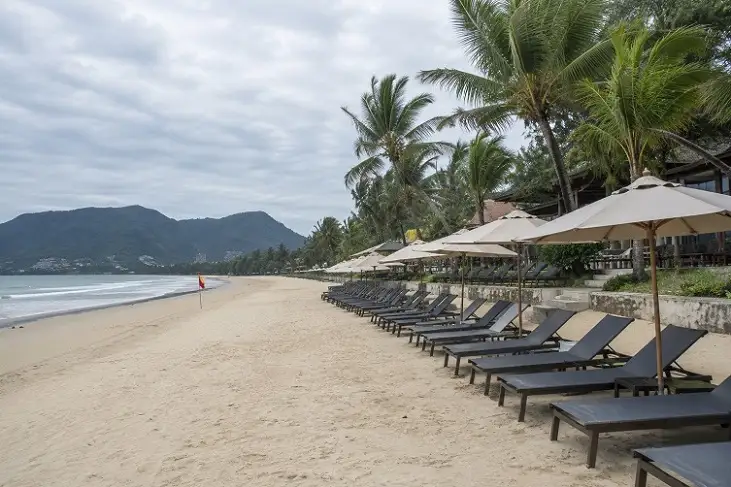
Image Credit: Thailand Hotel News
Regional tourism figures paint a worrying picture, with the average hotel occupancy across Southern Thailand reported at around 42 percent during June. By mid-July, however, that figure had slipped even further to approximately 37 percent as bookings continued to slow.
This Thailand Hotel News report highlights how a combination of global geopolitical tensions, disrupted airline routes and high travel costs has created a difficult trading environment for one of Thailand’s most important tourism regions. Industry leaders warn that while domestic promotions and efforts to attract new overseas markets are helping to soften the impact, they remain insufficient to replace the sharp decline in European visitors who have traditionally formed the backbone of the Andaman tourism economy.
Phangnga Suffers Sharpest Decline
Among the hardest-hit destinations is Phangnga, where hotels are reporting occupancy levels of only around 20 percent during what would normally be considered the quieter but still sustainable low season.
Lertsak Ponklin, President of the Phangnga Tourism Association, said those figures compare with the 50 to 60 percent occupancy hotels would normally achieve during this period. Instead of seeing a steady flow of advance reservations, operators are experiencing only slow and sporadic bookings, forcing many businesses to rethink pricing strategies and marketing efforts.
According to Mr Lertsak, the renewed escalation of conflict in the Middle East has further weakened international demand. Expensive long-haul airfares continue to discourage European travelers, while disruptions to aviation routes through major Middle Eastern transit hubs have significantly reduced visitor numbers from the continent.
Europe remains Phangnga’s most valuable long-haul market, making the province especially vulnerable to any disruption affecting European travel patterns. Even where flights are gradually returning, many visitors now choose to remain in Phuket instead of continuing on to neighboring Phangnga, reducing overall travel costs and shortening their itineraries.
Hotels Chase Alternative Markets
Faced with declining European arrivals, hotel operators have launched aggressive discount campaigns targeting domestic travelers while also expanding promotional efforts in China, India and Russia.
Despite these initiatives, Mr Lertsak said replacement markets have not generated enough visitor numbers to offset the dramatic reduction in European tourists. As a result, occupancy continues to remain well below historical seasonal averages, leaving many accommodation providers struggling to cover operating costs.
Tourism businesses have increasingly relied on discounted room rates and promotional packages simply to maintain cash flow during one of the slowest trading periods experienced in recent years.
Concerns Grow Over High Season Outlook
Tourism leaders are becoming increasingly concerned that the weakness experienced during the low season may extend into the traditionally stronger final months of the year.
Mr Lertsak warned that if international demand fails to recover soon, the distinction between the low and high seasons could effectively disappear, resulting in another severe financial setback for Phangnga’s tourism industry.
He estimates tourism revenue for the province could reach only between 30 billion and 40 billion baht this year, a substantial decline from the 56 billion baht generated during the previous year.
To reverse the trend, Mr Lertsak has urged the Tourism Authority of Thailand to strengthen cooperation with private tourism operators through coordinated international marketing campaigns and targeted promotional initiatives designed to stimulate demand before the peak travel season begins.
Infrastructure Remains Key to Long-Term Recovery
While immediate attention remains focused on attracting visitors, tourism businesses continue monitoring several major infrastructure developments that could strengthen the region’s long-term competitiveness.
Among the projects attracting significant interest is the proposed bridge linking the mainland to Koh Kho Khao. Environmental impact assessments are expected to commence next year, with the island earmarked as a future low-carbon tourism destination capable of attracting new investment and diversifying visitor experiences.
Mr Lertsak also welcomed the government’s decision to introduce a 30-day visa exemption for Indian visitors, describing the measure as a positive step that should benefit Phangnga and neighboring Andaman provinces. Nevertheless, he stressed that visa incentives alone would not guarantee sustained growth without continued investment in tourism infrastructure.
Attention also remains focused on the proposed Andaman Airport project. Although Airports of Thailand has completed its feasibility study, uncertainty surrounding land expropriation continues to generate concern among affected residents. Local tourism businesses fear these unresolved issues could delay construction and postpone one of the region’s most anticipated transport developments.
Phuket Experiences Slowest Low Season in Years
The slowdown has extended well beyond Phangnga. Hotels across Phuket are reporting occupancy levels averaging between 32 and 43 percent during June and the first half of July 2026, making this the island’s slowest low season in approximately six to seven years.
Hotel operators attribute the downturn to the combination of elevated international airfares, ongoing global economic uncertainty and the continuing impact of the Middle East conflict on long-haul travel demand.
To encourage bookings, many hotels have introduced dramatic reductions in accommodation prices. Average room rates during the low season have reportedly fallen by between 70 and 80 percent across much of the island as operators prioritize occupancy and cash flow over profitability.
Krabi and Samui Also Feel the Pressure
Neighboring Krabi has not escaped the downturn, with hotel occupancy averaging approximately 37 percent during June and mid-July.
While the province traditionally experiences softer demand during the monsoon season, industry operators say this year’s decline has been amplified by the reduction in European arrivals and rising travel costs. Increased visitation from short-haul Asian markets has provided some support but has not been enough to compensate fully for the loss of long-haul business.
Meanwhile, Koh Samui is reporting hotel occupancy averaging around 36 percent, reflecting similar challenges affecting destinations across Southern Thailand.
Global Events Reshape Thailand’s Tourism Landscape
Industry observers note that the current downturn is not solely the result of domestic tourism conditions but rather a reflection of broader international developments influencing travel decisions worldwide.
The conflict in the Middle East has forced airlines to reroute services, increasing operating costs and extending flight times on many European routes to Asia. Higher airfares have made long-haul holidays less affordable, particularly for European travelers who have historically represented one of Thailand’s strongest visitor segments.
At the same time, Chinese arrivals have remained weaker than expected, with early-year visitor numbers significantly below previous levels, adding further pressure to Thailand’s overall tourism recovery.
National hotel occupancy has also softened, with five-star hotels across the country increasingly relying on substantial promotional discounts to stimulate bookings as international demand remains uneven.
Rather than representing a challenge unique to Thailand, tourism analysts increasingly view the current situation as evidence of how geopolitical instability, economic uncertainty and changing airline operations can rapidly influence travel patterns thousands of kilometers away, directly affecting hotel occupancy, tourism revenues and local businesses throughout the Kingdom.
The coming months will be closely watched by tourism operators across Southern Thailand, who remain hopeful that stronger international marketing, improving airline connectivity and renewed traveler confidence can help restore visitor numbers before the traditional high season begins. Without a meaningful improvement, many businesses fear another prolonged period of reduced occupancy, lower revenues and continued pressure on one of Thailand’s most important tourism economies.
For the latest on the hospitality industry in Southern Thailand, keep on logging to Thailand Hotel News.