

Key points
- The development has become one of the most significant REIT-related cases in Thailand in recent years because it tests the legal strength of sale-and-buyback agreements and the protections afforded to trust unitholders.
- ONEAM has stressed that the matter is not simply a disagreement between companies but a contractual issue governed by the law and by the conditions set out when the Grand Royal Orchid Hospitality Real Estate Investment Trust (GROREIT) was established in 2021.
- The company maintains that the legal framework leaves no room for flexibility once the buyback deadline has passed, making the expiry of ROH’s repurchase rights automatic under the agreement.
Thailand Hotel News: Thailand’s hospitality and property investment sectors are closely watching the unfolding dispute surrounding the Royal Orchid Sheraton Hotel & Towers after One Asset Management (ONEAM) confirmed that Royal Orchid Hotels (Thailand) Public Company Limited (ROH) has lost its contractual right to repurchase the landmark Bangkok hotel. The asset, carrying a contractual repurchase value of 4.873 billion baht, is now set to move into a sale process after ROH failed to complete the transaction within the agreed five-year deadline. The development has become one of the most significant REIT-related cases in Thailand in recent years because it tests the legal strength of sale-and-buyback agreements and the protections afforded to trust unitholders. Midway through this unfolding dispute, this Thailand Hotel News report examines how the contractual deadline expired, why the repurchase failed, what happens next, and what the outcome could mean for Thailand’s hotel investment landscape.
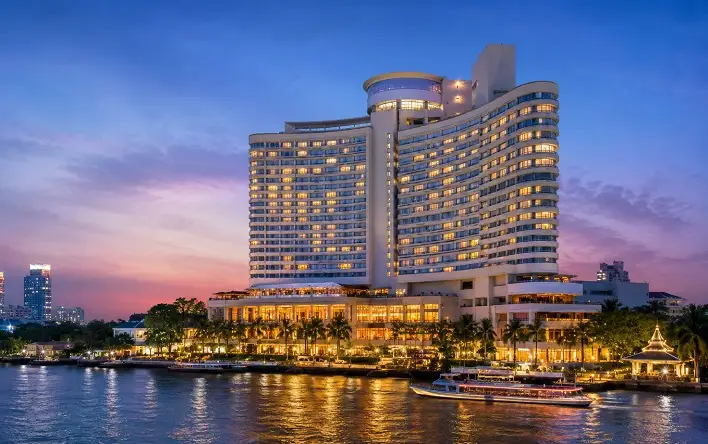
Image Credit: Thailand Hotel News
ONEAM has stressed that the matter is not simply a disagreement between companies but a contractual issue governed by the law and by the conditions set out when the Grand Royal Orchid Hospitality Real Estate Investment Trust (GROREIT) was established in 2021. The company maintains that the legal framework leaves no room for flexibility once the buyback deadline has passed, making the expiry of ROH’s repurchase rights automatic under the agreement.
Contract Deadline Triggers Legal Process
The dispute centers on the Royal Orchid Sheraton Hotel & Towers, which GROREIT acquired in 2021 for approximately 4.5 billion baht through a sale-and-buyback arrangement financed by a combination of public investment and a 1.35-billion-baht loan from the Government Savings Bank.
Under the agreement, ROH was required to repurchase the property within five years for 4.873 billion baht, excluding value-added tax. That deadline expired on July 14, 2026, without payment being completed.
Following the missed deadline, ONEAM, acting as REIT manager, together with trustee MFC Asset Management, initiated contractual enforcement procedures designed to protect approximately 1,600 trust unitholders.
ROH has now been instructed to return possession of the hotel within 30 days, with the deadline expected around August 14, 2026. If the company does not comply, legal proceedings are expected to follow.
ONEAM Says Repurchase Rights Have Expired
Alongkorn Prathanratnikorn, Chief Executive Officer of One Asset Management Co., Ltd., firmly rejected suggestions that the issue represents a conflict between organizations.
“What happened was not a conflict between organizations, but rather an error in the execution of the contract. The repurchase transaction was only supposed to occur on July 14, 2026, as per the contract.”
He explained that MFC, acting as trustee, had repeatedly reminded ROH of the approaching deadline, including issuing formal notice three months before the contractual expiry.
Alongkorn said the legal position is now straightforward.
“Legally speaking, ROH has lost the right to repurchase the hotel and the right to manage it.”
He added that Starwood, operator of the Sheraton hotel brand, has assumed hotel management on behalf of the trust, ensuring business operations continue without interruption.
Hotel Operations Continue Under New Revenue Structure
Although ownership issues remain unresolved, guests are expected to notice little operational disruption.
According to ONEAM, the hotel’s revenue model has already changed. Previously, operating income flowed to ROH, which then paid rental income to the trust. Now, as the trust becomes the full owner of the hotel, operating revenue will flow directly to GROREIT.
ONEAM emphasized this arrangement safeguards business continuity while protecting investor interests.
Should ROH wish to regain ownership in future, it would no longer enjoy any contractual priority. Instead, it would have to participate in a completely new auction alongside other interested buyers after an updated valuation is conducted under Securities and Exchange Commission (SEC) regulations.
Eight Buyers Already Express Interest
ONEAM revealed that market interest in the property remains strong despite the legal dispute.
Alongkorn disclosed that around eight potential buyers have already expressed interest in acquiring the Royal Orchid Sheraton Hotel.
The executive noted that overseas investors, particularly from the Middle East, had previously shown strong interest in purchasing the landmark riverside property.
He reiterated that the contractual repurchase value of 4.873 billion baht should now be viewed as the minimum acceptable selling price.
The previous appraisal five years ago valued the property at approximately 5.2 billion baht. GROREIT purchased the hotel for around 4.5 billion baht before establishing the contractual buyback price of 4.873 billion baht.
Although current indicative values remain around 4.8 billion baht, ONEAM said a completely new independent valuation will be required because the original buyback arrangement has now expired.
Thirty-Day Countdown Begins
Alongkorn explained that the next phase of the process has already commenced.
Within the 30-day period, ROH must hand over the hotel assets and complete all transfer documentation.
If that occurs, GROREIT will proceed with preparations for an auction, including appointing property valuers and convening a meeting of trust unitholders to approve the sale process and transaction conditions.
If ROH refuses to hand over the property, legal proceedings will commence.
“The entire process, from asset sales to refunds to unit holders, is expected to be completed within this year. This is an initial forecast based on the condition that delivery proceeds as planned.”
Separately, ONEAM confirmed it will meet with the SEC while also seeking an extension on repayment terms with Government Savings Bank regarding the trust’s outstanding loan of approximately 1.35 billion baht.
Investors Focused on Returns
Despite the legal complications, ONEAM remains optimistic that investors will ultimately achieve satisfactory returns.
The trust has delivered approximately 27% cumulative returns over the past four and a half years, equivalent to roughly 6% annually.
The Royal Orchid Sheraton itself continues to demonstrate healthy operating performance, recording average occupancy of approximately 72% during the latest year while generating profits exceeding 300 million baht.
The trust also continues to target dividend distributions of at least 90% of net profit twice each year, although management acknowledged future yields may decline temporarily because reserves must be maintained while the sale process proceeds.
Under current assumptions, ONEAM estimates investors could ultimately achieve an internal rate of return of approximately 8% annually through a combination of dividend income and capital gains from the eventual sale.
Capital Market Watches Landmark REIT Case
The implications extend well beyond one hotel. ONEAM acknowledged that GROREIT may no longer qualify as a REIT buyback structure following the failed repurchase.
Management is currently discussing future options with Thailand’s Securities and Exchange Commission, including whether the trust should continue operating as a conventional REIT. Any such change would require approval from trust unitholders.
The case has become an important benchmark because relatively few hotel REITs operate in Thailand.
Poj Harinsut, Chief Executive Officer of One Asset Management, said the incident demonstrates that even carefully drafted contracts cannot guarantee successful outcomes if contractual obligations are not fulfilled.
“The repurchase agreement was clearly defined from the start of the trust’s establishment, stipulating that repurchase must occur in the fifth year. However, when the deadline arrived, the repurchase was not possible.”
He continued: “Therefore, the most important aspect of this type of investment is the legal and contractual framework. No matter how well-written the contract is, if the contracting parties do not comply, the subsequent processes will be difficult. The legal structure is thus crucial.”
He also observed that hotel REITs remain relatively uncommon because hotel income fluctuates seasonally, is vulnerable to external economic conditions, and generally carries lower liquidity than sectors such as logistics warehouses or data centres.
ROH Maintains Financing Was Available
ROH has consistently denied that the failed transaction resulted from an inability to secure funding.
Managing Director Vitavas Vibhagool said financing had already been approved through Singapore-based private credit investment manager OCP Asia.
According to him, the financing package amounted to approximately US$87 million, equivalent to around 5.6 to 5.7 billion baht, with roughly 500 million baht earmarked for hotel renovations and working capital. “The company is fully prepared financially.”
However, he argued that disagreement over payment mechanics ultimately prevented the transaction from being completed.
According to Vitavas, ROH’s lenders objected to transferring funds through Thailand’s Bahtnet payment system before receiving the property because they believed doing so exposed financiers to unnecessary risk.
“This arrangement was unacceptable to ROH’s financiers because it would require funds to be transferred before the assets were delivered, exposing lenders to unnecessary risk.”
He maintained that the contract required payment and title transfer to occur simultaneously. “The contract clearly stipulated the transaction must be conducted on a ‘same-time’ basis, under which payment and transfer of title deeds take place simultaneously.”
Earlier discussions involving ROH, ONEAM, MFC, Government Savings Bank and prospective lenders reportedly explored alternative payment arrangements, including splitting payments between GROREIT and Government Savings Bank through the Bahtnet system. MFC later confirmed it had issued detailed payment instructions on July 8, but the transaction still failed to close before the contractual deadline.
Wider Implications for Thailand’s Hospitality Investment Sector
The Royal Orchid Sheraton dispute is now being closely followed across Thailand’s hospitality, financial and legal communities because it raises fundamental questions about how sale-and-buyback REIT structures should operate when contractual obligations cannot be fulfilled. While ONEAM insists the contract has been enforced exactly as written, ROH maintains that financing was available and that procedural disagreements over payment prevented completion. The coming weeks will therefore be critical as the 30-day handover period progresses. If the hotel is successfully transferred to the trust, an auction involving at least eight interested parties could become one of the most closely watched hotel transactions in Thailand this year. Equally significant will be the response of regulators, investors and future REIT sponsors, who are likely to examine this case as an important precedent for contractual certainty, investor protection and risk management in Thailand’s property investment market. Whatever the eventual outcome, the Royal Orchid Sheraton case has already established itself as a defining moment for Thailand’s hotel REIT sector and a valuable lesson on the importance of meeting contractual deadlines in complex real estate transactions.
For the latest on the Royal Orchid Sheraton saga, keep on logging to Thailand Hotel News.
Read Also:
https://thailandwellness.news/
https://www.thailandmedical.news/
https://www.bangkokbusiness.news/