

Key points
- Scheduled to begin full operations in early 2027, the groundbreaking project will rely exclusively on advanced robots and artificial intelligence to deliver every aspect of the guest experience, marking a dramatic shift in how hotels could function in the years ahead.
- This Hotel News report highlights how the ambitious venture is expected to become a global showcase for AI-driven tourism, with every service—from guest check-in and luggage handling to housekeeping, room service and security—being carried out entirely by intelligent robotic systems operating around the clock.
- Among the robot fleet expected to operate within the hotel are FlashBot delivery robots that manage mobile food and beverage orders, PUDU T300 robots responsible for transporting guest luggage, and PUDU CC1 Pro together with MT1 autonomous cleaning robots that use artificial intelligence to identify and remove dirt and waste throughout the property.
Hotel News: The global hospitality industry is on the brink of one of its biggest technological transformations as China prepares to open what is being promoted as the world’s first hotel to operate entirely without human staff. Scheduled to begin full operations in early 2027, the groundbreaking project will rely exclusively on advanced robots and artificial intelligence to deliver every aspect of the guest experience, marking a dramatic shift in how hotels could function in the years ahead.
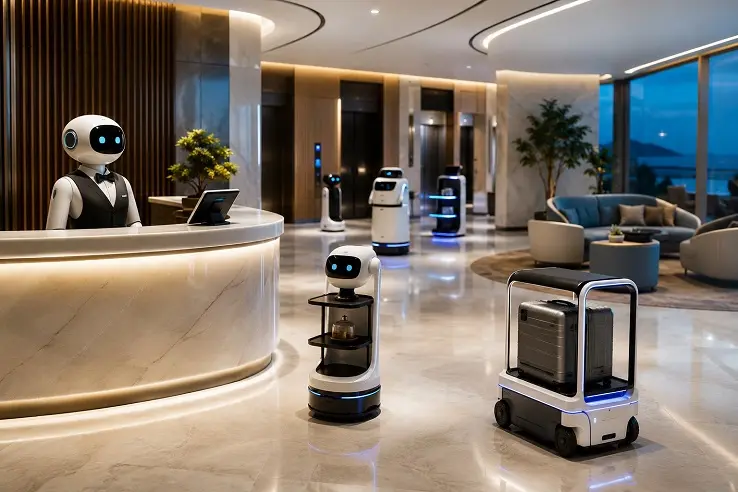
Image Credit: Thailand Hotel News
Developed through a partnership between Shenzhen-based Pudu Robotics and Shenzhen Culture & Tourism Industry Development Co., Ltd., the futuristic property is designed to demonstrate what a fully automated hospitality ecosystem can achieve. This Hotel News report highlights how the ambitious venture is expected to become a global showcase for AI-driven tourism, with every service—from guest check-in and luggage handling to housekeeping, room service and security—being carried out entirely by intelligent robotic systems operating around the clock.
Landmark Location on a Smart Artificial Island
The 44-room premium hotel will be located on the West Artificial Island of the Shenzhen-Zhongshan Link in Guangdong Province, one of China’s most ambitious bridge-and-tunnel infrastructure developments connecting major cities within the Greater Bay Area.
The artificial island, which only recently opened to visitors, is rapidly being transformed into a technology-focused tourism destination where robotics, artificial intelligence and smart infrastructure are expected to become central attractions. Chinese planners envision the area evolving into a model smart tourism hub where digital technologies seamlessly integrate with hospitality, transport and visitor services.

Image Credit: Thailand Hotel News
Every Guest Service Delivered by Robots
Unlike conventional hotels where employees interact with guests throughout their stay, this pioneering property will eliminate human staff entirely from daily operations.
Upon arrival, guests will be welcomed and assisted by reception robots capable of handling check-in procedures and providing directions. Intelligent luggage robots will transport baggage directly to guest rooms, while autonomous delivery robots will bring meals, beverages and amenities ordered through mobile applications.
Housekeeping duties will also be fully automated. AI-powered cleaning robots equipped with advanced sensors will continuously monitor rooms and public spaces, detecting dust, debris and spills before automatically cleaning affected areas without human intervention.
Additional robotic systems will conduct security patrols, assist guests with inquiries, provide navigation throughout the property and even offer interactive companionship, creating what developers describe as a fully integrated hospitality experience.
AI Functions as the Hotel’s Central Brain
Behind the hotel’s operations is Pudu Robotics’ proprietary PuduFM 1.0 artificial intelligence platform working alongside its PuduAgent intelligent management system.
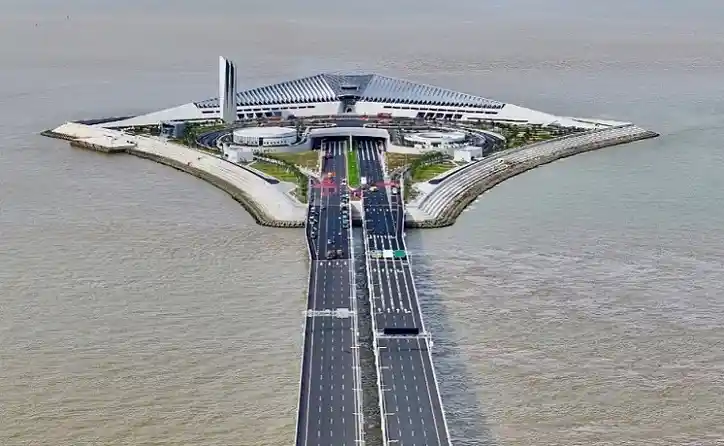
The West Artificial Island of the Shenzhen-Zhongshan Link in Guangdong Province where the hotel will be based at
Image Credit: Shenzhen Culture & Tourism Industry Development Co., Ltd
Rather than functioning independently, every robot communicates through this centralized AI platform, allowing multiple specialized robots to coordinate tasks simultaneously. This collaborative system enables efficient scheduling, resource allocation and real-time decision-making while ensuring uninterrupted 24-hour operations.
Among the robot fleet expected to operate within the hotel are FlashBot delivery robots that manage mobile food and beverage orders, PUDU T300 robots responsible for transporting guest luggage, and PUDU CC1 Pro together with MT1 autonomous cleaning robots that use artificial intelligence to identify and remove dirt and waste throughout the property.
Technology Meets Hospitality
Developers describe the hotel as much more than a building filled with robots. Instead, they say it represents a complete “closed-loop smart service ecosystem” where every operational function is digitally connected under one intelligent management platform.
Beyond its guestrooms, the property will also feature a restaurant, fitness center and additional guest facilities, all operating through the same integrated AI network.
Supporters believe automation will improve consistency, minimize human error, maintain continuous service and significantly enhance operational efficiency while reducing long-term operating costs.

Image Credit: Deposit Photos
Industry Watches with Mixed Reactions
While the project has generated enormous international attention for its technological innovation, it has also sparked widespread discussion about the future of employment within the hospitality industry.
Many analysts acknowledge that artificial intelligence and robotics have enormous potential to improve operational efficiency, particularly for repetitive service tasks. However, others caution that widespread adoption of fully automated hotel models could reshape employment opportunities across hotels worldwide if similar concepts become commercially successful.
Despite these concerns, industry observers agree that the project represents a significant milestone in hospitality innovation and may influence future hotel development strategies far beyond China.
The hotel is expected to begin limited trial operations during late 2026 before welcoming the general public with a full commercial opening in early 2027. Whether it becomes a blueprint for the future or remains a unique technological showcase, the project is already redefining expectations of what modern hospitality can become. Hotel operators around the world will be closely monitoring its performance, guest satisfaction and operational success as artificial intelligence continues to reshape the travel industry. As automation advances at an unprecedented pace, this remarkable development may well signal the beginning of an entirely new chapter for global hospitality.
For more on Pudu Robotics, visit: https://www.pudurobotics.com/en
For the latest developments in the global hospitality industry, keep on logging to Thailand Hotel News.