

Key points
- Thailand’s luxury hotel industry is adapting, recalibrating, and finding new ways to operate efficiently in a changed global landscape.
- The presence of ghost floors does not diminish Thailand’s appeal as a world-class destination, but it does offer a rare glimpse into the behind-the-scenes strategies shaping the future of hospitality.
- For the latest on the state of the Thai hospitality industry, keep on logging to Thailand Hotel….
Thailand Hotel News: A Silent Reality Behind the Glamour
Thailand’s luxury hotel sector appears, at first glance, to have fully rebounded. Lobbies are polished, staff greet guests with precision, and social media showcases infinity pools overlooking pristine coastlines. But beneath this carefully maintained image lies a quieter, less visible reality—entire floors in some high-end hotels remain closed off, unused, and deliberately hidden from public view.
Industry insiders reveal that this practice, now informally referred to as “ghost floors,” has become an open secret across several upscale properties in Bangkok, Phuket, and Chiang Mai. While occupancy rates are publicly framed as strong, the truth is more nuanced. Hotels are selectively operating only portions of their buildings, creating the impression of near-full capacity while quietly managing lower-than-expected demand.
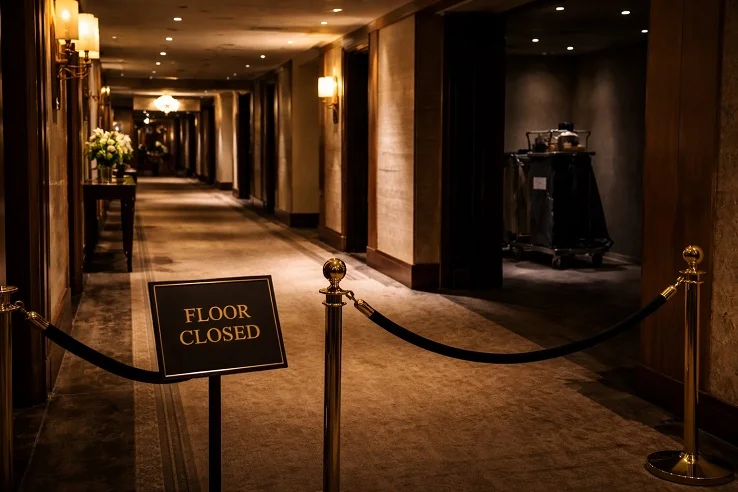
Image Credit: Thailand Hotel News
Cost Cutting Behind Closed Doors
This Thailand Hotel News report highlights that the decision to shut down entire floors is largely driven by financial survival rather than deception alone. Operating a luxury hotel at full capacity is expensive—energy costs, housekeeping, maintenance, and staffing requirements increase significantly with each additional occupied level.
By consolidating guests onto fewer floors, hotels can dramatically reduce operational expenses. Air conditioning systems can be limited to active zones, fewer housekeeping staff are required per shift, and maintenance teams can focus only on areas in use. The result is a leaner, more controlled cost structure that helps properties maintain profitability even when demand fluctuates.
However, this strategy also introduces subtle shifts in the guest experience. Elevators may seem quieter, hallways less populated, and certain room categories mysteriously “unavailable” despite visible vacancies.
Staff Consolidation and Changing Service Dynamics
Another layer of this hidden adjustment is workforce restructuring. Many luxury hotels have not returned to their pre-pandemic staffing levels. Instead, employees are now expected to handle multiple roles, blending responsibilities across departments.
Front desk staff may assist with concierge duties, while housekeeping teams are assigned larger room quotas per shift. From a business standpoint, this consolidation is efficient. From a service perspective, it can stretch staff thinner, sometimes impacting the highly personalized attention Thailand’s hospitality industry is globally known for.
Despite this, hotels are making deliberate efforts to ensure guests do not notice these internal changes. Training has intensified, workflows have been optimized, and technology is increasingly used to fill service gaps.
The Illusion of Full Recovery
The concept of ghost floors ultimately feeds into a broader narrative—the illusion that the luxury hotel sector has fully recovered. In reality, recovery remains uneven, influenced by shifting tourist demographics, shorter booking windows, and changing travel behaviors.
While high-spending travelers have returned, they are not always filling rooms at the same volume or consistency as before. Some markets remain volatile, and competition from alternative accommodations continues to challenge traditional hotel models.
Yet, maintaining an image of success is crucial. Perception influences pricing power, brand reputation, and investor confidence. For many hotels, keeping up appearances is not just about pride—it is a strategic necessity.
What This Means Going Forward
The rise of ghost floors signals a transitional phase rather than a permanent decline. Thailand’s luxury hotel industry is adapting, recalibrating, and finding new ways to operate efficiently in a changed global landscape. These hidden adjustments reflect resilience, but also reveal the fragility behind the polished surface.
As travel patterns continue to evolve, hotels may gradually reopen these dormant spaces. Until then, the industry walks a fine line between reality and perception, balancing operational survival with the expectation of seamless luxury.
The presence of ghost floors does not diminish Thailand’s appeal as a world-class destination, but it does offer a rare glimpse into the behind-the-scenes strategies shaping the future of hospitality. Understanding this hidden layer allows for a more honest view of where the industry truly stands today, beyond the curated images and confident headlines.
For the latest on the state of the Thai hospitality industry, keep on logging to Thailand Hotel News.