

Key points
- Yet in many properties, F&B directors continue to rely on outdated strategies, failing to inject innovation or differentiate their venues in an increasingly crowded market.
- In some cases, there is also criticism surrounding communication skills, particularly in an industry that depends heavily on international clientele.
- Some of the PR teams at certain hotels in Bangkok are a total waste of monies and resources as the staff are not only lazy and clueless but are simply just too stupid to retainImage Credit.
Thailand Hotel News: A Shockwave with Unexpected Upside
The ongoing instability linked to tensions in the Middle East has sent ripples across global travel patterns, and Thailand’s hospitality sector has not been spared. Bookings have softened in certain segments, high-spending travelers are hesitating, and uncertainty has forced hotel operators to reassess forecasts that once seemed secure. Yet beneath the immediate anxiety lies an uncomfortable but necessary truth—this disruption may be exposing deep structural inefficiencies within the hotel industry itself.

Image Credit: Thailand Hotel News
For years, many properties have operated with bloated management layers, unclear accountability, and a culture that often rewards tenure over performance. Now, as revenue pressures mount, owners and operators are being forced to scrutinize every department with fresh urgency. This Thailand Hotel News report highlights a growing sentiment among industry insiders that the crisis could act as a long-overdue reset button.
The Era of Complacent Leadership Under Fire
At the center of this internal reckoning are General Managers who have, in some cases, grown overly comfortable. While many GMs remain highly capable leaders, there is a rising criticism that others have drifted into passive roles, focusing more on maintaining status quo operations rather than actively auditing team performance or driving innovation.
In a competitive and rapidly evolving hospitality landscape, complacency is costly. Hotels that once thrived on location or brand alone now face a new reality where agility and leadership visibility are essential. Owners are increasingly asking difficult questions: Are GMs truly evaluating departmental output? Are they challenging underperformance? Or are they simply managing optics while deeper inefficiencies persist?
This moment of crisis is forcing accountability in a way that years of steady tourism growth never did.
Food and Beverage Creativity Faces a Reality Check
Another area under intense scrutiny is the Food and Beverage division. Traditionally seen as a cornerstone of hotel identity, many F&B departments have fallen into predictable patterns. Menus are often repetitive, concepts lack originality, and there is little effort to adapt to changing consumer preferences.
The criticism is not merely about food quality but about creative stagnation. Guests today are more informed, more adventurous, and less forgiving of uninspired offerings. Yet in many properties, F&B directors continue to rely on outdated strategies, failing to inject innovation or differentiate their venues in an increasingly crowded market.
The current downturn is pushing hotel owners to reconsider whether these leadership roles are delivering measurable value or simply maintaining legacy systems that no longer resonate with modern travelers.
Marketing Departments Under the Microscope
Perhaps the most controversial shift is occurring within marketing and communications teams. For years, hotels have invested heavily in PR, brand communications, and social media marketing. However, the effectiveness of these functions is now being questioned more openly than ever.
There is a growing perception that many PR and Marcom managers are disconnected from actual revenue generation. Campaigns may look polished, social media feeds may appear active, but the tangible impact on bookings is often unclear. In some cases, there is also criticism surrounding communication skills, particularly in an industry that depends heavily on international clientele.
As digital channels become saturated and algorithms limit organic reach, reliance on traditional social media strategies is being challenged. Hotels are beginning to ask whether these roles need to evolve dramatically—or in some cases, be eliminated altogether.
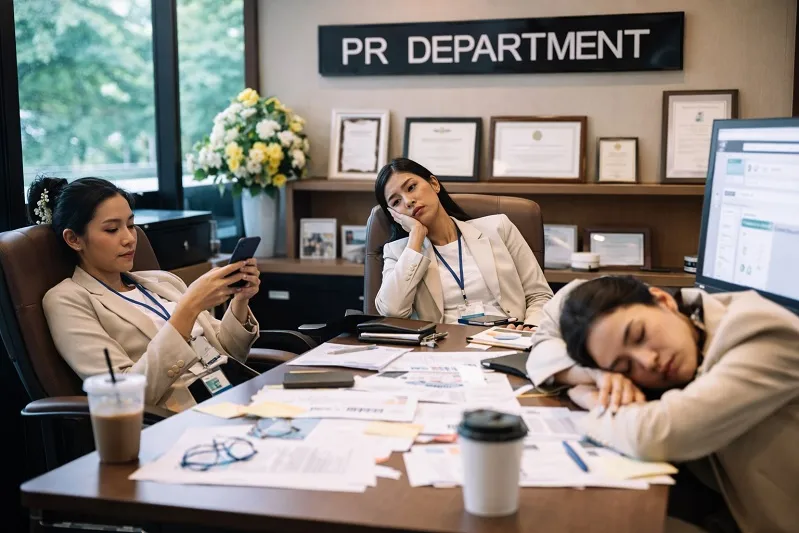
Image Credit: Thailand Hotel News
The Myth of Social Media Dominance
For over a decade, social media has been positioned as an essential marketing pillar for hotels. Instagram-worthy visuals, influencer collaborations, and constant content creation became standard practice. Yet the return on investment is now under serious debate.
The reality is that social media visibility does not automatically translate into bookings. Travelers are increasingly relying on direct recommendations, loyalty programs, and value-driven decisions rather than curated online imagery. Moreover, paid advertising has become necessary to achieve reach, further eroding margins.
This shift is prompting a reevaluation of entire digital teams. If social media is no longer delivering consistent results, hotels must rethink where their marketing budgets—and human resources—are best allocated.
Cutting Through the Noise of Inefficiency
The broader issue extends beyond individual departments. The hotel industry, particularly in mature markets like Thailand, has accumulated layers of roles that may no longer serve a clear purpose. Titles have multiplied, responsibilities have blurred, and performance metrics have often been vague or poorly enforced.
In times of prosperity, these inefficiencies were easy to overlook. Strong occupancy rates masked underlying problems, and profitability remained stable despite operational redundancies. However, the current crisis is stripping away that safety net.
Hotel owners are now compelled to identify which roles genuinely contribute to revenue, guest satisfaction, and long-term brand value—and which do not. This process, while uncomfortable, is essential for building leaner, more resilient organizations.
A Shift Toward Merit and Measurable Results
What is emerging is a potential cultural shift within the industry. Instead of relying on hierarchy or tenure, there is a growing emphasis on measurable performance. Departments are being evaluated based on clear outcomes, and individuals are being held accountable for tangible contributions.
This could mark the beginning of a more meritocratic era in hospitality, where innovation, adaptability, and results take precedence over traditional structures. Employees who bring creativity, strategic thinking, and operational excellence are likely to thrive, while those who rely on outdated practices may find themselves increasingly vulnerable.
Rebuilding a Stronger Hospitality Model
While the immediate impact of the Middle East conflict remains a concern, its indirect effect on the hotel industry may ultimately prove transformative. By forcing a reassessment of talent, structure, and strategy, the crisis is pushing hotels to confront long-standing issues that have gone unaddressed for years.
The challenge lies in executing these changes thoughtfully. Cost-cutting alone is not the answer; the goal must be to build smarter, more efficient teams that are aligned with modern market demands. This requires not only removing inefficiencies but also investing in the right kind of talent—individuals who can drive growth, adapt to change, and elevate the guest experience.
The Road Ahead for Thailand’s Hotels
The hospitality sector in Thailand has demonstrated resilience time and again, navigating political shifts, global pandemics, and economic fluctuations. This latest challenge is no different, but it comes with a unique opportunity for introspection and reinvention.
If handled correctly, the current crisis could lead to a leaner, sharper, and more competitive industry. Hotels that embrace change, demand accountability, and prioritize genuine value creation will be better positioned to succeed in an increasingly complex global landscape.
What may initially appear as a setback could, in fact, be the catalyst for long-overdue reform—one that reshapes the industry for years to come and ensures that only the most capable and forward-thinking professionals remain at the helm. And as difficult as these transitions may be, they could ultimately strengthen the foundation of Thailand’s hospitality sector in ways that periods of growth never could.
For the latest on the state of the hospitality industry in Thailand, keep on logging to Thailand Hotel News.