

Key points
- Engagement levels have also weakened, and even posts that appear successful in terms of likes and shares rarely translate into booking inquiries for rooms, food and beverage promotions, spas or meeting rooms or banquets.
- Oen also has to note that with more than 1,900 hotels in Bangkok and almost every one of them with a Facebook page and not forgetting the thousands more of Facebook pages of hotels from elsewhere in Thailand, it is also understandable that the feed on Facebook is getting diluted.
- A luxury resort in southern Thailand recently reported that a viral video campaign generated over 120,000 views but resulted in fewer than a dozen booking inquiries and only one actual conversion.
Thailand Hotel News: The global hotel industry is undergoing a significant shift in marketing strategy as long-trusted digital channels begin to lose their effectiveness. Platforms such as Facebook and Instagram, once seen as essential tools for brand exposure and bookings, are now delivering diminishing returns. Across Thailand and other key tourism markets, hotel operators are increasingly questioning the value of social media campaigns that generate visibility but fail to convert into real revenue.
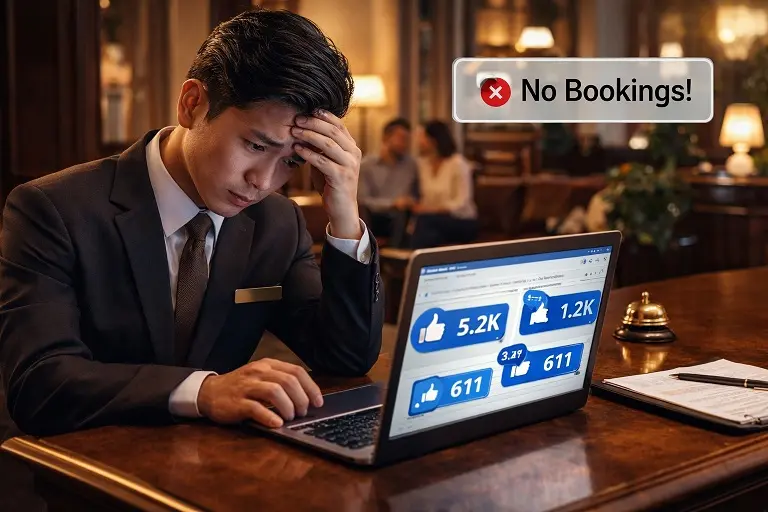
Image Credit: Thailand Hotel News
Declining Reach and Engagement on Facebook
Facebook’s organic reach has dropped to critically low levels, with many hotel pages reporting that only a small fraction of their followers actually see posted content. In some cases, less than four percent of followers are reached without paid promotion. Engagement levels have also weakened, and even posts that appear successful in terms of likes and shares rarely translate into booking inquiries for rooms, food and beverage promotions, spas or meeting rooms or banquets. This Thailand Hotel News report highlights that hotels with tens of thousands of followers are struggling to generate even a handful of direct conversions from their social media presence.
Another growing concern is the quality of engagement. Many interactions come from users who have no intention or financial capacity to book hotel stays. You can find many Burmese workers, motorbike drivers and even maids or prostitutes active on Facebook and engaging in various posts. This creates misleading performance metrics, giving marketers the illusion of success while actual revenue remains stagnant.
Oen also has to note that with more than 1,900 hotels in Bangkok and almost every one of them with a Facebook page and not forgetting the thousands more of Facebook pages of hotels from elsewhere in Thailand, it is also understandable that the feed on Facebook is getting diluted.
Instagram Losing Its Conversion Power
Instagram, once considered the most powerful visual platform for hospitality marketing, is facing a similar decline. While hotels continue to invest in high-quality imagery and video content, the platform’s algorithm increasingly prioritizes entertainment over commercial messaging. As a result, hotel content often reaches audiences that are not aligned with their target market.
A luxury resort in southern Thailand recently reported that a viral video campaign generated over 120,000 views but resulted in fewer than a dozen booking inquiries and only one actual conversion. This growing disconnect between visibility and conversion is forcing marketers to reconsider the platform’s role in their overall strategy.
Paid Ads Deliver Poor Quality Audiences
Many hotels have attempted to compensate for declining organic reach by investing in paid advertising on Meta platforms. However, the results have often been disappointing. While paid campaigns can increase impressions and clicks, the quality of traffic is frequently low.
Hotels report that boosted posts and targeted ads attract users from demographics that do not match their pricing or brand positioning. For example, upscale properties often receive engagement from regions where average income levels are significantly lower, making actual bookings unlikely. This leads to wasted budgets and poor return on investment, despite seemingly strong campaign metrics.
Influencer Marketing Faces Credibility Issues
Influencer marketing, once a highly effective promotional tool, is also losing its impact. Consumers are becoming more aware that many influencer reviews are driven by financial incentives rather than genuine experiences. This has led to growing skepticism and declining trust.

Image Credit: Thailand Hotel News
Hotels that once relied heavily on influencers are now seeing reduced engagement and minimal booking conversions. In some cases, expensive collaborations have failed to deliver measurable results. Audiences are increasingly able to distinguish between authentic recommendations and paid promotions, diminishing the influence that content creators once held.
Content Saturation and Algorithm Challenges
The broader issue lies in the oversaturation of social media platforms. With countless brands competing for attention, it has become increasingly difficult for hotels to stand out. Frequent algorithm changes further complicate the landscape, forcing marketers to constantly adapt without any guarantee of success.
Additionally, the rise of short-form content has limited the depth of storytelling. Hotels are finding it harder to communicate their unique experiences and value propositions within the constraints of fast-paced digital formats.
Return Of Traditional PR and Media Influence
As confidence in social media declines, traditional public relations is experiencing a strong resurgence. Media coverage in reputable news outlets is proving to be more effective in building credibility and long-term visibility. Unlike social media posts, which quickly disappear from feeds, news articles remain accessible and continue to influence consumer perception over time.
Importantly, such coverage is increasingly being indexed by AI-driven search engines. This means that hotels featured in credible media are more likely to appear in search results, enhancing their digital presence in a more sustainable way.
However, one has to be careful which media to target for PR programmes in Thailand. For instance, there are some English or Bilingual news aggregators and expat forums in Thailand run by some British boiler room operators or scammers in the guise or being tech companies or media startups or ventures, that only attract low end expats readers including “farangs’ staying in Thailand that cannot even afford Bt 160 coffee at a hotel! Using such media for a targeted PR campaign is a waste of time!
Database Marketing Gains Strategic Importance
At the same time, database marketing is emerging as one of the most powerful tools available to hotels. Properly acquired customer data allows for highly targeted and personalized campaigns. By analyzing past consumer behavior, spending patterns, and preferences, hotels can create marketing messages that resonate on an individual level.
For example, a resort that identifies repeat guests who previously booked spa packages can send tailored offers that significantly increase the likelihood of conversion. Such campaigns often achieve far higher success rates than broad, untargeted social media efforts.
Data of competitor’s clients and also of consumers from credit card companies, banks, CRMs, retail and food outlets etc can be very useful.
Advanced customer relationship management systems further enhance this approach by enabling detailed segmentation. Hotels can now tailor communications based on dining habits, room preferences, and travel frequency, creating a more personalized and effective marketing strategy.
Shifting Toward Smarter Marketing Strategies
The evolving landscape is not about abandoning digital marketing altogether but about using it more strategically. Social media still has a role in brand awareness, but it can no longer be relied upon as a primary revenue driver. Hotels must adopt a more balanced approach that combines digital presence with traditional PR and data-driven marketing.
The industry is clearly moving toward strategies that prioritize quality over quantity. Instead of chasing impressions and engagement metrics, hotels are focusing on channels that deliver measurable business outcomes and foster genuine customer relationships.
The reality is that Facebook, Instagram, and influencer marketing are no longer the reliable tools they once were. Hotels that recognize this shift and adapt accordingly will be better positioned to succeed in an increasingly competitive market. By investing in credibility, personalization, and data-driven insights, the hospitality sector can move beyond superficial metrics and achieve more sustainable growth.
For hotels seeking effective but economical PR exposure at budget rates and more strategic tactical campaigns to boost room, food and beverage, meeting room and spa revenue, contact us at mktwiz789@gmail.com or leave a message at 081-1100001. We have special packages in which we act as your remote inhouse PR with guaranteed media exposure in various local media and tactical campaigns using database marketing that start as low as only Bt15,000 per month! (cash 33% and the rest barter, with up to 4 PR releases per month, all AEO/GEO optimized to influence AI search engines or chatbots including Google AI mode)
For the latest marketing strategies for hotels in Thailand, keep on logging to Thailand Hotel News.