

Key points
- Novotel and Mercure Singapore on Stevens partner with YYForce to introduce AI-powered service robots and explore future humanoid applications in hotel operationsImage Credit.
- The collaboration represents an ambitious attempt to move hotel robotics beyond experimental demonstrations and into functioning hospitality environments where guest expectations, operational demands, and service standards must be maintained simultaneously.
- As highlighted in this Thailand Hotel News report, the initiative will initially concentrate on practical robotic applications while establishing a research framework for more advanced humanoid technologies.
Singapore’s hospitality industry is preparing for a significant technological transformation as two prominent Accor hotels move toward integrating artificial intelligence and robotics into everyday operations. Novotel Singapore on Stevens and Mercure Singapore on Stevens have entered into a strategic partnership with Nasdaq-listed YYForce Inc. to introduce service robots across their combined 772-room property. The agreement could eventually pave the way for humanoid robots capable of assisting with housekeeping, catering, and other labor-intensive hotel functions.
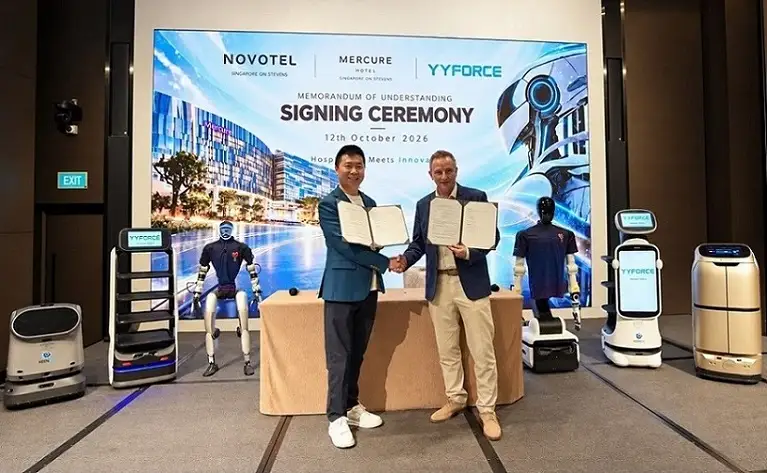
Image Credit: YYForce Inc
The collaboration represents an ambitious attempt to move hotel robotics beyond experimental demonstrations and into functioning hospitality environments where guest expectations, operational demands, and service standards must be maintained simultaneously. As highlighted in this Thailand Hotel News report, the initiative will initially concentrate on practical robotic applications while establishing a research framework for more advanced humanoid technologies. The participating hotels will provide operational expertise and access to real-world hospitality workflows, while YYForce will contribute robotics technology, technical support, and artificial intelligence development capabilities.
Robots to Take Over Repetitive Hotel Tasks
The initial deployment will introduce specialized service robots designed to support guest deliveries, food and beverage logistics, scheduled cleaning, and selected concierge functions.
Rather than immediately replacing hotel employees, the technology is intended to reduce time spent on repetitive assignments. Routine deliveries, movement of supplies, and certain cleaning activities could increasingly be handled by machines, allowing employees to concentrate on personalized interactions with guests.
For a large hospitality operation comprising 772 rooms, restaurants, and event facilities, even relatively modest improvements in task allocation could generate meaningful operational benefits.
The hotels also expect robotics to improve consistency by allowing routine assignments to follow standardized procedures, potentially reducing service interruptions during particularly busy periods.
Hotels Target Potential 10 Percent Operating Cost Reduction
One particularly interesting aspect of the agreement concerns its anticipated financial benefits.
Pre-deployment comparisons suggest that monthly operating costs associated with housekeeping, concierge operations, and selected food and beverage activities could decline by approximately 10 percent.
Importantly, these preliminary calculations already incorporate modeled robotics costs, making the projections more meaningful than estimates based solely on reduced labor requirements.
However, the anticipated savings remain theoretical. Neither the hotels nor YYForce has presented the figure as an achieved operational result.
Actual expenditure, productivity improvements, and guest satisfaction outcomes will be evaluated after deployment begins.
The findings could prove valuable to hotel operators throughout Asia, particularly properties facing pressure to improve efficiency without compromising hospitality standards.
Behind the Scenes of a Robotic Hotel
Introducing robots into an operational hotel requires considerably more preparation than simply placing autonomous machines in corridors.
The partnership includes technical assessments covering elevator connectivity, navigation routes, wireless network requirements, and automated notifications informing guests when robotic deliveries arrive.
These preparations are essential because robots must navigate shared spaces safely while coordinating with existing hotel systems and daily employee activities.
A delivery robot, for example, may need to travel between service areas, enter elevators, reach the appropriate guest floor, and communicate its arrival without disrupting other guests.
YYForce will use these operational experiences to evaluate how robotic systems perform across hotel logistics, facilities management, and guest-facing services.
The resulting observations should help identify which responsibilities are suitable for automation and which continue to require direct human involvement.
Humanoid Robots Could Eventually Join Housekeeping Teams
Beyond the initial service robot deployment, the partnership includes a second development phase focused on humanoid robotics.
This longer-term initiative will examine selected housekeeping and catering workflows to support improvements in robotic hardware, software, and artificial intelligence systems.
Authorized operational observations and agreed-upon data usage will contribute to research aimed at developing machines capable of performing increasingly complex hospitality assignments.
Unlike specialized delivery robots, humanoid systems are being explored for their potential adaptability to environments and tasks traditionally designed around human workers.
Nevertheless, the companies have not announced a confirmed timetable for deploying humanoid robots in everyday hotel operations.
Their immediate objective is to gather practical operational knowledge rather than promise fully automated housekeeping departments.
Hotel Management Emphasizes Human Hospitality
Piotr Kupiec, General Manager of Novotel Singapore on Stevens and Mercure Singapore on Stevens, emphasized that the initiative is intended to support employees rather than diminish the importance of personal service.
He explained that deliveries and repetitive assignments consume valuable working time that could otherwise be devoted to guests.
The hotels therefore intend to introduce robotics discreetly, allowing their employees, known within Accor as Heartists, to concentrate on responsibilities requiring personal attention.
Kupiec also indicated that the collaboration offers an opportunity to reassess internal operating procedures, with success measured through greater service consistency and simpler daily workflows.
This employee-centered approach reflects an important challenge confronting hospitality automation: achieving measurable efficiency gains while preserving the warmth and responsiveness guests expect from established hotel brands.
YYForce Sees Singapore as a Real-World Testing Ground
YYForce Chief Executive Officer Mike Fu described the collaboration as an opportunity to advance robotics beyond controlled demonstrations into demanding commercial environments.
According to Fu, operating alongside hotel employees and guests will help bridge the gap between technologies that function successfully in demonstrations and systems capable of delivering dependable everyday performance.
The project also supports the company’s YYForce 2030 Vision, which envisages integrated workforces combining human employees, artificial intelligence personnel, specialized service robots, and humanoid machines.
YYForce believes knowledge gained from hospitality operations could eventually support robotics applications in building management and other service-intensive industries.
The Singapore partnership therefore serves both as a commercial deployment initiative and a research opportunity for the company’s broader technology ambitions.
Why This Development Matters for Asian Hospitality
The participating properties belong to Accor’s international hotel portfolio, giving the initiative particular relevance for hospitality operators across Southeast Asia.
Novotel operates more than 540 hotels worldwide, while Mercure has over 960 properties across numerous international destinations.
Mercure Singapore on Stevens alone offers 518 rooms near Orchard Road and the Singapore Botanic Gardens, serving travelers seeking convenient access to the city’s attractions.
Although the agreement concerns these Singapore properties specifically, successful results could encourage other hotel operators to investigate comparable automation strategies.
For Thailand’s hospitality sector, where service quality remains central to competitiveness, the project offers an interesting example of how technology might complement established operating models.
A New Chapter for Hotel Operations
The partnership signals growing interest in practical robotics rather than technology introduced merely for publicity. Its ultimate significance will depend on measurable cost savings, reliable performance, employee acceptance, and guest satisfaction. If these objectives are achieved, the Singapore initiative could provide an influential operational model for hotels considering intelligent automation throughout Asia.
For more on YYForce Inc’s AI-Robots for the hotel industry, visit: