

Key points
- Escalating conflicts in Europe and the Middle East are raising energy, aviation, and economic risks for Thailand’s tourism and hotel sectorImage Credit.
- At the same time, this Thailand Hotel News report finds that escalating conflict in the Middle East is putting additional pressure on oil supplies and aviation routes.
- Europe’s gas storage was about 69% full in mid-September, below its five-year seasonal average, while gasoline and diesel prices across the European Union were sharply higher than a year earlier and jet-fuel costs had more than doubled.
Thailand’s tourism industry is heading toward the final months of 2026 with a problem largely beyond its control. Two distant theaters of conflict—Europe and the Middle East—are increasingly affecting the costs, confidence, and connectivity on which international travel depends. For Thai hotels, the danger is not simply that travelers may cancel trips because of war. The broader threat is a chain reaction involving oil prices, jet fuel, airfares, inflation, consumer confidence, airline routing, and slower economic growth in important source markets.
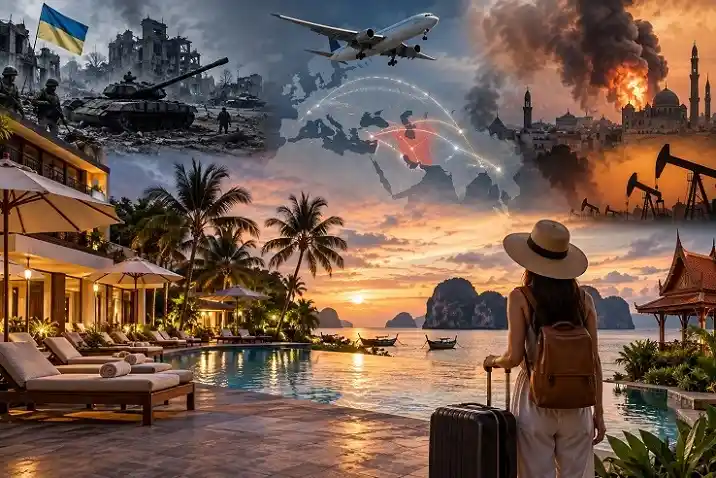
Image Credit: Thailand Hotel News
The pressure is becoming harder to dismiss as temporary. Europe is confronting the continuing Russia-Ukraine war while also dealing with drone incidents, infrastructure security concerns, expensive energy, and renewed inflation risks. At the same time, this Thailand Hotel News report finds that escalating conflict in the Middle East is putting additional pressure on oil supplies and aviation routes. Europe’s gas storage was about 69% full in mid-September, below its five-year seasonal average, while gasoline and diesel prices across the European Union were sharply higher than a year earlier and jet-fuel costs had more than doubled.
Europe’s Security Problems Are Becoming Economic Problems
The war in Ukraine remains a central source of uncertainty. Recent developments have also reinforced European concerns about drones and attacks on critical infrastructure. Germany has attributed an attempted drone attack in Leipzig to Russia, while EU foreign policy chief Kaja Kallas said the incident had the hallmarks of state-sponsored terrorism. Separately, unauthorized drones temporarily forced Luxembourg Airport to suspend operations before flights resumed.
For tourism, the significance extends beyond individual security incidents. Higher energy costs can work through European economies by increasing household expenses, business costs, and borrowing pressures. Europe’s benchmark natural-gas price was recently around €81 per megawatt-hour, approximately 150% higher than a year earlier. With winter approaching and storage below normal seasonal levels, another prolonged energy squeeze could leave European consumers with less discretionary income for long-haul holidays.
That matters to Thailand because European visitors are particularly valuable during the high season. Markets including Germany, Scandinavia, Britain, France, and Eastern Europe contribute to winter demand in Bangkok, Phuket, Krabi, Samui, Pattaya, and other destinations. Even where arrival numbers remain resilient, more expensive flights and weaker purchasing power can influence trip frequency, length of stay, hotel category, and spending outside the room.
Middle East Escalation Raises the Stakes for Aviation
The Middle East presents a more immediate transportation and energy risk. Fighting involving Iran and its regional adversaries has already disrupted shipping and raised concerns over the Strait of Hormuz and Red Sea routes. The latest escalation involving Yemen’s Houthis and Saudi Arabia has added another layer of uncertainty.
On September 19, Saudi authorities issued aerial-threat alerts as Houthi forces launched attacks toward the kingdom. Reuters reported that the Houthis have been targeting Saudi cities, energy infrastructure, and shipping, threatening oil supplies and the Red Sea route while traffic through the Strait of Hormuz remains disrupted. Smoke and flames were also observed near Riyadh’s King Khalid International Airport, with flight disruptions reported.
For Thailand, developments around Gulf aviation hubs deserve close attention. Bangkok and Phuket depend heavily on connecting traffic through major Middle Eastern airports linking Thailand with Europe and other long-haul markets. Even without widespread cancellations, airlines facing longer routings, higher insurance costs, elevated jet-fuel prices, or airspace restrictions eventually have to absorb those costs or pass some of them to passengers.
Oil Above $100 Changes the Tourism Equation
Global oil prices have climbed above $100 a barrel amid the Middle East conflict, while refined fuels have risen even faster in some markets. European gasoline prices were recently 24% higher year-on-year and diesel 38% higher, while jet fuel had risen by more than 100%.
Higher ticket prices can be especially damaging for Thailand because the country competes with destinations closer to European travelers. A holidaymaker comparing Thailand with Spain, Greece, Turkey, North Africa, or destinations within Europe may still prefer Thailand, but a substantially higher airfare changes the total vacation budget. Families and middle-income travelers are particularly sensitive to such increases.
Thai Hotels Face an Uneven High Season
The source material supplied for this article puts foreign arrivals during the first eight months of 2026 at approximately 20.9 million, down 3.1% year-on-year, while also pointing to weaker forward bookings and caution among hotel operators. It describes a mixed hotel market, with Bangkok benefiting from relatively strong occupancy and rates while Phuket’s luxury and upscale sector experienced softer occupancy and revenue per available room.
This divergence explains why the industry’s increasingly visible “value over volume” strategy may provide some protection but cannot solve every problem. Premium travelers generally have greater capacity to absorb airfare increases, and Thailand can continue developing wellness, dining, events, luxury accommodation, and longer-stay experiences. However, mid-market hotels, independent properties, tour operators, restaurants, transport businesses, and attractions still require broad visitor volumes.
There are potential offsets. Some European markets continue to show growth, new direct air services can stimulate demand, and Thailand remains an established destination offering accommodation across a wide range of prices. Chinese demand, domestic tourism campaigns, and higher-spending Gulf travelers can also help diversify the market. Yet Gulf traffic itself becomes vulnerable when regional airspace and consumer confidence are affected by conflict.
A High Season with More External Risk
Thailand’s tourism and hotel sector has repeatedly demonstrated an ability to adapt to shocks, but the present challenge is unusually interconnected. A missile or drone attack in the Middle East can influence oil and jet-fuel prices; an energy shortage in Europe can weaken household spending; an aviation security incident can disrupt flights; and each can eventually affect a hotel booking in Phuket, Bangkok, or Samui.
The coming high season therefore depends on far more than Thailand’s attractions, service standards, promotions, and hotel inventory. Energy prices, aviation connectivity, European consumer confidence, and the security of Gulf transport corridors will influence demand. Thailand can continue shifting toward higher-value visitors and diversified source markets, but sustained geopolitical disruption would make that strategy more difficult and leave price-sensitive hotels particularly exposed. The resilience of the industry remains substantial, but the external risks surrounding the 2026 high season are becoming increasingly difficult for operators to ignore or price away.