

Key points
- Thailand’s travel and hospitality sector is facing renewed concerns after KTC issued a warning that online hotel booking scams are becoming increasingly sophisticated, with fraudsters abandoning simple fake websites in favor of carefully orchestrated deception designed to manipulate consumers throughout the entire booking journey.
- Raiwin Worawongsathit, President of the Credit Card Fraud Prevention Club and Chief Operating Officer and Merchant Operations Officer of KTC, explained that today’s fraudsters understand consumer behavior and deliberately create a false sense of security before asking for payment.
- Victims may be told that only one room remains available, that an exclusive promotional rate is about to expire, or that immediate payment is required to secure the reservation.
Thailand Hotel News: Thailand’s travel and hospitality sector is facing renewed concerns after KTC issued a warning that online hotel booking scams are becoming increasingly sophisticated, with fraudsters abandoning simple fake websites in favor of carefully orchestrated deception designed to manipulate consumers throughout the entire booking journey. The latest warning comes as more travelers rely on digital platforms to secure accommodation, creating fresh opportunities for criminals to exploit trust, urgency, and payment systems.
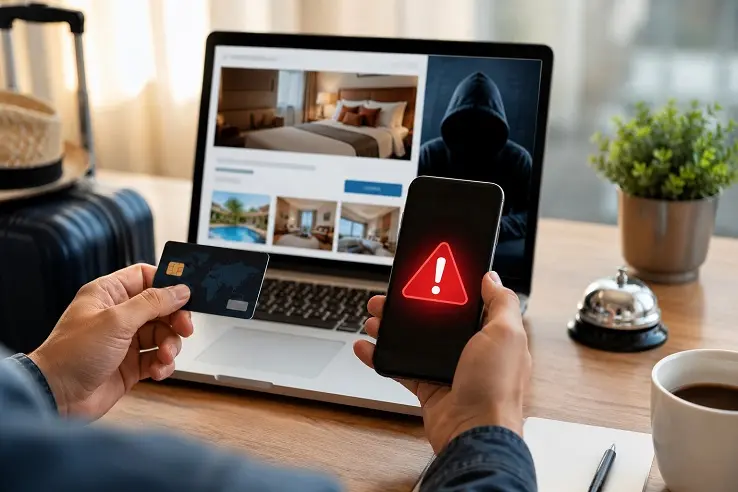
Image Credit: Thailand Hotel News
According to KTC, scammers are now adopting multi-stage tactics that appear far more convincing than previous fraud attempts. This Thailand Hotel News report highlights how these operations no longer depend solely on counterfeit websites but instead involve a carefully planned sequence that builds confidence before gradually pressuring victims into making costly mistakes. The company said criminals increasingly exploit genuine hotel names, recognizable branding, authentic-looking photographs, and fabricated customer reviews to convince travelers that they are dealing with legitimate accommodation providers.
Scammers Build Trust Before Striking
Speaking on July 23, 2026, Mr. Raiwin Worawongsathit, President of the Credit Card Fraud Prevention Club and Chief Operating Officer and Merchant Operations Officer of KTC, explained that today’s fraudsters understand consumer behavior and deliberately create a false sense of security before asking for payment.
The first stage of the scam involves deception through fake hotel listings, fraudulent booking pages, or counterfeit accommodation profiles appearing on booking platforms or social media. Criminals frequently copy real hotels’ names, logos, promotional photographs, addresses, and descriptions to make their offers appear authentic. In many cases, they also publish fabricated reviews and advertise prices significantly below market rates to attract attention.

Image Credit: KTC
Once a potential customer shows interest, scammers move to the second stage by creating a sense of urgency. Victims may be told that only one room remains available, that an exclusive promotional rate is about to expire, or that immediate payment is required to secure the reservation. The pressure is designed to discourage careful verification while encouraging impulsive decisions.
Payment Information Becomes the Ultimate Target
The final stage focuses on capturing payment details or directing victims to fraudulent payment channels. Travelers may receive fake payment links or be instructed to transfer funds into bank accounts unrelated to the actual hotel or booking provider. In other situations, consumers unknowingly enter sensitive payment card information that can later be used to conduct unauthorized transactions.
Mr. Raiwin emphasized that consumers should be especially cautious whenever they feel pressured to act quickly. Fraudsters intentionally exploit limited-time offers and attractive discounts to distract victims from checking important details before completing transactions.
KTC also reminded consumers to carefully examine every One-Time Password (OTP) notification received during payment. The merchant name, payment amount, and transaction currency displayed in the OTP message should always match the intended purchase. If any information appears different or suspicious, customers should immediately stop the transaction and never enter the OTP code.
Five Essential Ways to Stay Protected
To reduce the risk of becoming a victim, KTC recommends several important safety measures.
Consumers should always verify the credibility of hotels, booking platforms, websites, social media pages, addresses, telephone numbers, and map locations using multiple trusted sources before making reservations.
Travelers are also encouraged to type official website addresses directly into their browsers or use verified mobile applications instead of clicking payment links received through chat messages, emails, or text messages from unknown sources.
Card details and OTP codes should never be shared with anyone, regardless of how convincing the request may appear. Users should also activate transaction notifications through their banking or financial institution’s mobile application and regularly monitor account activity for suspicious charges.
If any unauthorized transaction is detected, customers should immediately contact their financial institution to suspend card usage, initiate an investigation, and minimize financial losses.
Vigilance Remains the Best Defense
Mr. Raiwin noted that while fraudsters continually adapt their techniques to exploit changing circumstances and consumer habits, travelers can significantly reduce their exposure to scams by refusing to make rushed decisions and carefully verifying every aspect of an online booking before completing payment.
Taking a few extra minutes to confirm a hotel’s authenticity, checking payment details thoroughly, and remaining cautious of unusually attractive promotions can prevent substantial financial losses and unnecessary stress. As online travel bookings continue to grow in popularity, maintaining awareness and exercising patience remain the strongest defenses against increasingly sophisticated cybercriminals.
For more on KTC, visit:
For the latest about hotel online booking scams, keep on logging to Thailand Hotel News.
Visit our sister websites as well:
https://thailandwellness.news/
https://www.thailandmedical.news/
We have more than 1700 news websites covering various industries and topics across 35 countries and are scaling up to reach 28,000 sites by the end of 2026. We do not use social media accounts to drive traffic rather we depend on search engines and AI platforms along with database marketing involving 82 million names of high spenders from around the globe. We are the largest supplier of news content to various media and news platforms and wire agencies around the world covering various industries and sectors. Contact us at mktwiz789@gmail.com for more details or for pr, marketing and branding collaborations.