

Key points
- Hyatt Hotels Corporation is preparing for a major leadership change across its Asia-Pacific operations including Thailand, appointing hospitality veteran Stephen Ho to oversee a sprawling regional portfolio of 370 hotels.
- The transition marks the end of an extraordinary executive chapter for David Udell, whose 44-year career helped transform Hyatt into a formidable luxury hospitality player across Asia.
- His journey began in Singapore in 1982, when he joined Hyatt as a corporate management trainee after graduating from Cornell University’s hotel school.
Hyatt Hotels Corporation is preparing for a major leadership change across its Asia-Pacific operations including Thailand, appointing hospitality veteran Stephen Ho to oversee a sprawling regional portfolio of 370 hotels. The transition marks the end of an extraordinary executive chapter for David Udell, whose 44-year career helped transform Hyatt into a formidable luxury hospitality player across Asia.
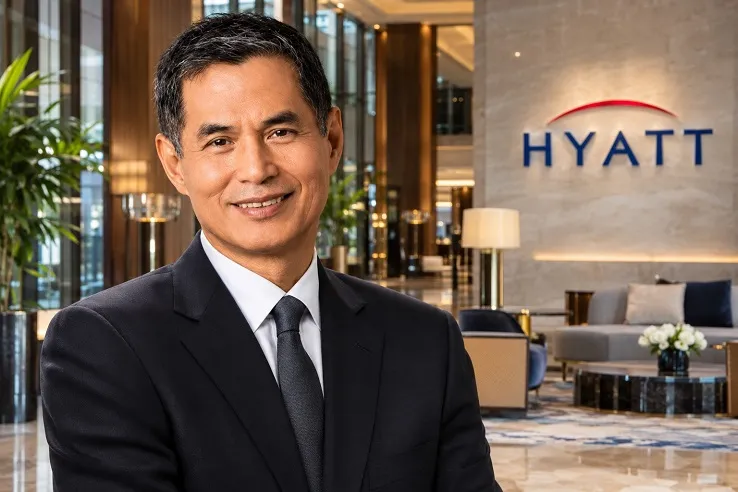
Image Credit: Hyatt Hotels
Announced from Hyatt’s Chicago headquarters on November 2, 2026, the appointment takes effect January 1, 2027, immediately after Udell relinquishes his executive responsibilities on December 31. Covering markets from Greater China to Southeast Asia, India, and Oceania, this Thailand Hotel News report examines a succession that arrives amid contrasting regional performance, ambitious luxury expansion, and intensifying competition for hotel investors.
Stephen Ho Takes Charge of a Hospitality Powerhouse
Ho currently serves as Hyatt’s President, Greater China & Growth, Asia Pacific, bringing more than four decades of international hospitality experience to his new responsibilities.
Before joining Hyatt in 2018, he served as President, Asia Pacific, at Starwood Hotels & Resorts and subsequently as CEO, Greater China, at Marriott International.
His appointment places an executive with extensive regional knowledge at the center of Hyatt’s expansion strategy.
Ho acknowledged Udell’s contributions while expressing confidence in the opportunities ahead for hotel owners, employees, guests, and surrounding communities.
Hyatt has not yet announced who will replace Ho in his existing Greater China leadership position.
David Udell Leaves Behind an Extraordinary Legacy
Few hospitality executives can claim a career spanning as many transformative decades as Udell.
His journey began in Singapore in 1982, when he joined Hyatt as a corporate management trainee after graduating from Cornell University’s hotel school.
Following operational assignments across Asia, he became the inaugural general manager of the legendary Park Hyatt Tokyo, subsequently leading Grand Hyatt Hong Kong and undertaking further assignments in Bangkok and Seoul.
He assumed responsibility for Hyatt’s Asia-Pacific business in July 2014, overseeing significant luxury development and strengthening relationships with regional property owners.
Hyatt Chairman, President and CEO Mark Hoplamazian credited Udell’s strategic leadership and longstanding partnerships with helping drive the region’s commercial success.
Importantly, Udell is not leaving Hyatt entirely. Beginning January 2027, he will serve as Senior Advisor, mentoring emerging hospitality leaders and supporting the company’s luxury ambitions.
Regional Performance Reveals Striking Differences
Ho inherits a substantial business operating across markets with markedly different economic conditions.
At the end of 2025, Hyatt’s Asia-Pacific portfolio comprised approximately 370 hotels and 89,600 rooms, excluding all-inclusive resorts.
Third-quarter 2026 figures reveal particularly strong momentum outside Greater China.
Comparable revenue per available room, commonly called RevPAR, increased 10.8% across Asia-Pacific excluding Greater China, outperforming every other Hyatt region.
Greater China recorded considerably slower growth of 2.1%, while Hyatt’s worldwide average reached 7.2%.
RevPAR combines occupancy and average room rates, making it an important indicator of hotel operating performance.
These differences highlight the challenges awaiting Ho as he balances opportunities in rapidly expanding destinations against comparatively subdued conditions in China.
Meanwhile, Hyatt reported a 21.9% increase in incentive management fees during the quarter, supported partly by Asia-Pacific performance.
Luxury Expansion Remains a Major Priority
Luxury hospitality will remain central to Hyatt’s regional strategy.
In July 2025, the company outlined plans for nearly 90 luxury and lifestyle hotel openings across Asia-Pacific over five years.
Among the notable developments is Park Hyatt Phu Quoc, scheduled to welcome guests in Vietnam on December 18, 2026.
Japan is preparing for its first Alila property, Alila Sengokuhara Hakone, expected to open in 2028.
Malaysia has already gained a striking luxury landmark through Park Hyatt Kuala Lumpur, occupying the upper floors of the Merdeka 118 skyscraper.
Meanwhile, the celebrated Park Hyatt Tokyo reopened in late 2025 following extensive renovations.
Shanghai’s Andaz Shanghai ITC, which opened February 3, 2026, further demonstrates Hyatt’s lifestyle expansion.
These properties illustrate how Hyatt is pursuing affluent travelers through distinctive architecture, premium experiences, and carefully positioned brands.
What the Leadership Change Means for Thailand and Asia
For Thailand’s hospitality industry, the appointment is particularly relevant because Hyatt’s regional decisions influence hotel development, investment partnerships, and luxury positioning throughout Southeast Asia.
Ho must preserve relationships with property owners while identifying opportunities across markets experiencing different demand patterns.
His experience with three major international hospitality groups provides valuable insight into these challenges.
Retaining Udell as an adviser should also help maintain institutional knowledge during the transition.
Ultimately, Hyatt’s leadership reshuffle represents more than an executive retirement. It places an experienced regional operator in charge of a substantial hospitality business at a pivotal moment for Asian tourism. Whether Ho can sustain luxury expansion, strengthen owner confidence, and narrow regional performance differences will help determine Hyatt’s next chapter across Asia-Pacific.
For more on Hyatt Hotels, visit:
https://www.hyatt.com/brands/hyatt