

Key points
- Hotels across Northern Thailand, particularly in Chiang Rai and Chiang Mai, are facing growing uncertainty as alarming reports of arsenic and heavy-metal contamination in regional waterways circulate widely online.
- On November 19, the PWA and Chiang Rai Hotel Association presented water quality findings at the Wang Kham water treatment plant.
- Further inspections on November 20 reportedly found no detectable arsenic in drinking water samples examined at selected Chiang Rai hotels, including The Riverie by Katathani and San Hotel.
Hotels across Northern Thailand, particularly in Chiang Rai and Chiang Mai, are facing growing uncertainty as alarming reports of arsenic and heavy-metal contamination in regional waterways circulate widely online. Over the past 48 hours, concerns about potentially contaminated water and food have reportedly prompted room cancellations, postponed reservations, and hesitation among prospective visitors despite the coming Yipeng festivities in the Northern provinces. The situation is creating fresh anxiety for hospitality operators as the region approaches its important year-end tourism season.
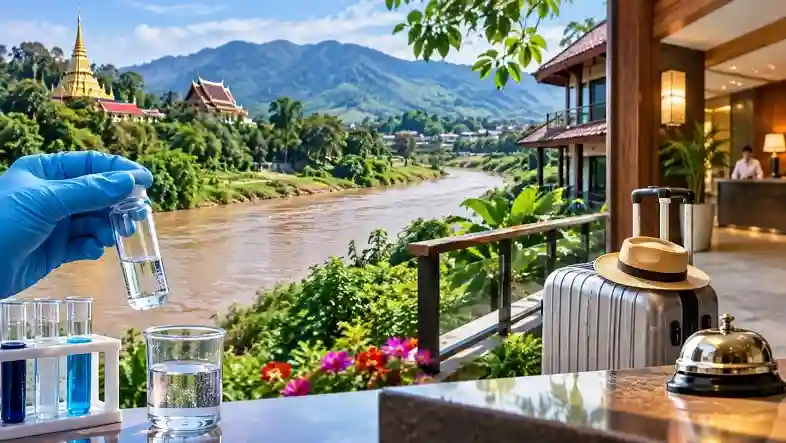
Image Credit: Thailand Hotel News
Although the contamination concerns primarily involve rivers in Chiang Rai, the resulting publicity is affecting perceptions of Northern Thailand more broadly. In Chiang Mai, reports of booking cancellations have also emerged, although their scale has yet to be independently established. Against this backdrop, this Thailand Hotel News report examines how fears surrounding water safety are influencing travel decisions despite official assurances that treated tap water supplied by the Provincial Waterworks Authority (PWA) meets established safety standards.
Chiang Rai Hotels Report Cancellations and Booking Delays
The Chiang Rai Hotel Association has acknowledged that contamination fears are beginning to affect visitor confidence, with some hotels reporting cancellations now reaching to approximately 12% of their reservations.
While this percentage remains small, larger establishments have encountered another worrying development. Some properties reportedly have more than 150 rooms awaiting booking confirmation as prospective guests delay their travel decisions.
Suwanna Pinsuwan, secretary of the Chiang Rai Hotel Association, said operators were closely monitoring developments and maintaining regular communication with water authorities.
The uncertainty is particularly concerning because Chiang Rai depends heavily on tourism-related spending, including accommodation, restaurants, transportation, and local attractions.
Chiang Mai Hospitality Sector Also Faces Growing Anxiety
The controversy is no longer confined to Chiang Rai. Reports circulating online have raised concerns among travelers considering Chiang Mai and other northern destinations, potentially affecting reservation decisions across the region.
However, verified figures detailing cancellations in Chiang Mai during the past 48 hours remain unavailable.
Importantly, contamination concerns involving Chiang Rai’s rivers should not be interpreted as evidence that Chiang Mai’s municipal drinking water or food supplies are unsafe.
Nevertheless, widespread online discussion can influence travel behavior even when the available scientific evidence does not establish a direct health risk at a particular destination.
Water Authorities Confirm Treated Supplies Meet Safety Standards
On November 19, the PWA and Chiang Rai Hotel Association presented water quality findings at the Wang Kham water treatment plant.
Nimit Pinthanee, manager of the PWA’s Chiang Rai branch, confirmed that arsenic concentrations in treated tap water remained within prescribed safety limits.
The authority conducted 48 water quality tests during 2025 and has continued monitoring throughout 2026, undertaking four assessments monthly through central and internal laboratories.
Officials explained that raw water drawn from the Kok River undergoes chemical treatment, sedimentation, filtration, and disinfection before distribution.
Daily arsenic screening using MU Test Kits provides additional monitoring.
Further inspections on November 20 reportedly found no detectable arsenic in drinking water samples examined at selected Chiang Rai hotels, including The Riverie by Katathani and San Hotel.
These findings offer reassurance but do not establish that every water source throughout the province is equally safe.
Community Water Systems Remain a Significant Concern
One important distinction involves households outside the PWA distribution network.
The authority supplies more than 82,000 households, while Chiang Rai province contains over 500,000 households overall.
Many residents consequently depend on community-managed water systems operating under different administrative arrangements.
Although the PWA can provide technical assistance, it does not directly supervise these independent facilities.
This creates an urgent need for broader testing, transparent reporting, and consistent water quality standards across communities.
Cross-Border Pollution Raises Questions About Long-Term Safety
Concerns surrounding the Kok, Sai, and Ruak rivers have intensified amid reports linking heavy-metal pollution to mining activities across the Myanmar border.
The controversy extends beyond drinking water because potential contamination of agricultural land, irrigation supplies, and food production could carry wider economic consequences.
Authorities have reportedly expanded attention to agricultural products, including rice, while considering sediment-control measures.
However, fears about contaminated food should not be confused with confirmed evidence that food sold throughout Northern Thailand is unsafe.
Hotel representatives are urging government agencies to investigate pollution sources and implement lasting preventive measures rather than relying exclusively on downstream treatment.
Restoring Confidence Before Tourism Suffers Further Damage
Northern Thailand’s hospitality industry now faces the challenge of separating documented contamination risks from exaggerated perceptions circulating online. Although official testing provides reassurance about treated municipal water, authorities must address concerns involving untreated rivers, community supplies, and agricultural exposure.
Transparent scientific monitoring, coordinated government action, and timely public communication will be essential to protecting residents while preventing unnecessary damage to tourism. Without credible long-term solutions, even relatively modest cancellations could develop into a more serious economic problem for hotels and surrounding communities.
Read Also: