

Key points
- Bangkok authorities have launched a major crackdown on allegedly illegal hotel operations and foreign-linked business networks in the capital’s Huai Khwang area, uncovering three hotels that officials said were unable to produce valid hotel business licenses.
- Officials said employees and translators were present during the inspection, while the hotel operator was identified as a Chinese national residing in China.
- During the inspection, authorities said reception staff and those operating the property were unable to produce a valid hotel business license.
Bangkok authorities have launched a major crackdown on allegedly illegal hotel operations and foreign-linked business networks in the capital’s Huai Khwang area, uncovering three hotels that officials said were unable to produce valid hotel business licenses. The August 9 operation, led by Deputy Interior Minister Polpeera Suwannachawi, also exposed suspected nominee arrangements, foreign-worker violations, concerns over building and fire safety, and allegations that payments had been made to government officials to allow certain businesses to continue operating.
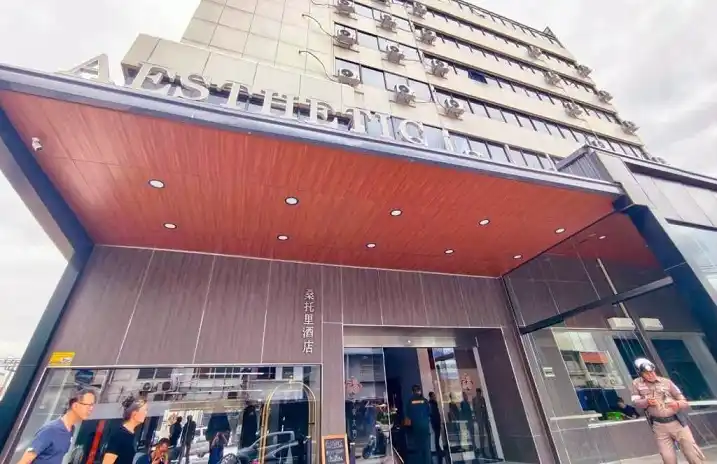
Image Credit: Ministry of Interior
The multi-agency operation brought together officials from the Department of Provincial Administration, Immigration Bureau, Department of Business Development, Department of Employment and Department of Special Investigation, or DSI. Authorities carried out surprise inspections of hotels, restaurants, barber shops and other establishments following complaints and information received from residents about potentially unlawful business activities. During the inspections, this Thailand Hotel News report notes that investigators found issues extending well beyond hotel licensing, prompting officials to examine company ownership structures, employment practices, financial transactions and possible corruption involving public officials.
Three Bangkok Hotels Unable to Produce Valid Licenses
Among the most significant discoveries were three hotels that authorities said could not produce valid hotel business licenses during the inspections.
The first property inspected was Haiman Hotel on Soi Pracha Uthit 6 in Huai Khwang District. According to information obtained during the operation, the hotel has 34 rooms, with room rates ranging from approximately 1,120 baht to 1,450 baht per night.
https://th.trip.com/hotels/bangkok-hotel-detail-130513761/haiman-hotel
The property is operated by Haiman International Co., Ltd., whose shareholding was reported as 51% Thai and 49% Chinese. Officials said employees and translators were present during the inspection, while the hotel operator was identified as a Chinese national residing in China.
When authorities requested documentation, the operator was reportedly unable to present a valid hotel business license. Officials subsequently collected evidence for further investigation and possible legal proceedings.
The inspection also uncovered five foreign workers who authorities said were violating employment regulations, including working outside the scope permitted under their documentation and failing to notify the registrar about changes involving their employer or workplace within the legally required period. Department of Employment officials took action against the workers under the applicable laws.
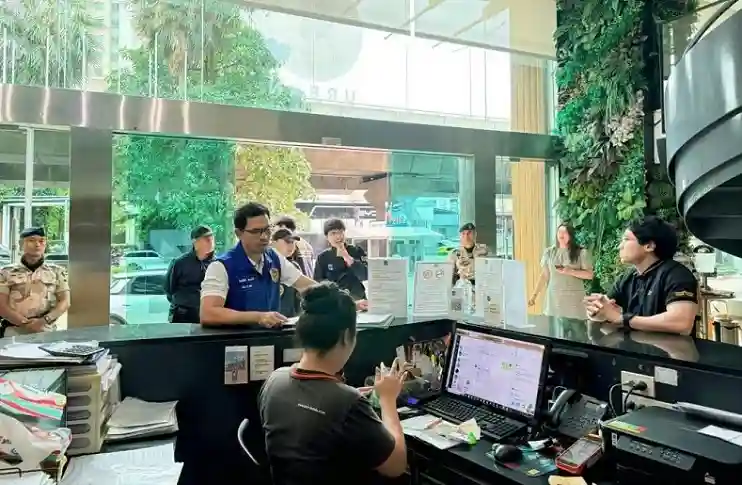
Image Credit: Ministry of Interior
Zazz Urban Bangkok Hotel Also Comes Under Scrutiny
The second property inspected was Zazz Urban Bangkok Hotel on Rama 9 Road in Huai Khwang District.
The hotel has 48 guest rooms, with reported nightly rates ranging from around 1,000 baht to 3,000 baht. The property is operated by GNC Group Co., Ltd., with company registration documents identifying Piyamat Udomprasertkul and Lin Chih-Chao Shawn as directors.
During the inspection, authorities said reception staff and those operating the property were unable to produce a valid hotel business license.
Evidence was collected at the premises, and authorities said the investigation would be expanded to determine whether additional legal violations had occurred.
Aesthetic Hotel Becomes Third Property Investigated
The third hotel identified during the operation was Aesthetic Hotel, located at 169 Sutthisan Winitchai Road in Samsen Nai Subdistrict, Phaya Thai District.
https://www.agoda.com/aesthetic-hotel/hotel/bangkok-th.html
The property reportedly contains approximately 52 rooms spread across seven floors and operates on a daily accommodation basis. It is operated by Zhenyi Group Co., Ltd., with Apiwan Maenketmai identifying herself to officials as a company director.
Authorities again requested a hotel business license but said the required valid documentation could not be presented. Evidence was therefore collected for further investigation and potential legal proceedings.
The discovery of three properties allegedly operating without the required hotel licenses is particularly significant for Bangkok’s accommodation sector, where licensed operators are required to comply with regulatory requirements covering not only business operations but also building standards and guest safety.
Fire Escapes and Emergency Systems Raise Safety Concerns
Licensing was not the only hotel-related concern uncovered during the operation.
Officials examining the interior of one targeted hotel reported potentially serious deficiencies involving fire escapes, emergency exits and fire-prevention systems.
According to the Deputy Interior Minister, these systems did not meet standards required under relevant administrative and building-control regulations.
Authorities warned that inadequate emergency infrastructure could have severe consequences if a fire or another emergency occurred, potentially making it difficult for hotel guests and employees to evacuate safely.
Such findings add a significant public-safety dimension to the investigation. While operating without the appropriate hotel license is a regulatory issue, deficiencies involving fire escapes and emergency exits can directly affect the lives of guests, employees and other people inside a building.
Sixteen Foreign Workers Found in Violation of Regulations
The wider inspection also focused heavily on foreign employment.
Authorities said inspections of entertainment venues, hotels, restaurants, barber shops and other establishments uncovered violations involving four employers or establishments and 16 foreign workers under Thailand’s Foreign Workers Management Act B.E. 2560 (2017).
At one hotel, five Myanmar workers were reportedly found working in violation of employment requirements. A subsequent inspection around Thiam Ruammit Road identified another 11 foreign workers, including nine Myanmar nationals and one Chinese national, as well as one person whose registration status was reported as irregular.
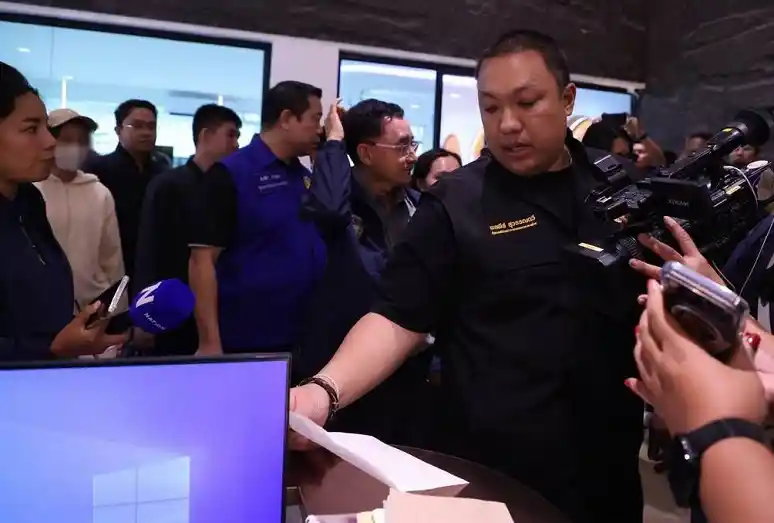
Deputy Interior Minister inspecting the documents of a hotel at Huai Khwang area
Image Credit: Ministry of Interior
Officials said many of the cases involved working without appropriate permission or other breaches of employment regulations. Concerns were also raised about foreigners allegedly performing occupations legally reserved for Thai citizens.
Those facing allegations were transferred for the appropriate legal proceedings, with authorities indicating that investigations into employers and establishments would continue.
Suspected Nominee Structures Draw Greater Attention
One of the most consequential elements of the crackdown involves allegations that Thai nationals may have been used as nominees in businesses effectively controlled by foreign investors.
Investigators examining the ownership structure of certain businesses found arrangements in which Chinese nationals reportedly held 49% of shares while 51% were registered under the name of a Thai spouse.
Officials said questioning in one case raised further suspicions when the Thai woman registered as a shareholder appeared to have little or no knowledge about share payments, the establishment of the company or its management.
Authorities are consequently investigating whether such structures were legitimate or whether Thai shareholders were being used as nominees to circumvent restrictions applicable to foreign businesses.
Information obtained during the investigation also pointed authorities toward an accounting firm and a law office that may have been connected with establishing the corporate arrangements. Officials said those connections require further investigation before responsibility can be determined.
Alleged Bribery Claims Emerge During Raid
The operation took an even more serious turn when allegations emerged that some business operators had been making payments to people claiming connections with government agencies.
During the inspections, a business operator reportedly attempted to contact people by telephone in an effort to “clear” the situation. Claims were allegedly made about connections with officials in Huai Khwang and members of the Immigration Bureau.
Even more significantly, the caller was said to have claimed that payments were being made in installments involving several establishments.
Polpeera ordered the Department of Provincial Administration to investigate the allegations, including tracing telephone numbers and establishing the identities of individuals whose names or official connections were mentioned.
Authorities are expected to determine whether the people cited were genuine government officials, individuals falsely claiming official connections, intermediaries, or other parties.
The Deputy Interior Minister stressed that if evidence shows government personnel accepted bribes or used their positions to facilitate illegal business operations, those responsible could face both disciplinary and criminal proceedings.
Land Ownership and Financial Trails Face Investigation
The investigation is now expanding into land ownership and financial transactions connected with the businesses under scrutiny.
The Land Department is being asked to examine property ownership and land holdings associated with the investment groups. If investigators determine that land has been acquired illegally through nominee arrangements or in violation of Thai law, authorities have warned that rights could be revoked and the land could ultimately be forced into sale through the applicable legal process.
Financial transactions are also attracting attention.
Officials reported discovering QR codes linked to online gambling websites during related investigations, along with payment systems in which money was allegedly not deposited into Thai bank accounts. The use of foreign food-delivery platforms has also prompted questions surrounding business registration and taxation.
These financial trails could become an important part of determining how the businesses were structured, where revenues were being directed and whether additional Thai laws were breached.
Crackdown Expected to Expand Beyond Bangkok
Authorities have made clear that the Huai Khwang operation is not intended to be an isolated enforcement exercise.
Polpeera said investigations would eventually expand beyond Bangkok to other provinces, with officials using public complaints, information from local representatives, online advertisements and financial records to identify suspicious establishments.
Online platforms advertising hotels, businesses or services operating outside legal requirements are expected to receive greater scrutiny, while investigators will also follow payment trails and corporate structures where there are indications of foreign nominee arrangements.
The operation therefore carries potentially significant implications for Thailand’s hospitality sector. Legitimate hotel operators invest considerable resources in licensing, building compliance, employment documentation, taxation, fire protection and other regulatory requirements. Authorities pursuing unlicensed properties may consequently argue that enforcement is necessary not only for legal compliance but also to protect guests and prevent properly registered operators from being placed at a competitive disadvantage.
The Huai Khwang raids have now developed into a much broader investigation involving hotel licensing, foreign employment, suspected nominee companies, property ownership, financial transactions, building safety and alleged corruption. The eventual significance of the operation will depend on what investigators can substantiate and whether evidence supports the allegations raised during the raids. For Thailand’s hotel industry, however, the case is already a strong indication that licensing, ownership structures, worker documentation and guest-safety compliance are receiving increasingly coordinated scrutiny from multiple government agencies. Authorities have signaled that similar investigations could follow elsewhere in the country, meaning hotel and accommodation operators will likely face greater pressure to ensure that every aspect of their businesses complies with Thai law.