

Key points
- Thailand’s hotel industry is facing growing uncertainty as the economic ripple effects of the escalating conflict in the Middle East begin to affect tourism, employment, and business confidence across the Kingdom.
- Fresh insights released by the Bank of Thailand (BOT) indicate that while the country’s overall labor market remains relatively stable, the hotel sector has emerged as one of the industries experiencing increasing pressure, with many operators responding by reducing their workforce as international travel patterns shift.
- Thailand’s hotel sector faces mounting employment pressures as the Bank of Thailand warns that the Middle East conflict is beginning to weigh heavily on tourism and workforce stabilityImage Credit.
Thailand Hotel News: Hotels Feel the Pressure as Global Conflict Reaches Thailand’s Tourism Economy
Thailand’s hotel industry is facing growing uncertainty as the economic ripple effects of the escalating conflict in the Middle East begin to affect tourism, employment, and business confidence across the Kingdom. Fresh insights released by the Bank of Thailand (BOT) indicate that while the country’s overall labor market remains relatively stable, the hotel sector has emerged as one of the industries experiencing increasing pressure, with many operators responding by reducing their workforce as international travel patterns shift.
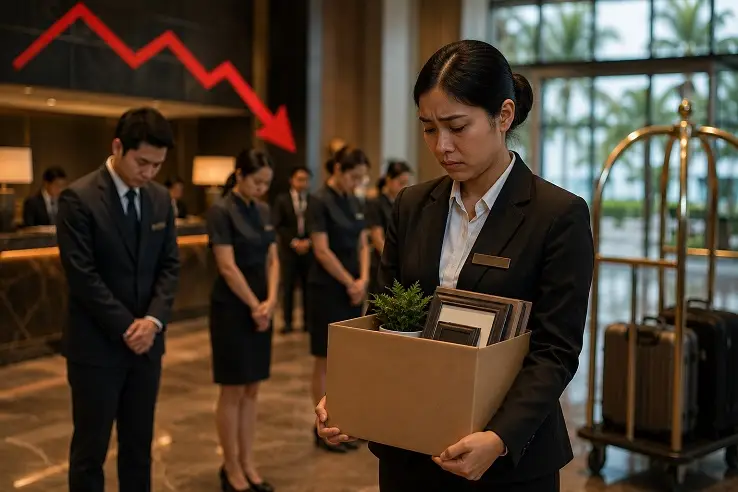
Image Credit: Thailand Hotel News
The latest assessment from the central bank highlights that the impact of the conflict extends well beyond energy prices and global financial markets. As travel demand from several key markets softens and operational costs remain elevated, this Thailand Hotel News report finds that hotel businesses are being forced to reassess staffing requirements in an effort to control expenses while maintaining financial sustainability. Industry observers note that uncertainty surrounding international travel has encouraged some travelers to delay holidays, while others are choosing destinations perceived to involve lower travel risks, placing additional pressure on tourism-dependent economies such as Thailand.
Bank of Thailand Monitors Employment Trends
According to Ms. Pranee Sutthisri, Senior Director of the Macroeconomic Department at the Bank of Thailand, the country’s overall labor market remained generally stable during May 2026. Data showed that the number of insured workers under Section 33 of Thailand’s Social Security system reached approximately 12.2 million people, representing a modest monthly increase of 0.2 per cent.
The employment index has continued its gradual upward trend since early 2023, suggesting that the broader labor market has not yet experienced widespread disruption. However, beneath these encouraging national figures, sector-specific data paints a more challenging picture for industries closely linked to tourism and transportation.
Although the Social Security Office is still updating detailed employment statistics for individual sectors, additional data reviewed by the Bank of Thailand indicates that employment levels in hotels and transportation businesses have begun to decline. These sectors are among the first to feel the consequences whenever international travel demand weakens due to geopolitical instability.
Hotel Businesses Respond with Cost-Cutting Measures
Thailand’s hospitality industry has endured a series of external shocks over recent years, from the global pandemic to inflationary pressures and fluctuating international visitor numbers. The latest geopolitical tensions have introduced yet another layer of uncertainty for hotel operators already navigating a highly competitive marketplace.
Hotel owners are increasingly reviewing labor costs as occupancy levels fluctuate. While many businesses continue attempting to retain experienced employees wherever possible, some have little choice but to reduce staffing levels, delay new hiring, or implement more flexible workforce arrangements until market conditions improve.
Industry analysts suggest that the reduction in hotel employment reflects cautious business planning rather than widespread panic. Employers are seeking to balance operational efficiency with maintaining service standards, particularly as booking patterns become more unpredictable amid ongoing international tensions.
Technology Continues to Reshape Hotel Employment
Beyond the immediate impact of the Middle East conflict, the Bank of Thailand also pointed to longer-term structural changes affecting Thailand’s labor market.
The central bank observed that newly established factories increasingly rely on automation and advanced machinery instead of traditional labor-intensive production methods. While this finding relates primarily to manufacturing, the broader trend toward automation is also becoming increasingly relevant within the hospitality industry.
Many hotels have already introduced self-service check-in kiosks, mobile room keys, automated reservation systems, artificial intelligence-powered customer service tools, and digital housekeeping management platforms. These technologies improve operational efficiency while reducing reliance on manual administrative tasks.
Rather than expecting sudden large-scale job losses, the Bank of Thailand believes automation will continue replacing certain routine functions gradually over time. The more significant challenge will be ensuring existing employees develop new skills that allow them to work alongside evolving technologies rather than being displaced by them.
Upskilling Becomes Increasingly Important
The Bank of Thailand has encouraged businesses, employees, and educational institutions to work together in strengthening workforce capabilities.
Officials believe that improving digital literacy, technological skills, customer service expertise, and operational flexibility will help hotel employees remain competitive in an industry undergoing rapid transformation. Staff capable of combining personalized hospitality with modern technology are expected to remain highly valuable as hotels continue modernizing their operations.
Training initiatives focused on digital systems, revenue management, multilingual communication, and guest experience enhancement may help displaced workers secure new opportunities while supporting Thailand’s long-term tourism competitiveness.
The central bank also emphasized that improving workforce productivity should not be viewed simply as replacing people with machines. Instead, businesses should focus on enabling employees to work more effectively alongside technology, ultimately increasing both productivity and income potential.
The outlook for Thailand’s hotel industry will largely depend on how quickly geopolitical tensions ease and international travel confidence returns. Until then, many accommodation providers are expected to remain cautious with staffing decisions while continuing to invest in technologies that enhance operational efficiency. Although the broader labor market has so far demonstrated resilience, the challenges facing hotels serve as a reminder of how closely Thailand’s tourism economy remains connected to global events. Continued cooperation between government agencies, industry leaders, employers and workers will be essential to help safeguard employment, strengthen business resilience and position the country’s hospitality sector for a stronger recovery once international travel conditions stabilize.
For the latest on the Thai hospitality industry, keep on logging to Thailand Hotel News.