

Key points
- Chinese investment in Northeast Thailand’s hotel sector is growing as the Thai-Chinese high-speed railway increases the strategic value of Udon Thani, Nong Khai, Khon Kaen and Nakhon RatchasimaImage Credit.
- This Thailand Hotel News report focuses on concerns surrounding hotel acquisitions and the ownership structures being used as foreign capital targets properties in cities expected to benefit from the railway.
- Authorities therefore need to establish who provides the money for acquisitions, who actually controls the business, who owns the land and whether Thai shareholders are genuine investors or are holding shares on behalf of foreigners.
Chinese Capital Moves into Northeast Thailand
Chinese investment is expanding across Northeastern Thailand, with growing interest in hotels and property in Udon Thani, Nong Khai, Khon Kaen and Nakhon Ratchasima. The four cities are strategically positioned along or near the Thai-Chinese high-speed railway corridor, making them increasingly attractive to investors anticipating stronger tourism, trade and property demand.
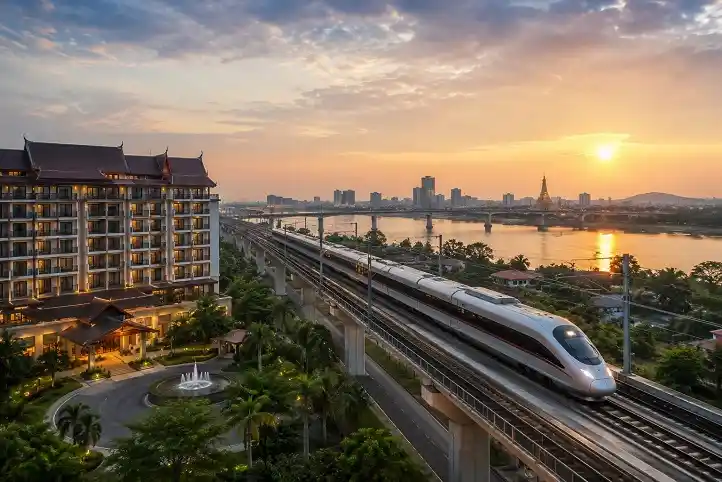
Image Credit: Thailand Hotel News
The movement represents a shift beyond Bangkok, major tourism destinations and the Eastern Economic Corridor. Chinese investors are increasingly looking toward the Northeast, where infrastructure development could substantially increase commercial opportunities and land values. In particular, this Thailand Hotel News report focuses on concerns surrounding hotel acquisitions and the ownership structures being used as foreign capital targets properties in cities expected to benefit from the railway.
Hotels Becoming Attractive Acquisition Targets
Small and medium-sized hotels are attracting particular interest, especially properties whose owners face liquidity problems or are considering selling. Acquiring an existing hotel provides an investor with an operating business, established accommodation inventory and access to potentially valuable real estate.
Chinese capital has already entered businesses and joint ventures across Northeastern Thailand, with Nakhon Ratchasima attracting significant attention. Udon Thani and Khon Kaen are also becoming more appealing investment locations, while Nong Khai offers the additional advantage of being Thailand’s gateway to Laos and, ultimately, China.
The issue now facing authorities is whether some hotel acquisitions involve ownership arrangements designed to circumvent Thai restrictions on foreign business activities and land ownership.
Nominee Ownership Raises Concerns
Thailand has previously investigated cases involving foreigners allegedly using Thai nominee shareholders to control businesses, companies and property.
The hotel sector requires particular scrutiny because ownership can involve several components: the hotel operating company, the building and the land beneath the property.
Authorities therefore need to establish who provides the money for acquisitions, who actually controls the business, who owns the land and whether Thai shareholders are genuine investors or are holding shares on behalf of foreigners.
Foreign investment itself is not the problem. Chinese investors operating legally can contribute capital, renovate ageing properties and create employment. The concern is investment structured specifically to bypass Thai laws.
High-Speed Railway Changes the Investment Landscape
Much of the growing interest is connected to the Thai-Chinese high-speed railway, which is designed to eventually connect Bangkok with Nong Khai before linking with the railway network through Laos toward China.
Phase One covers approximately 253 kilometers between Bangkok and Nakhon Ratchasima, with trains designed to operate at speeds of up to 250 kilometers per hour. Important stops include Krung Thep Aphiwat, Don Mueang, Ayutthaya, Saraburi, Pak Chong and Nakhon Ratchasima.
Construction has moved beyond the halfway point, with completion targeted around the end of the decade. Major engineering works include elevated sections and tunnels through the mountainous areas around Pak Chong and Muak Lek.
For the hospitality industry, improved connectivity could increase hotel demand while pushing up the value of strategically located land around railway stations and commercial districts.
Phase Two Extends Toward Nong Khai
The second phase will extend approximately 357 kilometers from Nakhon Ratchasima to Nong Khai and carries an estimated investment cost of around 341.35 billion baht.
Construction is expected to progress from 2027, with completion targeted around 2031. Once developed, the line will create a high-speed transport spine running deep into Northeastern Thailand toward the Laos border.
Nong Khai could become particularly important because it sits opposite Vientiane across the Mekong River. The existing Laos-China Railway has already strengthened connectivity between Laos and China, increasing the strategic significance of completing Thailand’s railway connection to the border.
Four Cities to Watch
Nakhon Ratchasima stands to benefit as the terminus of Phase One and the starting point of Phase Two. Khon Kaen already functions as a major commercial, educational, healthcare and convention Centre, while Udon Thani serves as an important economic hub for the upper Northeast.
Nong Khai has the additional advantage of its border position and could eventually become one of Thailand’s most important railway gateways to Laos and China.
These advantages explain why hotels in the four cities are becoming increasingly attractive investment assets. Investors purchasing properties before the railway becomes fully operational could benefit considerably if tourism, passenger movements and property prices increase.
Hotel Ownership Faces Greater Scrutiny
The expansion of Chinese investment into Udon Thani, Nong Khai, Khon Kaen and Nakhon Ratchasima is likely to reshape the Northeast’s hotel market as the high-speed railway advances. Hotels close to transport hubs and commercial areas could become increasingly valuable, intensifying competition for existing properties.
Thai authorities will therefore need to closely examine funding sources, corporate structures, beneficial ownership and landholding arrangements behind hotel acquisitions. Foreign investment can contribute significantly to regional development, but illegal nominee structures that allow foreigners to circumvent Thai ownership restrictions must be addressed. With the railway promising closer economic integration between Thailand, Laos and China, the battle for strategically located hotel and property assets across the Northeast is likely to intensify considerably over the coming years.