

Key points
- Thai authorities are intensifying scrutiny of foreign-linked hotels, property businesses and corporate structures on Koh Phangan and Koh Samui amid investigations into suspected nominee ownership, unlicensed accommodation operations and alleged schemes that may allow tourism revenue to leave Thailand without being properly accounted for.
- The expanding enforcement campaign comes as officials examine dozens of companies and substantial property holdings in Surat Thani Province, while separate social-media allegations have raised questions about a Koh Phangan hotel owned by an Israeli reportedly accepting or transferring revenue through cryptocurrency.
- The supplied case information links the investigation to allegations involving an unlicensed hotel or resort operation, Thai nominee shareholders and a multimillion-baht cannabis investment fraud involving French victims.
Thai authorities are intensifying scrutiny of foreign-linked hotels, property businesses and corporate structures on Koh Phangan and Koh Samui amid investigations into suspected nominee ownership, unlicensed accommodation operations and alleged schemes that may allow tourism revenue to leave Thailand without being properly accounted for. The expanding enforcement campaign comes as officials examine dozens of companies and substantial property holdings in Surat Thani Province, while separate social-media allegations have raised questions about a Koh Phangan hotel owned by an Israeli reportedly accepting or transferring revenue through cryptocurrency. Authorities have stressed through their investigations that foreign investment itself is not the target; rather, enforcement is focused on arrangements suspected of circumventing Thai ownership, licensing, employment and taxation laws.
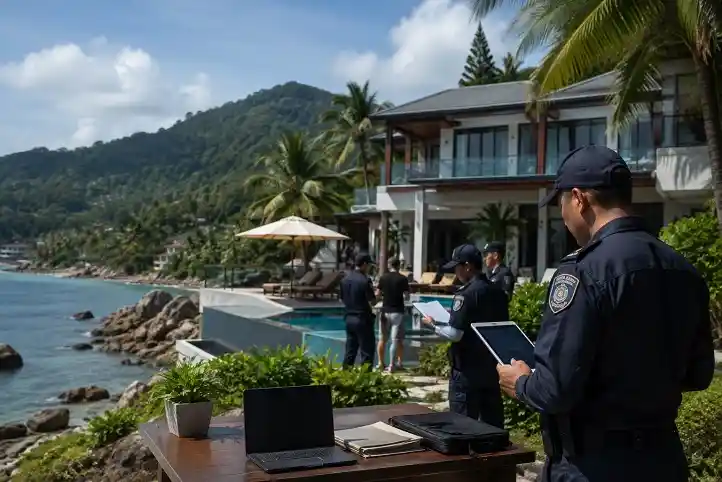
Image Credit: Thailand Hotel News
The renewed attention comes at a particularly sensitive time for Thailand’s island tourism economy, where hotels, villas and other accommodation businesses compete for a lucrative international market. Questions are increasingly being asked about whether some foreign-controlled businesses are operating on an equal legal footing with licensed Thai and international operators that pay taxes, obtain permits and comply with employment regulations. In the midst of growing scrutiny, this Thailand Hotel News report examines both the large-scale official crackdown and separate allegations involving cryptocurrency payments, while distinguishing between matters documented by investigators and claims that have yet to be officially substantiated. The wider operation involves multiple government agencies examining suspected nominee structures and possible violations of the Foreign Business Act and hotel licensing requirements.
More Than 300 Officials Mobilized in Surat Thani
The government’s latest action, described as “Operation Dismantle Foreign Nominee Network Phase 7,” brought together more than 300 personnel and involved senior police, immigration, provincial and business-regulation officials.
The operation builds on investigations associated with what authorities have called the “Koh Phangan Model.” According to information released about the investigation, officials inspected 12,906 companies on Koh Samui and identified 8,254 with foreign shareholders. Of these, 875 were initially suspected of potentially using Thai nominees, with further inquiries narrowing the focus to 59 companies.
Those 59 companies collectively controlled 37 plots of land and buildings covering more than 31 rai, with their estimated value placed at approximately 1.2 billion baht. The investigation has generated 60 cases involving 88 suspects, including 26 Thai nationals and 62 foreigners.
The Koh Samui Provincial Court issued 37 search warrants, and authorities reported 14 arrests at the stage described in the supplied information. Those arrested included nationals of China, Britain, Italy, France, the Netherlands, Austria, the Philippines and the United States.
Israeli-Linked Network Among Five Groups Investigated
Investigators have focused on five principal business networks employing differing corporate models.
One, identified by authorities as the “Galp-Tree” network, is Israeli-linked and comprises 19 companies. Investigators allege that it used a multilayered corporate structure involving Thai nominees. Businesses connected with the network were also linked to unlicensed preschool childcare activities and the purchase, development, rental and sale of luxury villas to foreign customers.
A second network consists of four German-linked companies associated with real estate and luxury villa construction on steep mountain terrain. Officials are examining construction permissions, changes to nominee-company shareholding structures used in villa transactions and possible tax issues involving land transactions and corporate income.
Other investigations concern companies allegedly established to help foreigners obtain work permits or long-term business visas despite discrepancies between registered and actual activities. Another network under investigation originated from information supplied by the French Embassy concerning alleged investment fraud connected with a cannabis operation.
French Businessman and Unlicensed Accommodation Investigation
Separately, Surat Thani immigration authorities expanded an investigation involving 74-year-old French national Stephane Thierry Bastok. The supplied case information links the investigation to allegations involving an unlicensed hotel or resort operation, Thai nominee shareholders and a multimillion-baht cannabis investment fraud involving French victims.
Investigators allege that money connected with French victims was used through a structure involving Thai nominees to purchase land and develop a luxury property containing a swimming pool and tennis courts.
Another company was allegedly established to manage the property, with investigators examining whether lease arrangements concealed its actual ownership and commercial structure. The property was reportedly marketed online for daily accommodation at between 11,000 and 17,000 baht per night. Authorities said they could find no hotel operating license for the premises.
Koh Phangan Crypto Claims Raise New Questions
Alongside the official investigations, allegations circulated by the Facebook page “News1” have put another Koh Phangan accommodation business under the spotlight. The page alleged that foreigners had operated a hotel illegally for as long as four years and questioned whether revenue generated from tourists was being transferred overseas through online cryptocurrency transactions.
https://www.facebook.com/photo/?fbid=1575028881321737&set=a.630649625759672
https://www.facebook.com/photo/?fbid=1574982237993068&set=a.630649625759672
The cryptocurrency allegation is significant because it raises questions about taxation and whether tourism income generated in Thailand is being properly recorded. However, the supplied information explicitly notes that claims concerning crypto transfers and so-called “zero dollar” or “0 coin” operations remain unsubstantiated allegations. They should therefore not be treated as established evidence unless financial records, tax information and transaction trails are examined by the relevant authorities.
Similar concerns have surfaced on Koh Samui, where another social-media page alleged that a foreign-linked hotel had operated improperly for four years while continuing to receive normal water and electricity services. Those claims likewise remain allegations pending official verification of the hotel’s legal status, licensing and tax position.
Enforcement Campaign Could Spread Beyond the Islands
Officials have indicated that the Surat Thani operations are part of a wider national campaign. Across the previous six phases, investigators examined 238 companies and 272 land plots covering more than 184 rai, with land and buildings valued at approximately 2.839 billion baht. Authorities had also obtained 178 arrest warrants.
The Department of Business Development joined the latest multi-agency operation alongside the Department of Provincial Administration, Department of Lands, Department of Employment, Immigration Bureau and local authorities. Agencies are examining different potential offences within their respective jurisdictions, including suspected nominee ownership, Foreign Business Act violations, unlicensed hotels and illegal employment of foreign workers.
For Thailand’s hotel sector, the significance extends well beyond individual raids. Licensed operators invest heavily in permits, staff, taxes and regulatory compliance, and sustained enforcement against illegal nominee structures could help create a more transparent competitive environment. At the same time, allegations involving particular businesses or individuals must be tested through proper investigations rather than assumed to be proven. What happens next on Koh Phangan and Koh Samui will therefore be closely watched, especially as authorities follow corporate ownership, hotel licenses, taxation records and potentially complex financial trails.
For the latest on the hospitality industry in Samui and Koh Phangan, keep on logging to Thailand Hotel News.