

Key points
- Bangkok hotels are filling more rooms in 2026, but they are having to do so at lower average rates, exposing an increasingly important weakness in the capital’s hospitality market just as thousands of additional rooms prepare to enter the city.
- The city already had 156,402 hotel rooms at the end of the first half of 2026, yet another 17,500 rooms are in the pipeline, equivalent to 11.
- That strategy can work for an individual property in the short term, but when competing hotels follow the same approach, pricing pressure can spread across an entire segment.
Bangkok hotels are filling more rooms in 2026, but they are having to do so at lower average rates, exposing an increasingly important weakness in the capital’s hospitality market just as thousands of additional rooms prepare to enter the city.
During the first half of 2026, Bangkok’s average hotel occupancy increased to 76.2%, up 1.1% from the same period last year, but the improvement came alongside a 2.1% decline in average daily rate (ADR) to 4,012 baht. As a result, this Thailand Hotel News report notes that revenue per available room (RevPAR) slipped 0.6% to 3,055 baht, illustrating a market where hotels are succeeding in attracting guests but finding it considerably harder to translate that demand into stronger room revenue.
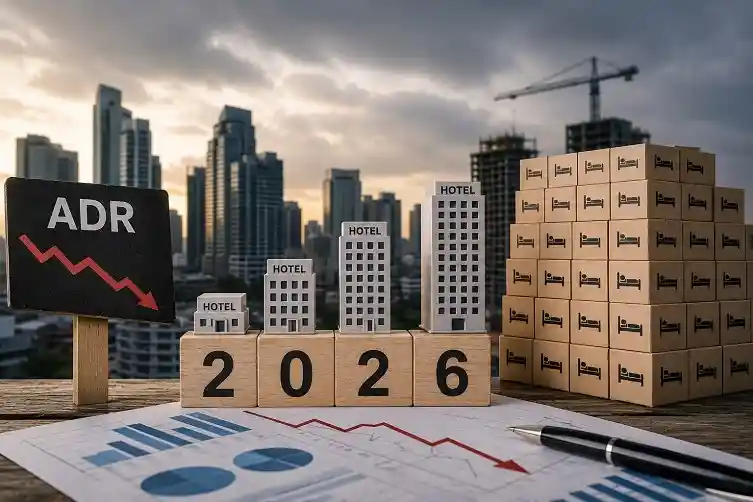
Image Credit: Thailand Hotel News
The figures are especially significant because Bangkok is approaching one of its largest periods of hotel supply growth in recent years. The city already had 156,402 hotel rooms at the end of the first half of 2026, yet another 17,500 rooms are in the pipeline, equivalent to 11.2% of current operational supply.
Much of that development is concentrated in luxury and upscale hotels, the very categories where competition is already becoming increasingly intense.
Phuket, meanwhile, is producing an almost opposite set of results. The island’s hotels recorded lower occupancy during the first half of the year, but ADR climbed strongly enough to deliver further RevPAR growth. The contrast provides a revealing picture of two major Thai hotel destinations entering the next development cycle with very different strengths and vulnerabilities.
Bangkok Hotels Are Selling More Rooms for Less
Bangkok’s 76.2% average occupancy during the first six months of 2026 would normally be interpreted as a positive indicator, particularly after increasing 1.1% year-on-year. The problem is that the improvement has not been accompanied by stronger pricing.
ADR fell 2.1% to 4,012 baht, while RevPAR declined 0.6% to 3,055 baht. In practical terms, hotels collectively improved the proportion of available rooms they sold but received less revenue for those rooms on average.
This points to one of the central issues confronting Bangkok hotels: limited pricing power.
As supply expands, hotels competing for similar guests have an incentive to adjust rates to protect occupancy and market share. That strategy can work for an individual property in the short term, but when competing hotels follow the same approach, pricing pressure can spread across an entire segment.
Hotels with strong brands, exceptional locations, distinctive designs or clearly differentiated guest experiences have more scope to resist discounting. Properties offering products that consumers consider interchangeable face a much greater risk of being pulled into direct price competition.
Online distribution has intensified that pressure because potential guests can compare rates, locations, reviews, facilities and inclusions across numerous hotels within seconds. The question is increasingly not simply whether a traveler likes a particular hotel, but whether its experience appears worth the premium compared with competing properties nearby.
Upscale Bangkok Hotels Face the Heaviest ADR Pressure
The differences become particularly clear when Bangkok’s performance is separated by hotel category.
Luxury hotels maintained an ADR of 7,010 baht during the first half, representing a modest 0.6% increase. Midscale hotels achieved a similarly small improvement of 0.4%, taking ADR to 2,151 baht.
Upscale hotels moved sharply in the other direction, with ADR falling 4.4% to 4,196 baht.
That decline deserves attention because upscale properties frequently occupy the most competitive part of the market. Guests have a large selection of branded and independent alternatives, and the differences between competing properties can appear relatively small when viewed through an online booking platform.
The situation becomes more significant when Bangkok’s existing hotel composition is considered. Approximately 63% of the capital’s hotel rooms are already positioned in the luxury and upscale segments.
Bangkok therefore does not have a shortage of higher-end accommodation. It already has a market heavily weighted towards it, and the development pipeline is about to increase that concentration further.
Bangkok Hotel Supply Has Already Reached 156,402 Rooms
At the end of the first half of 2026, Bangkok contained 156,402 hotel rooms (including licensed serviced apartments and licensed hostels and guest houses).
Branded hotels accounted for approximately 76% of the inventory, while 24% was unbranded. Local and regional hotel operators continued to have a substantial presence, managing approximately 57% of the market, compared with 43% managed by international operators.
New supply has already begun arriving.
Grand Nikko Bangkok Sathorn has been gradually opening since April with 405 units, including 36 serviced residences. Akyra Bangkok 11 has introduced 100 rooms, while Aiden Surawong Bangkok has added another 77 rooms.
Reopenings and rebrandings are contributing additional inventory. VOCO Bangkok Surawong, occupying the former Tawana Hotel building, has 244 rooms, while the rebranded Radisson Hotel Chateau de Bangkok brings another 178 rooms to the market.
Those openings are important, but they represent only a fraction of what Bangkok could receive over the next several years.
Another 17,590 Hotel Rooms Are in Bangkok’s Pipeline
Bangkok has a development pipeline of 17,590 hotel rooms, equivalent to approximately 16.7% of the city’s current operational inventory.
Of these, projects scheduled to open during 2027 account for 7,630 rooms, with further projects expected in 2028. Around 78% of the scheduled developments are positioned in the luxury and upscale segments.
The geographic concentration is equally significant. More than half of the forthcoming projects are located around Sukhumvit and Lumpini-Siam.
This concentration means Bangkok’s competitive environment increasingly needs to be examined at district rather than city level. A hotel can operate in a city experiencing healthy overall visitor demand while facing aggressive competition from several newly opened properties within the same immediate catchment.
Location, transport connections, nearby offices, retail centers, entertainment districts, convention demand and the ability of individual hotels to distinguish themselves will consequently become increasingly important.
Sukhumvit and Siam Prepare for More Hotels
Several additional hotels and rebrandings are expected during the second half of 2026.
The latest addition includes the Canopy by Hilton Bangkok Sukhumvit with 174 rooms. The other scheduled additions include, Hotel Indigo Bangkok Thonglor, The Quarter Ekkamai, YOTEL Bangkok Sukhumvit at Cloud 11 and Fairmont Bangkok Sukhumvit.
The Ratchathewi-Siam area is also expected to welcome Mercure and ibis hotels within the Siam Ratchathewi project.
The number and concentration of these developments illustrate why the pressure on ADR cannot be viewed simply as a temporary first-half fluctuation.
Every additional hotel entering a busy submarket must establish occupancy. New properties frequently launch with promotional offers and introductory rates, while established hotels may respond with their own packages or pricing strategies to protect existing accounts and market share.
That does not necessarily mean Bangkok is heading into a citywide price war. Strongly differentiated hotels can continue commanding premiums. However, properties competing predominantly on location, room quality and broadly similar amenities will face a much more difficult environment.
Bangkok Still Has Powerful Demand Drivers
The supply story should not obscure Bangkok’s considerable strengths.
Hotel performance during the second half of 2026 is expected to remain relatively stable, although the third quarter could experience seasonal weakness before demand strengthens again during the final months of the year.
Bangkok benefits from peak-season leisure tourism, but its demand base extends considerably further. MICE business, medical travel, shopping, concerts and major events provide additional sources of hotel demand and reduce the city’s dependence on conventional holiday travelers.
Air passenger numbers also improved during the first half of 2026, with international passenger traffic increasing 2.0% and domestic passenger numbers rising 2.5%.
Visa adjustments, accommodation co-payment programmes and airfare discounts have provided additional stimulus during selected periods, although these measures have not been sufficient to create substantial growth across the hotel market as a whole.
The challenge, therefore, is not necessarily finding visitors. Bangkok has multiple sources of demand. The harder task is converting that demand into higher room rates when customers are being presented with an expanding range of competing hotels.
Phuket Hotels Tell a Very Different ADR Story
Phuket’s first-half results provide a striking contrast. Average hotel occupancy fell 3.2%, declining from 80.0% to 76.8%. Despite selling a smaller proportion of available rooms, Phuket hotels increased ADR by 5.3% to 7,117 baht.
That increase was strong enough to push RevPAR up 1.1% to 5,465 baht.
Phuket therefore remains a rate-led hotel market. Revenue growth is being supported by the ability to charge higher prices rather than by selling more room nights.
It is a valuable position, but it cannot be taken for granted.
The fact that ADR increased 5.3% while RevPAR rose only 1.1% demonstrates that declining occupancy is already absorbing a substantial portion of the benefit generated by higher rates. If room prices continue increasing while occupancy continues falling, the balance could eventually become considerably less favorable.
Phuket Passenger Traffic Slips to 4.39 Million
The first-half airport numbers also show softer demand. International travelers passing through Phuket International Airport declined 0.9%, from 2.77 million to 2.74 million
Domestic travelers fell 2.3% to 1.65 million, leaving total passenger traffic at 4.39 million, down 1.4%.
The comparison comes after strong growth during the first half of 2025, and the decline has not fundamentally altered Phuket’s position as a major international resort destination.
Its source-market diversity remains a major strength. Russia was Phuket’s largest international market with 574,328 visitors, followed by China with 314,140. The United Kingdom and Australia each generated approximately 122,000 visitors, while Germany, France, Kazakhstan, Malaysia and South Korea remained important contributors.
Many visitors from Russia, Kazakhstan, Canada and European markets stay for longer periods, which can support premium resorts and higher accommodation spending. The trade-off is greater exposure to international aviation capacity, exchange rates, overseas economic conditions and geopolitical disruption.
Phuket’s Seasonality Remains a Major Vulnerability
Phuket’s hotel performance also varies dramatically according to the time of year.
January and February together accounted for 43.4% of air travelers during the first half of 2026. June accounted for only 10.8%.
The difference becomes even more dramatic through the RevPAR Seasonality Index, where 100 represents the average. Phuket reached 196 in January but fell to only 41 in June.
That volatility means an annual occupancy or RevPAR figure can conceal the operational reality of running a Phuket resort.
Hotels must generate sufficient revenue during peak periods to withstand much weaker months, while simultaneously managing payroll, food and beverage operations, maintenance and other costs throughout the year.
Phuket’s ability to maintain high ADR is therefore extremely valuable, but protecting that pricing power as additional luxury accommodation opens will become increasingly important.
Phuket Has Another 2,500 Rooms Scheduled for 2026
The island also has substantial new hotel supply approaching. Another 2,500 rooms are scheduled to open during the second half of 2026, although some projects could be delayed into the following year. Approximately 1,560 rooms are scheduled for 2027, followed by another 1,300 rooms during 2028.
Approximately 86% of Phuket’s new supply between 2026 and 2028 is expected to be in the luxury and upscale categories.
The development mix includes branded resorts, high-end hotels, branded residences and luxury villas, demonstrating how heavily investors continue to bet on affluent travelers.
If high-spending international demand expands sufficiently, Phuket could absorb that inventory while retaining strong rates. If demand fails to keep pace, however, occupancy could face additional pressure and the island’s current pricing advantage could eventually weaken.
Thailand’s Hotel Battle Is Becoming a Battle for Better Revenue
The most revealing lesson from Bangkok and Phuket is that occupancy can no longer be considered in isolation. Bangkok has demonstrated that filling more rooms does not automatically produce better financial performance, while Phuket has shown that fewer occupied rooms can still generate RevPAR growth when hotels retain sufficient pricing power.
Bangkok’s immediate challenge is particularly significant because another 17,500 rooms are in the pipeline and approximately 80% of scheduled projects are concentrated in luxury and upscale accommodation. Phuket has a different problem: it must defend an ADR of 7,117 baht and its existing rate strength while coping with weaker occupancy, extreme seasonality and further high-end supply.
For operators in both destinations, the next phase will require considerably more sophisticated revenue management. ADR, distribution costs, labor expenses, food and beverage performance and ancillary income will all matter, as will the ability to create hotel products that guests cannot simply replace with the property appearing immediately beside them on a booking platform.
Bangkok still possesses powerful and diverse demand generators, while Phuket retains exceptional international appeal and demonstrable pricing strength. Neither advantage, however, guarantees that every new hotel will perform successfully. With supply expanding rapidly at the upper end of both markets, the decisive issue will increasingly be whether individual hotels can maintain profitable rates without sacrificing too much occupancy. Bangkok’s falling ADR is an early indication of that challenge, while Phuket’s narrowing gap between rate growth and RevPAR growth shows that even strong pricing power has limits. The next two years could therefore separate hotels capable of generating high-quality revenue from those forced to compete primarily on price.
Read Also: