

Key points
- Bangkok has emerged as the most active city for hotel development across the Asia-Pacific region excluding China, with 67 projects representing 16,372 rooms in the development pipeline, according to the latest Q2 2026 data from Lodging Econometrics (link to report can be found at the bottom of the article).
- Bangkok’s position at the top of the rankings is notable because the capital is competing for hotel investment with some of Asia’s largest and fastest-growing urban economies.
- The substantial number of four-star developments suggests continued investor interest in upscale accommodation, while new three-star supply will add further competition in a segment already characterized by aggressive pricing and a large selection of independent and branded properties.
Thailand has a total of 167 Hotels in the pipeline from now till end of 2028
Bangkok has emerged as the most active city for hotel development across the Asia-Pacific region excluding China, with 67 projects representing 16,372 rooms in the development pipeline, according to the latest Q2 2026 data from Lodging Econometrics (link to report can be found at the bottom of the article). The figures place the Thai capital ahead of major regional competitors including Bengaluru, Mumbai and Jakarta, while reinforcing Thailand’s position as one of Asia’s most closely watched hotel investment markets. Thailand as a whole has 167 projects comprising 42,069 rooms in the pipeline, while Phuket has also secured a prominent position among the region’s leading development destinations.
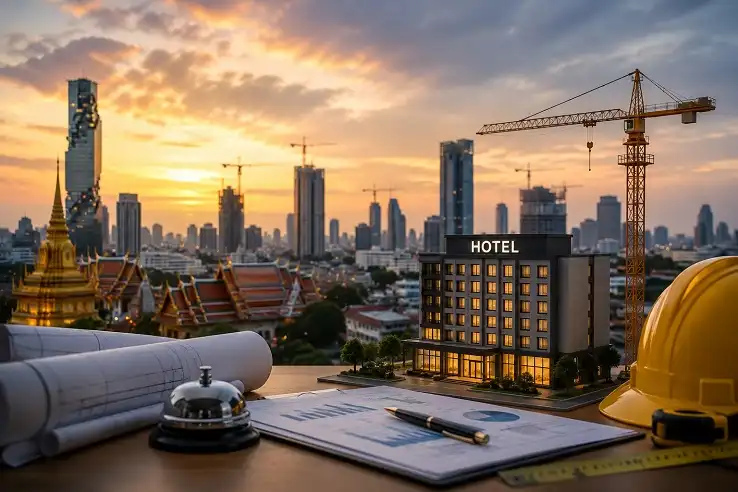
Image Credit: Thailand Hotel News
The scale of Bangkok’s pipeline is particularly significant because the city is not entering this development cycle with a shortage of accommodation. Bangkok already has an enormous and highly competitive hotel inventory covering everything from budget properties and independent hotels to international luxury brands. In the middle of this rapidly changing hospitality landscape, this report highlights an important question for developers and operators: how much additional supply can Bangkok absorb without placing substantial pressure on occupancy, room rates and profitability? That issue is becoming increasingly relevant as thousands of new rooms move through the development process.
Bangkok Takes the Regional Lead
Lodging Econometrics’ Q2 2026 Hotel Construction Pipeline Trend Report shows Bangkok leading all cities in the Asia-Pacific region excluding China with 67 projects and 16,372 rooms. Bengaluru follows with 51 projects and 10,258 rooms, while Mumbai has 49 projects and 10,232 rooms. Jakarta has 47 projects representing 10,140 rooms, and Phuket completes the five leading cities with 44 projects and 10,352 rooms.
Bangkok’s position at the top of the rankings is notable because the capital is competing for hotel investment with some of Asia’s largest and fastest-growing urban economies. The pipeline reflects continued confidence in Bangkok’s long-term tourism appeal, international air connectivity, extensive food and entertainment sectors, expanding luxury retail market, medical tourism industry and role as a regional business hub.
However, a large development pipeline does not automatically translate into an easy operating environment. More hotels mean more competition for guests, employees, management talent, corporate accounts and online visibility.
67 Bangkok Hotels Across Multiple Market Segments
Information provided indicates that Bangkok’s 67-property pipeline includes 14 five-star properties, 22 four-star properties and 18 three-star properties, with the remaining developments falling outside those stated classifications or awaiting clearer positioning.
The numbers indicate that developers are not concentrating exclusively on Bangkok’s luxury market. The substantial number of four-star developments suggests continued investor interest in upscale accommodation, while new three-star supply will add further competition in a segment already characterized by aggressive pricing and a large selection of independent and branded properties.
The 14 planned five-star hotels are also important. Luxury hospitality has become an increasingly visible component of Bangkok’s tourism strategy and investment market, with international brands competing for affluent leisure travelers, high-spending visitors, business executives and guests seeking premium dining, wellness and lifestyle experiences.
Sukhumvit Faces Another Wave of Hotel Supply
Perhaps the most striking element of Bangkok’s expansion is the continued concentration of development around Sukhumvit, one of the city’s most established and already heavily supplied hotel corridors.
Figures provided to Thailand Hotel News indicate that 26 hotels are scheduled for the wider Sukhumvit area, including six five-star properties, eight four-star hotels and nine three-star properties, with the balance outside those stated categories.
The scale of development raises questions about future supply pressure in an area that already contains hundreds of accommodation businesses ranging from small independent hotels to internationally branded luxury properties.
Sukhumvit remains attractive to developers for understandable reasons. BTS Skytrain connectivity, shopping centers, restaurants, nightlife, international schools, offices and expatriate communities have helped turn the corridor into one of Bangkok’s most recognizable hospitality districts.
Yet the addition of another large wave of hotel rooms could intensify competition considerably. Operators will increasingly need to differentiate themselves through brand strength, location, design, food and beverage concepts, wellness facilities, guest experience and sophisticated revenue management rather than relying simply on Bangkok’s rising visitor numbers.
Recent market indicators already underline that challenge. Cushman & Wakefield Thailand reported Bangkok hotel occupancy at approximately 73% during Q2 2026, while revenue per available room fell 7% quarter-on-quarter. Bangkok’s existing hotel inventory had reached approximately 147,230 rooms during the quarter, according to the consultancy.
Thailand Has 167 Hotels and More Than 42,000 Rooms in the Pipeline
Bangkok’s growth forms part of a much larger expansion taking place across Thailand.
Lodging Econometrics reported that Thailand finished Q2 2026 with 167 projects and 42,069 rooms in its construction pipeline, making the country one of the five largest hotel development markets in Asia-Pacific excluding China.
The figures demonstrate how strongly developers continue to view Thailand as a long-term tourism market despite concerns surrounding economic conditions, operating costs, competition and the pace at which new supply is being introduced.
Thailand’s hotel pipeline is also geographically significant. Bangkok accounts for 67 projects, while Phuket has 44 projects representing 10,352 rooms. Together, the two destinations account for 111 projects, meaning roughly two-thirds of Thailand’s entire project pipeline is concentrated in Bangkok and Phuket.
Phuket’s 44-project pipeline places the island fifth among all cities covered by the regional survey, illustrating the extraordinary level of hospitality investment continuing to flow into Thailand’s leading resort market.
Record Development Across Asia-Pacific
Thailand’s hotel boom is taking place against an unprecedented regional development backdrop.
At the close of Q2 2026, the Asia-Pacific hotel construction pipeline excluding China reached a record 2,506 projects and 452,972 rooms, representing year-on-year increases of 17% in projects and 11% in rooms.
Of that total, 989 projects representing 199,362 rooms were already under construction. Another 398 projects and 72,213 rooms were scheduled to begin construction within the following 12 months.
Most significantly, early planning reached a record 1,119 projects and 181,397 rooms, representing 45% of the entire regional pipeline. Early-stage projects increased 26% by project count and 25% by rooms compared with the same period a year earlier.
The figures suggest Asia’s hotel development cycle still has considerable momentum rather than approaching an immediate peak.
Upscale and Luxury Hotels Continue to Expand
Higher-end hotels are playing a major role in the development boom.
The upscale segment reached 658 projects and 121,365 rooms, increasing 22% by projects year-on-year. Luxury development climbed to a record 432 projects and 79,928 rooms, while upper-upscale projects reached 435 properties and 91,231 rooms.
Upper-upscale and upscale projects together account for 44% of projects and 42% of rooms in the regional pipeline.
Renovations and conversions are expanding as well. Combined hotel renovation and brand-conversion projects reached a record 346 projects representing 58,429 rooms, increasing 36% by project count and 25% by rooms year-on-year.
That trend could become particularly relevant to established Bangkok hotels. As new properties arrive with contemporary rooms, technology, restaurants, wellness facilities and sustainability features, older hotels may face growing pressure to renovate or reposition themselves to remain competitive.
India Leads by Country, but Bangkok Leads by City
Although Bangkok leads Asia-Pacific excluding China at the city level, India is by far the largest development market when measured nationally.
India reached a record 1,033 projects and 137,601 rooms at the end of Q2 2026, with project numbers increasing 36% year-on-year. Vietnam followed with 265 projects and 81,848 rooms, Japan recorded 207 projects and 31,360 rooms, Indonesia had 189 projects and 31,772 rooms, and Thailand completed the leading five with 167 projects and 42,069 rooms.
Together, those five countries account for 1,861 projects and 324,650 rooms, equivalent to 74% of the region’s entire hotel construction pipeline.
At city level, however, Bangkok’s 67 projects keep Thailand’s capital firmly at the front of the regional development race.
Hundreds More Hotels Expected Across the Region
The pipeline is already translating into openings. Lodging Econometrics reported that 148 hotels containing 20,594 rooms opened across Asia-Pacific excluding China during the first half of 2026.
Another 236 projects representing 41,217 rooms were forecast to open during the third and fourth quarters of the year. Looking further ahead, 374 hotels and 68,396 rooms are forecast to open during 2027, followed by 363 hotels and 59,659 rooms during 2028.
Bangkok’s New Hotel Boom Adds to an Already Massive Accommodation Market
Thailand’s accommodation sector is already operating on a substantial scale, making the volume of new hotel development particularly noteworthy. The country currently has approximately 18,300 licensed and registered hotels offering around 890,000 guest rooms (Includes registered serviced apartments managed by notable hospitality groups), ranging from internationally branded luxury hotels and major resorts to boutique properties and independently operated regional hotels. When smaller serviced apartments, guesthouses, resorts, unlicensed hotels and other accommodation establishments are included—while excluding private rentals and certain alternative accommodation listed through online platforms—the nationwide total rises dramatically to more than 86,000 accommodation properties offering over 1.3 million rooms. Bangkok alone illustrates the scale of existing supply: as of the end of January 2026, the capital officially had 1,318 licensed hotels and serviced apartments comprising 156,402 room keys (Note our figures are higher as we included registered serviced apartments managed by notable hospitality groups) placing Bangkok among Asia’s most heavily supplied urban accommodation markets and adding further significance to the 67 additional hotel projects currently in its development pipeline.
For Bangkok and Thailand, the development figures send two messages simultaneously. International and domestic investors clearly retain considerable confidence in the country’s long-term hospitality fundamentals, but the sheer volume of incoming supply means that successful hotels will increasingly need strong positioning, disciplined revenue strategies and compelling reasons for travelers to choose them over a rapidly expanding field of competitors.
Bangkok’s position as the region’s number-one city for hotel projects is therefore both an endorsement and a warning. Sixty-seven new properties in the pipeline demonstrate remarkable confidence in Thailand’s capital, while 167 projects nationwide underline the continuing investment appeal of the Thai tourism industry. At the same time, with 26 developments concentrated in the already intensely competitive Sukhumvit area and Phuket carrying another 44 projects, the next several years could reshape Thailand’s accommodation landscape. Developers may see opportunity, but operators will have to work increasingly hard for occupancy, pricing power and guest loyalty as more rooms enter the market.
The Lodging Econometrics latest report can be found here:
https://lodgingeconometrics.com/apec-hotel-construction-pipeline-q2-2026/
Visit Also:
https://thailandwellness.news/
https://www.thailandmedical.news/
Coming Soon:
We have more than 1740 news websites covering various industries and topics across 35 countries and are scaling up to reach 28,000 sites by the end of 2026. We do not use social media accounts to drive traffic rather we depend on search engines and AI platforms along with database marketing involving 83 million names of high spenders from around the globe including about 680,000 top spenders in Thailand. Unlike most news sites in Thailand and around the world…we are not interested in the quantity of readers but rather the quality, purchasing power and interest of the readers. All our PR clients are happy with us as we have a track record of achieving sell-out hotels promotions, phenomenal gems and jewelry orders, trades deals and investor interest, and product sell outs unlike companies that went to competitor media or worse…to news aggregator sites or expat forums whose readers are basically cheap retirees or expats in Thailand who simply cannot afford any of the advertisers or clients’ products or services! We are also the largest supplier of news content under different pen-names or bylines to various media and news platforms and wire agencies around the world covering various industries and sectors. Contact us at mktwiz789@gmail.com for more details or of personalized and targeted pr, marketing and branding deals.