

Key points
- The Pheu Thai Party’s proposal to amend the Hotel Act to accommodate accommodation-sharing platforms such as Airbnb has already sparked concern among hotel owners, investors, and tourism professionals who fear the move could fundamentally reshape the competitive landscape.
- While supporters argue that the amendments would provide legal recognition for smaller accommodation operators and create new economic opportunities, many within the established hotel sector believe the long-term consequences could be severe for businesses that have spent years complying with strict regulations and significant financial obligations.
- Critics argue that while expanding legal accommodation options may appear beneficial on the surface, it risks placing enormous commercial pressure on hotels that have invested heavily to comply with licensing requirements, safety regulations, taxation, environmental standards, insurance obligations, labour laws and numerous operational requirements that alternative accommodation providers may not be required to meet at the same level.
Thailand Hotel News: Thailand’s hotel industry, one of the country’s most important economic pillars, is facing what many industry stakeholders believe could become one of its biggest challenges in decades. The Pheu Thai Party’s proposal to amend the Hotel Act to accommodate accommodation-sharing platforms such as Airbnb has already sparked concern among hotel owners, investors, and tourism professionals who fear the move could fundamentally reshape the competitive landscape.
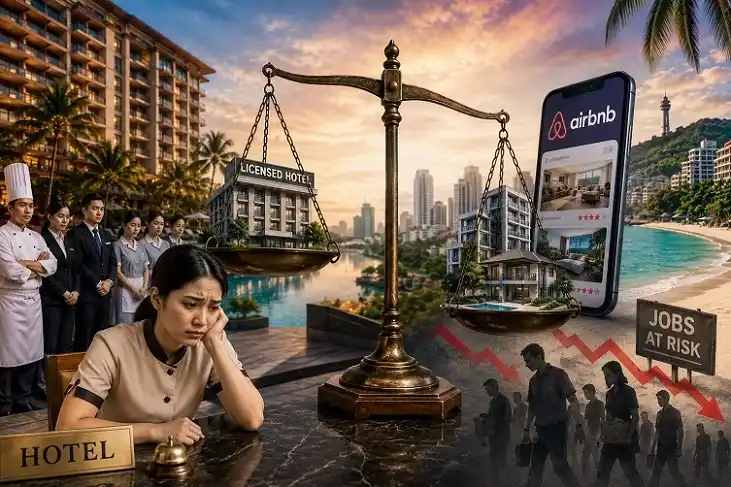
Image Credit: Thailand Hotel News
While supporters argue that the amendments would provide legal recognition for smaller accommodation operators and create new economic opportunities, many within the established hotel sector believe the long-term consequences could be severe for businesses that have spent years complying with strict regulations and significant financial obligations.
The proposed reforms would allow a much wider range of accommodation providers, including condominiums, apartments, private villas, guesthouses, homestays and other residential properties, to legally offer short-term accommodation under a new regulatory framework. This Thailand Hotel News report examines why many hoteliers believe the proposed amendments could create an uneven playing field that threatens the stability of Thailand’s licensed hotel sector. Critics argue that while expanding legal accommodation options may appear beneficial on the surface, it risks placing enormous commercial pressure on hotels that have invested heavily to comply with licensing requirements, safety regulations, taxation, environmental standards, insurance obligations, labour laws and numerous operational requirements that alternative accommodation providers may not be required to meet at the same level.
Thailand’s Hotel Industry Supports Hundreds of Thousands of Jobs
Thailand currently has approximately 18,300 licensed and registered hotels offering around 890,000 guest rooms across the country. These properties range from internationally branded luxury hotels and major resort developments to independently owned boutique hotels and regional accommodation providers that collectively form the backbone of Thailand’s tourism infrastructure.
However, when smaller serviced apartments, guesthouses, unlicensed hotels, resorts and similar accommodation establishments are included—excluding private rental properties and alternative accommodation listed on certain online booking platforms—the number of accommodation businesses rises dramatically to more than 86,000 properties offering over 1.3 million rooms nationwide.
Beyond accommodation capacity, the hotel industry remains a major employer.
Approximately 492,000 Thais work directly within the hotel sector, while tourism overall supports more than four million jobs across accommodation, restaurants, transport, entertainment and related services. For many provinces heavily dependent on tourism, hotels represent one of the largest sources of stable employment and local economic activity.
Equally significant is the industry’s contribution to government revenue. Licensed hotels collectively generate substantial tax income through corporate taxation, value-added tax, employee income tax contributions, property-related taxes and numerous licensing fees. Many industry observers argue that these revenues help fund public services while supporting tourism infrastructure throughout the country.
Pheu Thai Pushes Forward with Hotel Act Amendments
On 14 July 2026, senior representatives from the Pheu Thai Party met with Airbnb’s Public Policy team, led by Southeast Asia Head of Public Policy Shanta Arul, to discuss accelerating amendments to Thailand’s Hotel Act.
https://www.naewna.com/politic/976977
https://www.thaipost.net/economy-news/1031773
Deputy Secretary-General of the Pheu Thai party Chanin Rungthanakiat explained that the objective is to bring smaller accommodation operators—including hostels, guesthouses and homestays—into the formal legal system. The proposal would establish a separate licensing category distinct from traditional hotel licences, reducing regulatory barriers while introducing standards designed specifically for small operators.
According to the party, the reforms are intended to stimulate local economies, allow small entrepreneurs to operate legally, improve safety standards and provide greater regulatory flexibility as tourism continues to evolve.
The discussions also explored cooperation with Airbnb regarding an “Emergency Accommodation” programme that could provide temporary housing during natural disasters and other emergencies by utilizing Airbnb’s platform and accommodation network.
The legislative proposal has already been submitted to Parliament but, because it is classified as a financial bill, it requires the Prime Minister’s endorsement before formal parliamentary debate can proceed.
Fears of Unfair Competition
While supporters describe the amendments as modernizing outdated legislation, many within the hotel industry view the proposals quite differently.
Hotel owners argue that licensed hotels have invested enormous sums over many years to satisfy strict government regulations covering construction standards, fire safety systems, accessibility, health regulations, insurance, staffing, environmental compliance and ongoing inspections.

Image Credit: Thailand Hotel News
Should tens of thousands of condominiums, apartments and private residences suddenly be permitted to compete directly for the same tourist market under a lighter regulatory framework, hotel operators fear their businesses would face unprecedented pricing pressure.
Many industry analysts believe that declining occupancy rates would inevitably reduce hotel revenues, forcing operators to implement aggressive cost-cutting measures. Staff reductions, hiring freezes, delayed investment, reduced maintenance expenditure and, in some cases, permanent closures could become unavoidable if competition intensifies beyond sustainable levels.
Property Investors Could Benefit While Housing Affordability Suffers
Another growing concern centers on the possible impact on Thailand’s residential property market.
Many existing condominium and villa owners who already own multiple investment properties would stand to benefit considerably if short-term tourist rentals became easier to operate legally. Critics argue that these investors are often financially well-established Thai nationals or foreign property owners with significant investment portfolios.
Opponents of the proposed amendments also fear that easier access to the short-term rental market could encourage additional overseas investors to purchase residential property primarily for tourist accommodation rather than long-term residential use.
Some industry observers have even warned that organized foreign investment groups, including criminal syndicates seeking to channel illicit funds into property investments, may view a more liberalized market as an attractive opportunity if regulatory oversight proves insufficient.
As investor demand increases, residential property prices could continue rising, making home ownership increasingly difficult for ordinary Thai families. Many critics therefore argue that condominiums and residential housing should primarily remain places for people to live rather than evolving into large-scale commercial accommodation businesses.
Calls for Tighter Ownership Rules
Some industry participants believe the debate should extend beyond simply amending the Hotel Act.
Among the proposals being discussed is limiting individual or family ownership to a single primary residential property eligible for certain residential benefits while preventing large-scale commercial conversion of residential housing into tourist accommodation.
Others have suggested that condominiums or residential properties owned by foreign nationals should not be permitted to participate in short-term tourist rental programmes. Supporters of this approach believe such restrictions would help preserve housing affordability for Thai citizens while preventing excessive commercialization of residential communities.
Although these ideas remain outside the current legislative proposal, they reflect broader concerns regarding the balance between tourism growth, investment opportunities and the protection of local housing markets.
Questions Being Raised Across the Industry
The proposed reforms have also generated political debate.
Some critics are questioning whether the proposed amendments proposed may indirectly benefit major property developers, including companies such as Sansiri and SC Asset, by expanding commercial opportunities within residential developments. Others have suggested that the reforms could encourage greater foreign participation in Thailand’s accommodation sector.
No evidence has been presented indicating that the proposed legislation is intended specifically to favor any individual company or developer.
Some are worried that Thailand will see more Chinese and Chinese and other foreign criminals buying up condos etc to rent out to tourists
Nevertheless, such concerns continue to circulate within parts of the tourism and hospitality industry as the proposals move through the legislative process.
Perhaps equally surprising to many observers has been what some perceive as the relatively subdued public response from sections of the hotel industry itself.
While individual hotel owners have expressed concern, some industry participants believe that hotel associations and larger investors have not mounted a coordinated public campaign opposing the proposed amendments despite the potentially far-reaching implications for their businesses.
The Stakes for Thailand’s Tourism Future
The debate surrounding amendments to the Hotel Act extends well beyond accommodation licensing. It raises fundamental questions about how Thailand should balance tourism growth, economic opportunity, housing affordability, fair competition and long-term industry sustainability.
Supporters see an opportunity to modernize regulations and allow thousands of small accommodation operators to participate legally in the tourism economy.
Opponents believe the changes could unintentionally undermine an industry that already provides nearly half a million direct jobs while contributing billions of baht annually to government revenues and supporting Thailand’s global tourism reputation.
As Parliament prepares to consider the proposed legislation, policymakers will face the difficult task of balancing innovation with the protection of existing businesses that have invested heavily under the current regulatory framework. Whatever decision is ultimately reached is likely to influence Thailand’s tourism landscape for many years. The outcome will affect hotel owners, employees, investors, local communities, property markets and millions of future visitors.
References:
https://www.krungsri.com/en/research/industry/industry-outlook/services/hotels/io/2026-2028
https://japanvaluers.co.th/blogs/thailand-hotel-industry-2025/
https://www.statista.com/topics/6907/hotel-industry-in-thailand
https://www.hotelscombined.com/Place/Thailand.htm
https://www.nso.go.th/public/e-book/Statistical-Yearbook/SYB-2024/543
https://gdcatalognhic.nha.co.th/dataset/os_17_00002
https://rentechdigital.com/smartscraper/business-report-details/list-of-hotels-in-thailand
https://www.nationthailand.com/news/policy/40037889
https://zipdo.co/thailand-hospitality-industry-statistics
https://www.rgs.org/schools/resources-for-schools/paradise-lost/working-for-tourism
https://worldmetrics.org/thailand-hospitality-industry-statistics
https://statbase.org/data/tha-number-of-employed-persons-in-tourism
https://app.bot.or.th/BTWS_STAT/statistics/ReportPage.aspx?reportID=875&language=eng
For the latest developments in the Thai hospitality industry, keep on logging to Thailand Hotel News.