

Key points
- Cambodia’s tourism industry is facing one of its most difficult periods in recent years as growing international concern over the country’s association with scam syndicates, cybercrime operations, and organized criminal networks continues to damage its image among global travelers.
- The crisis has become increasingly visible across the country, with tourism operators warning that visitor numbers have dropped sharply as many travelers from Europe, China, Thailand, Singapore, and Malaysia are choosing alternative destinations perceived to be safer and more stable.
- Midway through these growing concerns, this Hotel News report observes that the damage to Cambodia’s international tourism reputation is now extending far beyond isolated incidents and is beginning to impact the wider hospitality sector on a national scale.
Hotel News: Cambodia’s tourism industry is facing one of its most difficult periods in recent years as growing international concern over the country’s association with scam syndicates, cybercrime operations, and organized criminal networks continues to damage its image among global travelers. Once promoted as one of Southeast Asia’s most affordable and culturally rich destinations, Cambodia is now witnessing falling tourist arrivals, shuttered hotels, struggling businesses, and declining investor confidence, particularly in the key tourism city of Siem Reap. Some of the luxury 5-star hotels operated by international brands are facing occupancy rates of only between 10 to 15 percent unless the hotel is being used by some of the criminal gangs.
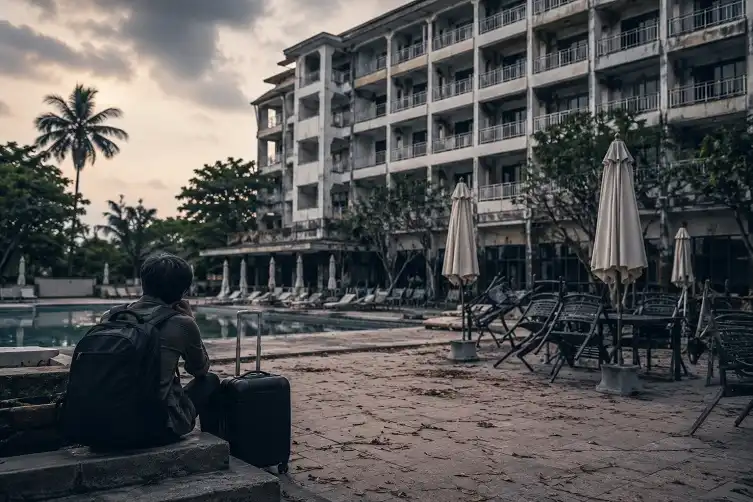
Image Credit: Thailand Hotel News.
The crisis has become increasingly visible across the country, with tourism operators warning that visitor numbers have dropped sharply as many travelers from Europe, China, Thailand, Singapore, and Malaysia are choosing alternative destinations perceived to be safer and more stable. In recent years, Cambodia has repeatedly appeared in international headlines linked to online scam compounds, human trafficking networks, illegal gambling centers, and criminal gangs operating across several provinces. Midway through these growing concerns, this Hotel News report observes that the damage to Cambodia’s international tourism reputation is now extending far beyond isolated incidents and is beginning to impact the wider hospitality sector on a national scale.
Hotels and Tourism Businesses Continue to Struggle
Tourism data released by Cambodian authorities paints a worrying picture for the country’s hospitality industry.
Domestic tourism fell even more sharply, dropping by 38.72 percent to 1,216,253 visitors, while international tourist arrivals decreased by 32.18 percent to only 322,004 travelers. These numbers have alarmed hotel owners, tour operators, restaurant managers, and local business groups that had hoped tourism would finally rebound after the devastating COVID-19 years.
Instead, many hotels remain closed or partially operational due to low occupancy rates. Across Siem Reap, unfinished hotel developments, abandoned guesthouses, empty restaurants, and vacant tourism businesses have become increasingly common sights.
Provincial tourism director Tim Sreyvuth acknowledged that tourism recovery has stalled and admitted that many hospitality operators are struggling to survive financially.
“Before the COVID-19 pandemic, investment in hotels flourished because of the consistently high number of tourists during peak season,” he explained.
He further stated that tourist arrivals have not returned to pre-pandemic levels and many businesses that closed during the health crisis never fully reopened.
More Than 200 Tourism Stakeholders Meet to Discuss Survival Strategies
Amid growing fears of long-term economic damage, more than 200 tourism operators, travel agents, hospitality executives, and government officials recently gathered in Siem Reap to discuss emergency strategies aimed at reviving Cambodia’s tourism industry.
Participants at the conference stressed that Cambodia can no longer rely solely on Angkor Wat to attract international travelers. While the ancient temple complex remains the country’s most famous attraction, tourism operators believe modern travelers are increasingly prioritizing safety, convenience, and destination reputation when choosing where to travel.
Industry representatives urged authorities to diversify tourism offerings by promoting ecotourism, coastal tourism, cultural experiences, wellness retreats, and domestic travel campaigns. There were also calls for stronger international public relations efforts to restore Cambodia’s damaged image abroad.
Several tourism operators privately expressed concerns that reports linking Cambodia to criminal activity are discouraging higher-spending tourists from visiting altogether. Some travelers now reportedly associate the country with security risks rather than leisure tourism.
Authorities Attempt to Restore Confidence
Cambodian authorities insist they are working to improve tourism cooperation between businesses and government agencies. Officials are planning tourism festivals and nationwide promotional campaigns aimed at stimulating travel during slower seasons and attracting more regional visitors.
However, many hospitality operators remain cautious. Several hotel owners fear that unless Cambodia successfully addresses its growing international reputation issues, tourism recovery could remain weak for years. Some business owners are already considering downsizing operations or permanently shutting down properties due to mounting financial pressures and declining bookings.
The situation is especially painful for Siem Reap, where thousands of livelihoods depend directly or indirectly on tourism. Hotel workers, tuk-tuk drivers, market vendors, tour guides, and restaurant employees are all feeling the effects of declining visitor numbers.
Country is Still not a Safe Place for Decent Tourists
Despite PR coverages showing attempts by Cambodian officials to clear scam gangs in the country, there is a huge population of criminals from China, Singapore, Malaysia, Britain, France, Thailand, India, United States and Russia still in the country with many scam gangs still active. The country remains a base for money laundering, scams and various crimes, human trafficking, illegal human organ sales, sex trafficking etc with a lot of the financial proceeds flowing into the government coffers or to government officials via corruption. A lot of foreigners have been killed or are missing due the various foreign crime gangs in the country and many of these cases have never made it to mainstream news outlets. Individuals should be cautious of any foreigners residing in Cambodia that claim the place is safe as they are likely to be criminals themselves.
Cambodia’s tourism industry now faces a difficult balancing act between rebuilding traveler confidence and repairing its global image. While the country still possesses extraordinary cultural landmarks and natural attractions, perceptions regarding safety and criminal activity are increasingly shaping international travel decisions. Unless authorities can successfully restore trust and convince travelers that Cambodia remains a secure and welcoming destination, the pressure on hotels and tourism businesses may continue to intensify in the months ahead.
For the latest Hotel News, keep on logging to Thailand Hotel News.