

Key points
- Officials arrested a woman identified as Natcha, a Koh Phangan resident, accusing her of illegally operating a hotel without a license.
- An Uruguayan national identified as Constantino Von Kamnopoles Politis reportedly identified himself as the owner and was later accused of operating a hotel business without a legal license.
- Nominee ownership structures have become a growing concern in Thailand’s tourism industry, particularly in major resort destinations where foreign investors are sometimes accused of using Thai nationals to bypass legal ownership restrictions.
Thailand Hotel News: Authorities on Koh Phangan have launched an aggressive crackdown on unlicensed hotels and suspected nominee-owned tourism businesses, leading to multiple arrests and triggering wider investigations into foreign-linked resort operations across Surat Thani province.
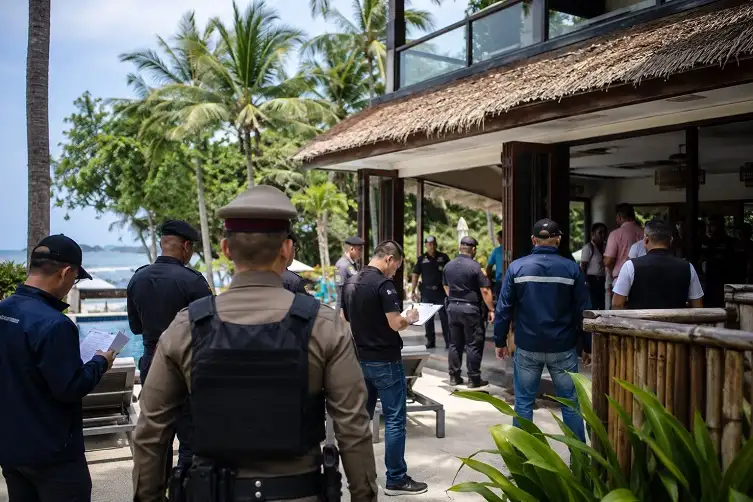
Image Credit: Thailand Hotel News
The coordinated operation, carried out on May 9, involved officers from the Department of Provincial Administration, Surat Thani Immigration Bureau, Koh Phangan police, labor officials, and security agencies. Investigators targeted four resorts in the Sri Thanu area, a location widely known for its large foreign resident population and thriving tourism sector. Amid growing scrutiny over illegal tourism operations on Thailand’s islands, this Thailand Hotel News report reveals how officials are now intensifying probes into hotel licensing, foreign business structures, land ownership, tax compliance, and visa violations connected to the booming hospitality industry.
Three Arrested Over Alleged Illegal Hotel Operations
Police confirmed that three individuals were arrested for allegedly operating hotel businesses without licenses in violation of Thailand’s Hotel Act B.E. 2547 (2004).
Several foreign workers were also detained for allegedly working without proper permits or carrying out duties restricted under Thai labor laws.
One of the main targets was Zama Resort, a 23-room property operated by Honos Management Co Ltd, which was reportedly registered under Thai and Swiss shareholders. Officials arrested a woman identified as Natcha, a Koh Phangan resident, accusing her of illegally operating a hotel without a license.
Authorities also searched Sritanu Residences Resort, operated by Muthita Koh Pha Ngan Co Ltd and linked to Thai and Slovenian shareholders. However, the resort had reportedly shut its doors shortly before officers arrived, and no arrests were made during the inspection.
At Haad Chao Phao Resort, an eight-room property connected to Thai and Greek shareholders, investigators arrested a man identified as Phakphum from Nakhon Si Thammarat. He was accused of operating an unlicensed hotel business. During the same raid, two Myanmar nationals were detained after officials alleged, they were working outside the conditions permitted under their employment authorizations.
Meanwhile, officers also raided Samma Karuna Beach & Wellness Resort, a 12-room property linked to Thai and Uruguayan shareholders. An Uruguayan national identified as Constantino Von Kamnopoles Politis reportedly identified himself as the owner and was later accused of operating a hotel business without a legal license.
Nominee Ownership Under Heavy Scrutiny
Officials stated that three of the four businesses inspected were found to have allegedly breached the Hotel Act. Authorities seized accounting records, shareholder documents, and financial evidence as investigators widened their probe into possible nominee shareholding arrangements.
Nominee ownership structures have become a growing concern in Thailand’s tourism industry, particularly in major resort destinations where foreign investors are sometimes accused of using Thai nationals to bypass legal ownership restrictions.
The Sri Thanu area has increasingly attracted long-stay foreign residents, wellness tourists, and international entrepreneurs over recent years. Authorities say the latest raids are part of a broader effort to ensure tourism businesses comply with Thai laws governing hospitality operations, land ownership, taxation, and employment.
Surat Thani Governor Jumphot Wannachatsiri said provincial authorities are closely monitoring reports involving foreigners allegedly living long-term on Koh Phangan, Koh Samui, and Koh Tao while operating businesses using tourist visas or nominee company structures.
He stressed that the inspections were not directed at any particular nationality and that enforcement would apply equally to both foreigners and Thai citizens found violating the law.
“Inspections and arrests have continued, although many cases were not reported in the news,” the governor said. “Action will be taken against all nationalities, not any one nationality.”
Wider Tourism Industry Crackdown Emerging
The Koh Phangan raids are part of a much larger nationwide effort targeting illegal tourism-related businesses. Phuket Immigration recently conducted similar operations against suspected nominee businesses, resulting in the arrest of 11 foreigners and inspections at 15 separate companies across the island.
The latest enforcement campaign is sending a strong message across Thailand’s tourism and hospitality sector. Hotel operators, resort owners, and foreign investors are now facing significantly tighter scrutiny as authorities attempt to crack down on illegal hotel operations, visa abuse, nominee shareholding structures, and unauthorized foreign employment practices.
Many local business operators have welcomed the tougher enforcement measures, arguing that illegal operators have long created unfair competition within the tourism industry. Others, however, fear that intensified investigations could create uncertainty at a time when Thailand’s tourism economy remains highly competitive and heavily reliant on international visitors.
What is becoming increasingly clear is that authorities are no longer treating these investigations as isolated incidents. With coordinated operations now expanding across Koh Phangan, Koh Samui, Koh Tao, and Phuket, Thailand’s southern tourism sector appears to be entering a new era of strict enforcement and deeper regulatory oversight that could reshape parts of the island hospitality industry in the months ahead.
For the latest on the local hospitality industry, keep on logging to Thailand Hotel News.