

Key points
- While headlines continue to celebrate new hotel openings, luxury launches, and tourism recovery narratives, a parallel trend is unfolding—one that signals mounting pressure across the sector.
- While many big international hotel brokerage companies often come up with reports detailing how great the hotel market is like in Thailand with conjured figures and data coupled with predictions as to how great the market is going to be in a few years’ time.
- Even many hotel management companies with multiple brands are also at fault with giving misleading projections after all they are only concerning with securing management contracts and are not the ones bearing the cost for new hotel projects unlike the actual developers or investors who are being fed misleading projections and data.
Thailand Hotel News: Thailand’s hospitality industry is facing a stark and largely underreported reality. While headlines continue to celebrate new hotel openings, luxury launches, and tourism recovery narratives, a parallel trend is unfolding—one that signals mounting pressure across the sector. A growing number of hotel owners are quietly putting their properties up for sale, pointing to deeper structural issues within the market.
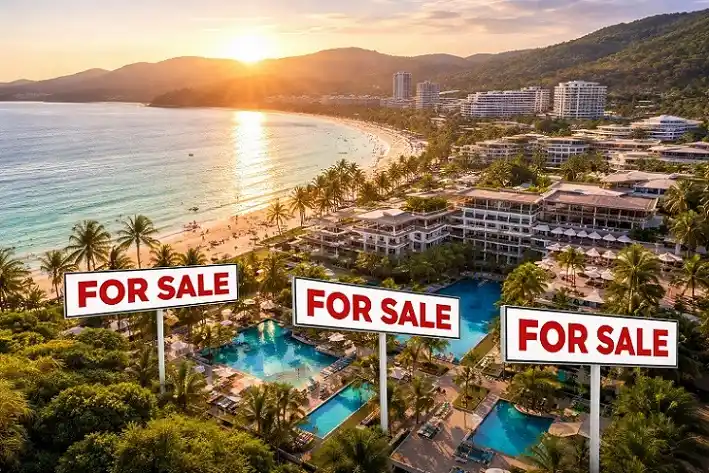
Image Credit: Thailand Hotel News
Rising Number of Hotels Flooding the Market
As of April 3rd, 2026, more than 329 hotels across Thailand are actively on the market. Of these, 192 properties are publicly listed through online platforms, databases, and brokerage channels, making them visible to investors and buyers. Meanwhile, another 157 hotels are being marketed confidentially, with owners choosing to discreetly approach select brokers and agencies to avoid public exposure.
Earlier in Mid-January 2026, there were only 117 hotel properties that were up for sale.
This Thailand Hotel News report underscores an even more concerning layer: an additional 28 hotels have already been classified as non-performing assets. Among these, at least 7 are expected to enter forced liquidation in the near future, signaling financial distress that goes beyond voluntary exits.
While many big international hotel brokerage companies often come up with reports detailing how great the hotel market is like in Thailand with conjured figures and data coupled with predictions as to how great the market is going to be in a few years’ time..all these simply for them to help close deals with unsuspecting buyers or investors…the reality is far more worrisome than what is being projected falsely.
Even many hotel management companies with multiple brands are also at fault with giving misleading projections after all they are only concerning with securing management contracts and are not the ones bearing the cost for new hotel projects unlike the actual developers or investors who are being fed misleading projections and data.
Phuket Leads the Sell-Off Despite Strong Image
Perhaps the most surprising development is where these sales are concentrated. Phuket, often promoted as Thailand’s strongest tourism destination, currently has the highest number of hotels for sale. Bangkok follows as the second most affected market, with Chiang Mai ranking third. Other major destinations such as Pattaya, Hua Hin, and Kanchanaburi are also seeing increasing levels of hotel divestment.
This distribution challenges the widely promoted perception that key tourism hubs are thriving uniformly. Instead, it suggests that even high-profile destinations are experiencing oversupply and declining returns for many operators.
Oversupply and Weak Regulation Driving Pressure
A major factor repeatedly cited by hotel owners is market oversaturation. Over the past decade, Thailand has experienced an aggressive wave of hotel development, ranging from boutique accommodations to large-scale resorts. However, many stakeholders argue that regulatory controls have not kept pace with this expansion.
Without strict oversight on new hotel licenses and development approvals, supply has grown faster than demand in several regions. As a result, occupancy rates have become increasingly volatile, and pricing competition has intensified to unsustainable levels.
Regional Competition Eroding Thailand’s Edge
Beyond domestic challenges, Thailand is facing intensifying competition from other tourism markets. Countries such as Vietnam and Indonesia have rapidly upgraded their infrastructure and hospitality offerings. India, Japan, Taiwan, and China are also becoming stronger contenders, attracting both regional and long-haul travelers.
These destinations are not only competitive in pricing but are also investing heavily in marketing, unique experiences, and new tourism segments. As a result, Thailand’s traditional dominance is being gradually diluted.
Reality Versus Perception in Tourism Performance
Several hotel owners have expressed concerns that official narratives around tourism recovery may not fully reflect on-the-ground realities. While arrival numbers may appear strong, actual spending patterns, length of stay, and occupancy consistency are not always meeting expectations.
Rising operational costs—including labor, utilities, and maintenance—are further squeezing margins. For many independent hotel operators, profitability has become increasingly difficult to sustain, prompting decisions to exit the market altogether.
A Market at a Turning Point
The surge in hotel sales across Thailand is more than a temporary fluctuation—it is a signal of structural imbalance within the industry. Oversupply, rising competition, and shifting global travel dynamics are converging to create a challenging environment for operators.
If left unaddressed, these pressures could reshape Thailand’s hospitality landscape in the years ahead. Strategic planning, tighter regulatory frameworks, and a stronger focus on sustainable tourism development may be necessary to restore balance and investor confidence. At the same time, operators will need to adapt quickly, embracing differentiation and efficiency to survive in an increasingly competitive global market.
For the latest on the hotel industry in Thailand, keep on logging to Thailand Hotel News.