

Key points
- On various forums and platforms online, tourists who arrived in Thailand are already starting to complain how the fuel shortages and rising prices are negatively affecting their itineraries and overall experiences.
- Despite some fake news reports by certain English media in Thailand that were most probably paid by some agencies to disseminate misinformation in order to spur tourism, hotels in the North and in the South are not recording an increase for hotel room bookings for the coming Songkran, instead many are reporting the opposite, with room bookings substantially down.
- Also fuel shortages in many of these provinces are far more worse than in Bangkok and is already affecting taxi and private cars availability and causing an increase in boats and ferry fees etc.
Thailand Hotel News: Rising concerns over fuel availability in southern Thailand have prompted Malaysian authorities to issue a travel advisory urging citizens to reconsider non-essential trips across the border.
The warning comes at a time when cross-border travel typically surges due to festive holidays, with popular destinations such as Hat Yai and Songkhla drawing large numbers of Malaysian tourists each year. However, current conditions on the ground suggest that travel convenience and affordability are being significantly disrupted.
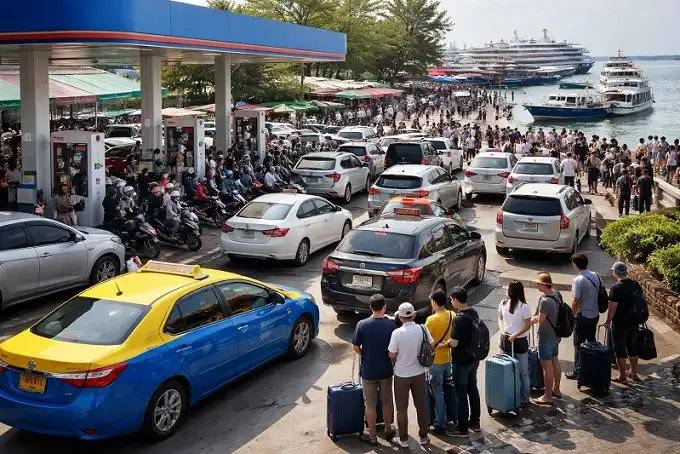
Image Credit: Thailand Hotel News
According to Malaysia’s consul-general in Songkhla, Ahmad Fahmi Ahmad Sarkawi, the advisory is a precautionary measure in response to escalating fuel shortages caused by panic buying among Thai residents. He emphasized that travelers without urgent reasons should delay their plans, while those who must travel should prepare carefully. He noted that long queues have formed at petrol stations across southern Thailand, with many outlets either running dry or implementing strict fuel purchase limits. In fact, this Thailand Hotel News report highlights how these disruptions are already affecting not just transport logistics but the broader tourism experience.
On various forums and platforms online, tourists who arrived in Thailand are already starting to complain how the fuel shortages and rising prices are negatively affecting their itineraries and overall experiences. Some on Reddit are advising others against coming to Thailand for the time being.https://www.reddit.com/r/ThailandTourism/comments/1s0dy4j/difficulties_to_tourists_due_to_shortage_of_fuel/
Travelers entering Thailand by road are among the hardest hit. Many Malaysians who drive across the border are reportedly struggling to find fuel, with some being forced to queue for hours or travel long distances between operational petrol stations. Even when fuel is available, purchase caps—such as 500 baht per car and 80 baht per motorcycle—have made it difficult for tourists to maintain their travel itineraries. This has created a ripple effect, impacting hotel check-ins, scheduled tours, and overall visitor satisfaction.
Hotel Bookings in Thailand Especially in the North and South Badly Affected
The fuel shortages, travel warnings and discussions online are indirectly affecting hotel bookings across Thailand. Despite some fake news reports by certain English media in Thailand that were most probably paid by some agencies to disseminate misinformation in order to spur tourism, hotels in the North and in the South are not recording an increase for hotel room bookings for the coming Songkran, instead many are reporting the opposite, with room bookings substantially down. Also fuel shortages in many of these provinces are far more worse than in Bangkok and is already affecting taxi and private cars availability and causing an increase in boats and ferry fees etc.
Situation That is Not Reported in Most Media
Air travelers are facing a different but equally frustrating set of challenges. Upon arrival at airports in Thailand, tourists are finding it increasingly difficult to secure transportation to their hotels. Taxi and limousine services, affected by fuel scarcity, have reduced availability, leading to longer waiting times and sharply increased fares. Reports indicate that some drivers are charging significantly higher prices, taking advantage of the limited supply of vehicles willing or able to operate under current conditions.
The situation extends beyond land transport. Boat and ferry operators servicing island resorts and coastal destinations are also adjusting their pricing structures, citing rising fuel costs. Tourists hoping to reach beachside resorts or nearby islands are encountering inflated ticket prices and reduced service frequency. These developments are particularly concerning for Thailand’s hospitality sector, which relies heavily on seamless connectivity between transport hubs and accommodations.
Compounding the issue is the rising cost of food and essential goods. Restaurant operators and food vendors are reportedly increasing prices, attributing the hikes to higher operational costs, including cooking gas and transportation expenses. Tourists are thus facing an overall increase in travel expenditure, from transport to dining, making what was once an affordable getaway significantly more expensive and unpredictable.
Despite these visible challenges, Thai authorities have maintained that there is no nationwide fuel shortage, insisting that supply remains sufficient for domestic needs. Officials have also stated that measures are being implemented to stabilize the situation. However, on-the-ground realities appear to tell a different story, with many petrol stations temporarily closed or operating under severe constraints. The discrepancy between official reassurances and actual conditions has contributed to uncertainty among travelers and industry stakeholders alike.
Industry voices have echoed these concerns. Aida Oujeh, president of the Thai-ASEAN Halal Tourism Industry Association, acknowledged that the disruption is likely to persist for some time. She noted that the issue is affecting both locals and tourists, with widespread closures of petrol stations due to depleted supplies. Her advice to travelers includes ensuring vehicles are fully fuelled before entering Thailand and attempting to refuel early in the morning when stations are more likely to have stock.
The broader implications for Thailand’s tourism sector are becoming increasingly apparent. Hotels, particularly in southern regions, may begin to see cancellations or reduced occupancy rates if the situation continues. Travel agencies and tour operators are also facing mounting pressure as they attempt to reassure clients while navigating logistical uncertainties.
The current situation remains highly volatile, with conditions changing rapidly and unpredictably. While government assurances aim to calm public concern, the lived experiences of travelers suggest that challenges are far from resolved. For Malaysians and other regional tourists, careful planning, flexibility, and awareness are now essential components of any travel decision involving southern Thailand.
For the latest situation in Thailand amid the Middle-East War, keep on logging to Thailand Hotel News