

Key points
- Thailand’s hospitality industry is facing an uncomfortable food safety question as reports of arsenic contamination in northern waterways and hazardous industrial waste dumping in central and eastern provinces raise concerns about the integrity of local food supply chains.
- As this Thailand Hotel News report examines, the growing environmental concerns expose a potentially significant blind spot in hospitality food safety, particularly when hotels depend on local suppliers without independently verifying the chemical safety of their ingredients.
- Although detecting arsenic in a river does not automatically establish that nearby agricultural products are unsafe, prolonged exposure to contaminated irrigation water can create conditions in which toxic substances accumulate in agricultural soils and certain crops.
Thailand’s hospitality industry is facing an uncomfortable food safety question as reports of arsenic contamination in northern waterways and hazardous industrial waste dumping in central and eastern provinces raise concerns about the integrity of local food supply chains. While hotels across the country promote their restaurants, elaborate breakfast buffets, farm-to-table dining experiences, and locally sourced organic ingredients, an increasingly important question remains unanswered: How many establishments actually test their food supplies for arsenic, lead, cadmium, mercury, and other potentially dangerous contaminants before serving them to unsuspecting guests?
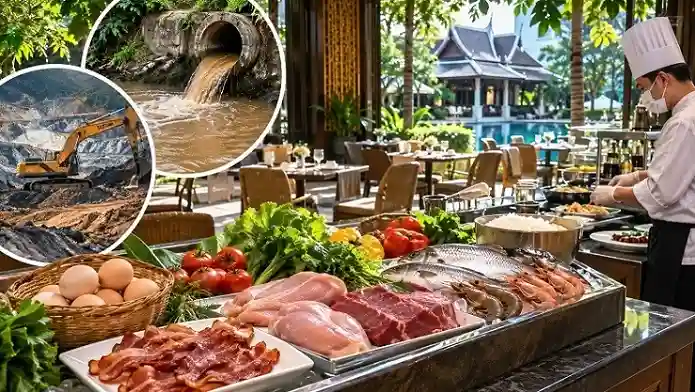
Image Credit: Thailand Hotel News
The concerns extend far beyond whether hotel kitchens maintain appropriate hygiene standards or comply with conventional food safety regulations. Environmental contamination can introduce toxic substances into vegetables, rice, seafood, meat, eggs, and drinking water long before these products reach a hotel kitchen. As this Thailand Hotel News report examines, the growing environmental concerns expose a potentially significant blind spot in hospitality food safety, particularly when hotels depend on local suppliers without independently verifying the chemical safety of their ingredients. A beautifully presented breakfast buffet may look perfectly wholesome, but appearances cannot establish whether the ingredients have been exposed to contaminated soil, irrigation water, or animal feed.
Arsenic Pollution in Northern Thailand Raises Serious Questions
Reports of arsenic contamination affecting the Kok, Sai, and Ruak river systems in northern Thailand have intensified concerns about agricultural production and water safety in communities bordering Myanmar.
Mining activities in Myanmar’s Shan State have been identified as suspected sources of contamination, with some reported measurements substantially exceeding applicable Thai surface-water standards.
These developments are particularly troubling because rivers support agricultural irrigation, freshwater fisheries, and surrounding communities.
Although detecting arsenic in a river does not automatically establish that nearby agricultural products are unsafe, prolonged exposure to contaminated irrigation water can create conditions in which toxic substances accumulate in agricultural soils and certain crops.
For hotels sourcing vegetables, rice, freshwater fish, or other ingredients from potentially affected agricultural areas, the implications deserve serious attention.
Illegal Industrial Waste Dumping Creates Additional Food Safety Concerns
Northern Thailand is not the country’s only environmental concern.
Investigations into illegal industrial waste processing and disposal have exposed hazardous waste management problems in provinces including Chonburi, Rayong, Prachinburi, and Samut Sakhon.
Some investigations have involved Chinese-linked businesses, unauthorized recycling operations, and allegations of improper handling of industrial residues containing hazardous substances.
Environmental campaigners and affected communities have raised questions about whether certain activities continued for extended periods without adequate intervention. However, allegations that officials knowingly concealed contamination require independent investigation rather than assumption.
The potential consequences for agriculture are substantial. Heavy metals released into soil, groundwater, or irrigation systems may eventually reach crops, livestock, and aquatic environments.
Importantly, contamination identified at individual industrial sites does not establish that agricultural products throughout these provinces are unsafe.
Could Hotel Breakfast Buffets Become an Unexpected Exposure Route?
Consider a typical complimentary breakfast at a Thai hotel. Guests may consume eggs, bacon, sausages, tomatoes, leafy vegetables, rice dishes, fresh fruit, and seafood without knowing precisely where the ingredients originated.
If chickens consume contaminated feed or water, certain contaminants can enter edible tissues or eggs. Similarly, pigs and cattle exposed to polluted feed, water, or soil may accumulate particular metals in their tissues or organs.
Vegetables grown in contaminated agricultural soils may absorb arsenic or cadmium, depending on the crop, soil chemistry, and environmental conditions.
This does not mean hotel breakfast ingredients in Thailand have been demonstrated to contain dangerous concentrations of these substances. Rather, it illustrates how contamination could reach consumers through ordinary meals if supply-chain safeguards fail.
Unlike bacterial contamination, arsenic and heavy metals cannot reliably be eliminated through conventional cooking, washing, or refrigeration.
Are Hotels Actually Testing Their Ingredients?
Most conventional hotel food safety programs emphasize refrigeration temperatures, kitchen sanitation, microbial contamination, pest control, and proper food handling.
These safeguards are essential, but they do not substitute for chemical contaminant testing.
A hotel may operate a spotless kitchen, maintain excellent hygiene ratings, and still lack direct evidence that its vegetables, meat, rice, or seafood are free from excessive heavy-metal residues.
Laboratory techniques such as inductively coupled plasma mass spectrometry can detect extremely low concentrations of multiple metals in food samples.
However, comprehensive laboratory testing requires specialized equipment, validated sampling procedures, and qualified personnel. Portable screening devices may be useful in certain circumstances but cannot universally replace accredited laboratory analysis.
There is currently insufficient publicly available evidence to determine what proportion of Thai hotels independently test incoming ingredients for heavy metals.
That information gap deserves attention from hotel operators, tourism authorities, and food safety regulators.
The Farm-to-Table and Organic Dining Paradox
The growing popularity of farm-to-table dining introduces another important consideration.
Luxury resorts and boutique hotels frequently advertise locally sourced organic vegetables, seasonal produce, and ingredients harvested from nearby farms.
These initiatives can support agricultural communities, reduce transportation distances, and offer distinctive culinary experiences.
However, organic certification does not automatically guarantee the absence of arsenic, cadmium, lead, or other environmental contaminants.
A farm can avoid synthetic pesticides and fertilizers while still operating on land affected by historical industrial pollution or contaminated irrigation water.
Hotels marketing premium organic dining experiences should therefore be prepared to explain whether their suppliers undergo periodic soil, water, and food testing.
Claims of freshness, sustainability, and organic production should not be confused with verified chemical safety.
Recent Investigations Show Why Stronger Oversight Is Necessary
The concerns are supported by developments extending into 2026. Thailand’s Pollution Control Department reported arsenic concentrations of 0.011–0.016 milligrams per liter at several northern river monitoring locations in February 2026, exceeding the applicable 0.01 mg/L surface-water standard. The Mekong River Commission subsequently highlighted more serious contamination in certain sediment samples.
Meanwhile, a November 2026 investigation in Chonburi identified suspected illegal industrial waste dumping, with questions raised about waste allegedly linked to a Chinese-owned industrial operation. The precise composition and environmental consequences of the discarded materials remain under investigation.
These findings warrant vigilance, although environmental contamination measurements must not be mistaken for proof that hotel meals contain unsafe concentrations of toxic substances.
What Should Thailand’s Hotels Be Doing?
Hotels should introduce risk-based chemical testing programs covering ingredients from potentially affected locations, with particular attention to rice, vegetables, freshwater fish, seafood, meat, and eggs.
Supplier audits should establish ingredient origins, irrigation sources, relevant laboratory results, and compliance with applicable food safety limits.
Hotels should also verify the safety of water used for drinking, cooking, ice production, and food preparation.
Importantly, the World Health Organization warns that prolonged exposure to inorganic arsenic through contaminated water and food can increase the risk of cancer and other serious health conditions.
There are also certain cooking methods that can reduced arsenic and heavy metal contamination drastically by 60 to 80 percent and hotels should also be studying such methods.
World Health Organization
Independent laboratory certification, transparent supplier documentation, and periodic testing would provide more meaningful assurances than promotional claims about freshness or organic sourcing.
Thailand’s Hospitality Reputation Depends on More Than Clean Kitchens
Thailand’s hotels cannot reasonably guarantee that every ingredient is completely free of environmental contaminants. They can, however, demonstrate that credible safeguards exist to identify and minimize exposure risks. The emerging pollution concerns should encourage hotel associations, regulators, and operators to establish stronger supplier verification and transparent chemical testing practices. Until such measures become more widespread, travelers may have limited means of independently assessing these risks. Protecting Thailand’s reputation as a world-class hospitality destination requires ensuring that the food served to guests is not merely delicious, hygienically prepared, and attractively presented, but also supported by verifiable evidence of chemical safety.