

Key points
- At the same time, Thailand’s long-standing strengths as a value-for-money destination are being challenged by competitors such as Vietnam and Malaysia, which are aggressively targeting the same source markets with visa-free access and competitive pricing.
- Food and beverage services contribute around 25 percent, particularly for medium-sized and large hotels in the four- and five-star segments, while the remainder comes from ancillary services such as retail leasing, laundry, and other guest amenities.
- In the World Economic Forum’s Travel and Tourism Development Index 2024, Thailand slipped to 47th place globally, reflecting declining competitiveness in areas such as safety and security, despite maintaining strengths in air transport infrastructure and natural resources.
Thailand Hotel News: Thailand’s hotel industry is moving into a defining phase as it transitions from post-pandemic recovery toward a more complex growth cycle shaped by shifting tourist markets, structural competition, rising costs, and evolving traveler expectations. According to Krungsri Research’s latest business outlook covering the 2026–2028 period, the sector is expected to continue expanding, though the pace will be gradual rather than dramatic. Growth will be underpinned by improving international arrivals, resilient domestic tourism, and continued investment by major hotel operators, but tempered by persistent safety concerns, intensifying regional rivalry, and mounting operational pressures.
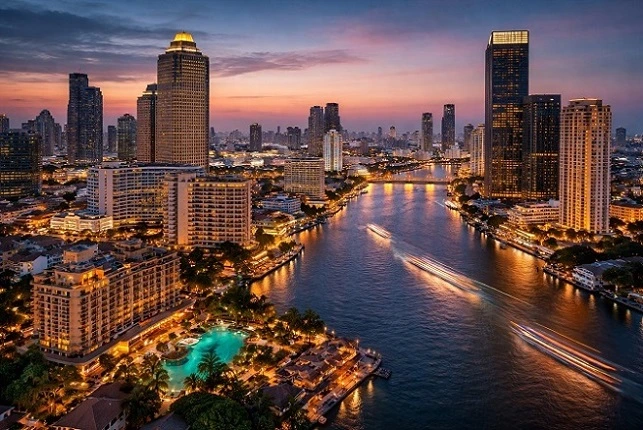
Image Credit: Thailand Hotel News
The coming years will test the industry’s ability to adapt. While international arrivals are projected to increase steadily, they are not expected to decisively surpass pre-COVID levels until after 2028. Domestic travel will remain a vital stabilizer, helping to offset volatility in foreign demand. At the same time, Thailand’s long-standing strengths as a value-for-money destination are being challenged by competitors such as Vietnam and Malaysia, which are aggressively targeting the same source markets with visa-free access and competitive pricing. This Thailand Hotel News report reflects not just a recovery narrative, but a broader recalibration of Thailand’s tourism and accommodation ecosystem.
A Forward-Looking Industry Outlook for 2026–2028
Krungsri Research forecasts that nationwide hotel occupancy rates will average between 72 and 73 percent over the 2026–2028 period. This relatively stable outlook reflects a balance between improving demand and a continued increase in room supply. Hotels located in major tourist destinations such as Bangkok, Pattaya, and Phuket are expected to outperform the national average, with occupancy rates projected to exceed 75 percent from 2026 onward. These destinations remain the primary beneficiaries of international tourism and high-spending travelers.
In contrast, hotels in regional centers and secondary tourist areas are expected to see slower but steady revenue growth, supported largely by domestic travel and spillover benefits from government stimulus measures. However, political uncertainty, particularly during periods of parliamentary transition and delayed budget disbursement, could pose downside risks to tourism-support initiatives, especially in 2026. Hotels in smaller provinces are likely to benefit from policies promoting travel dispersion, although their occupancy rates are expected to remain structurally below those of major destinations.
The Hotel Sector’s Role in Thailand’s Economy
Before the COVID-19 crisis, Thailand’s accommodation sector contributed approximately 2.5 percent of national GDP, reflecting tourism’s central role in the economy. This contribution collapsed sharply during 2020 and 2021 as international travel halted and domestic mobility was restricted. The sector’s share of GDP fell to just 0.6 percent in 2021 before beginning a gradual recovery in 2022.

Image Credit: Thailand Hotel News
By 2024, the accommodation sector had returned to its pre-pandemic GDP share, driven by the reopening of borders, the rebound of domestic travel, and pent-up demand from international tourists. Hotel revenues continue to be dominated by room sales, which account for roughly 65 to 70 percent of total income. Food and beverage services contribute around 25 percent, particularly for medium-sized and large hotels in the four- and five-star segments, while the remainder comes from ancillary services such as retail leasing, laundry, and other guest amenities.
International Tourism: Strengths, Shifts, and Setbacks
Thailand remains one of the world’s most recognizable tourism destinations, supported by diverse attractions, competitive pricing, expanding transport infrastructure, and extensive air connectivity. However, recent global rankings reveal emerging weaknesses. In the World Economic Forum’s Travel and Tourism Development Index 2024, Thailand slipped to 47th place globally, reflecting declining competitiveness in areas such as safety and security, despite maintaining strengths in air transport infrastructure and natural resources.
Prior to the pandemic, East Asia was Thailand’s largest source market, accounting for more than 40 percent of international tourism revenue. China alone contributed nearly 30 percent of total arrivals in 2019. In the post-pandemic era, however, the composition of foreign visitors has shifted markedly. European markets have expanded their share, while East Asian arrivals, particularly from China, have recovered more slowly due to lingering safety concerns and heightened sensitivity to travel-related risks.
Domestic Tourism as a Critical Pillar
Domestic tourism has emerged as a cornerstone of stability for Thailand’s hotel industry. Before COVID-19, Thai travelers averaged nearly 145 million trips per year, supported by government initiatives promoting regional tourism and improved transport connectivity. Although domestic travel collapsed during the pandemic, it rebounded strongly from 2022 onward.

Image Credit: Thailand Hotel News
By 2024, domestic trips had surged to nearly 200 million, driven by subsidy programs such as “We Travel Together,” tax deductions for tourism spending, and coordinated marketing campaigns between the public and private sectors. In 2025, domestic travel continued to expand, supported by extended public holidays, co-payment schemes for hotel stays, and the growing influence of social media and travel influencers. Importantly, many secondary cities recorded faster growth than traditional destinations, highlighting the effectiveness of policies aimed at dispersing tourism more evenly across the country.
Expanding Supply and Investment Momentum
Thailand’s hotel room supply has grown steadily over the past decade, rising from approximately 635,000 rooms in 2015 to more than 847,000 rooms in 2024. Around half of this supply remains concentrated in Bangkok, Phuket, and Chonburi, which continue to attract both domestic operators and international hotel chains.
Recent years have seen increased investment in regional hubs and emerging destinations such as Chiang Mai, Krabi, Surat Thani, Rayong, and Prachuap Khiri Khan. Construction permit data from 2025 suggests that investor confidence remains strong, particularly in Bangkok and Phuket, where new projects are expected to enter the market over the next one to two years. This expansion underscores optimism about long-term tourism demand, even as short-term uncertainties persist.
Occupancy, Pricing, and Revenue Dynamics
Thailand’s hotel occupancy rates have historically fluctuated between 60 and 70 percent, with sharp declines during periods of political instability and the pandemic. The COVID-19 crisis pushed occupancy to unprecedented lows, but recovery since 2022 has been steady and broad-based.
In 2025, the nationwide occupancy rate averaged 71.4 percent, little changed from the previous year. Major destinations reliant on international tourists experienced slight declines, while provinces supported by domestic travel recorded improvements. Average daily room rates softened in 2025, particularly in southern destinations, reflecting competitive pricing amid weaker foreign demand. Even so, Thai hotel room rates remain significantly lower than those in Japan, South Korea, Singapore, and Western markets, reinforcing Thailand’s reputation for value for money.

Image Credit: Thailand Hotel News
The Road Ahead for International and Domestic Travel
Looking forward, Krungsri Research projects international arrivals to rise to 35.5 million in 2026, 37.5 million in 2027, and 39 million in 2028. Growth is expected to be driven primarily by India, Europe, and Russia, supported by expanded flight capacity and visa facilitation. Nevertheless, international arrivals are likely to remain below the 2019 peak until after 2028.
Domestic tourism is expected to continue expanding, with trips projected to reach approximately 225 million by 2028. Growth will be supported by continued government stimulus, infrastructure upgrades, and the expansion of the MICE segment in regional hubs. New convention centers in Phuket, Chiang Mai, and Khon Kaen are expected to strengthen Thailand’s position as a regional meetings and events destination.
Structural Pressures and Long-Term Challenges
Despite positive growth prospects, the hotel industry faces enduring structural challenges. Competition remains intense, driven by new hotel developments, short-term rental platforms, and illegal daily rentals operating outside the Hotel Act. These alternatives exert sustained pressure on pricing and margins.
At the same time, operators face rising costs associated with digital transformation, sustainability initiatives, stricter safety regulations, labor shortages, and minimum wage increases. Large hotel chains are better positioned to invest in smart-hotel technologies and sustainable practices, while small and medium-sized operators often face financial and operational constraints, potentially widening the competitive gap within the sector.
A Measured Path Forward Without Saying the Forbidden Word
Thailand’s hotel industry over the 2026–2028 period is set to follow a path of cautious expansion rather than rapid acceleration. Demand is improving, but growth will remain uneven across markets and regions. Long-term success will depend on restoring traveler confidence, particularly in safety and security, maintaining price competitiveness, diversifying source markets, and embracing digital and sustainable transformation. Domestic tourism will continue to play a vital buffering role, helping the industry weather external shocks. As regional competition intensifies, Thailand’s hotel sector must evolve beyond its traditional strengths, aligning policy, investment, and service standards to ensure resilience and relevance in an increasingly competitive global tourism landscape.
For more details on the Krungri Research on Thailand’s Hotel industry, visit:
https://www.krungsri.com/en/research/industry/industry-outlook/services/hotels/io/2026-2028
For the latest on the Thailand’s hotel industry, keep on logging to Thailand Hotel News.