

Key points
- Bangkok’s hospitality sector has entered one of the most intense phases in its modern history, transforming the Thai capital into a city where hotels and serviced apartments appear on nearly every major street, in almost every district, and increasingly under brand names that sound strikingly similar.
- As of the end of January 2026, Bangkok officially counts 1,318 licensed hotels and serviced apartments with a combined 156,402 room keys, a scale that positions the city among the most densely supplied urban hotel markets in Asia.
- Behind the figures lies a massive data-driven effort that took two months and the support of more than 85 part-time contributors to compile, resulting in an updated database covering room rates, food and beverage offerings, spa packages, meeting facilities, and a detailed listing of over 15,000 hospitality professionals operating across Bangkok’s accommodation sector.
Thailand Hotel News: Bangkok’s hospitality sector has entered one of the most intense phases in its modern history, transforming the Thai capital into a city where hotels and serviced apartments appear on nearly every major street, in almost every district, and increasingly under brand names that sound strikingly similar. As of the end of January 2026, Bangkok officially counts 1,318 licensed hotels and serviced apartments with a combined 156,402 room keys, a scale that positions the city among the most densely supplied urban hotel markets in Asia. The numbers alone tell a story of growth, ambition, and investor confidence, but they also raise a pressing question now being whispered across boardrooms and tourism circles alike — has Bangkok reached the point of oversaturation?
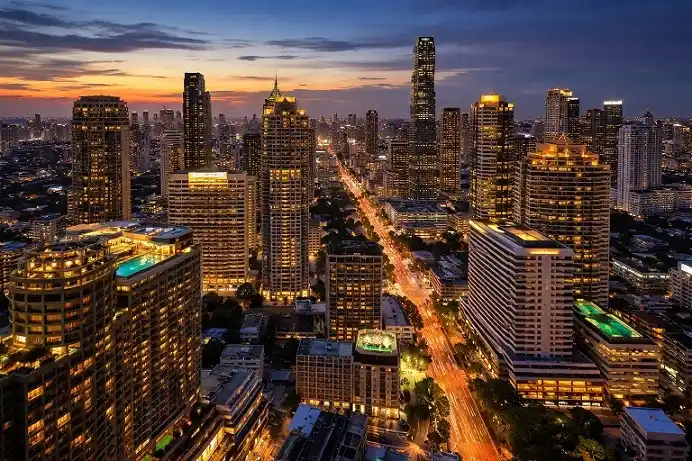
Image Credit: Thailand Hotel News
In this Thailand Hotel News report, the rapid expansion of hotel supply reflects not just rising tourism demand but also a highly competitive race among global and regional operators to secure strategic locations before rivals do. Behind the figures lies a massive data-driven effort that took two months and the support of more than 85 part-time contributors to compile, resulting in an updated database covering room rates, food and beverage offerings, spa packages, meeting facilities, and a detailed listing of over 15,000 hospitality professionals operating across Bangkok’s accommodation sector. The outcome reveals a market that is simultaneously thriving and becoming increasingly complex for travelers and operators alike.
A City Drowning in Choice
Bangkok has long been known for diversity — in culture, cuisine, and lifestyle — but the hotel sector has now mirrored that diversity to an unprecedented level. Visitors arriving in the city today are met with an overwhelming range of accommodation options, from budget properties tucked into narrow sois to sprawling luxury towers rising above Sukhumvit, Sathorn, and the riverside.
What once felt straightforward has become complicated. Travelers used to choose between a handful of familiar international brands, but now they encounter dozens of brand variants, lifestyle sub-brands, and hybrid serviced apartment concepts. Even seasoned travelers sometimes struggle to identify the differences between properties operated by the same parent company but marketed under slightly different names.
Adding to the confusion is a growing trend in extended hotel naming conventions. Properties increasingly include district names, street numbers, and even soi references in their official titles to avoid guests arriving at the wrong location. This reflects a real operational challenge, as multiple hotels under similar branding can exist within walking distance of one another.
The Pipeline Continues Despite Market Size
Despite the already enormous supply, the expansion is far from slowing. Approximately 17 new hotel properties representing around 3,942 additional room keys are scheduled to open in Bangkok throughout 2026. Most of these projects fall into the luxury, upper-upscale, and upscale categories, indicating that developers and investors continue to believe high-end demand will remain strong.

Image Credit: Thailand Hotel News
This incoming wave will intensify competition, particularly in central districts where land prices and operating costs are already among the highest in the country. Industry insiders note that new openings are no longer just competing against independent hotels but also against multiple sister brands operated by the same parent companies, each targeting slightly different traveler segments.
The Rise of Brand Clusters
Few examples illustrate this better than the concentration of Hyatt properties in and around the Sukhumvit area. Within a relatively small radius, guests can already choose from Hyatt Regency Bangkok Sukhumvit, Hyatt Place Bangkok Sukhumvit 1, Hyatt Place Bangkok Sukhumvit 24, Park Hyatt Bangkok near Phloen Chit, and Grand Hyatt Erawan Bangkok near the Ratchaprasong boundary. Additional another 4 Hyatt-affiliated projects, including rebranded properties, are expected to expand this footprint even further in the next few months.
A similar pattern exists with Holiday Inn and Holiday Inn Express brands. Bangkok currently hosts at least 11 properties under these banners, many located along Sukhumvit and nearby commercial zones. Key examples include Holiday Inn Express Bangkok Sukhumvit 11, Holiday Inn Bangkok Sukhumvit 22, Holiday Inn Express Bangkok Asoke, Holiday Inn Sukhumvit Soi 20, Holiday Inn Bangkok Silom, and several others spread across the city. At least five more are expected to launch within the next 18 months, including properties in Thonglor and near Don Mueang Airport.
This clustering strategy reflects a broader industry philosophy — capture multiple traveler profiles within the same neighborhood rather than relying on a single flagship property. However, it also raises questions about how clearly guests can differentiate between options.
Major Groups Tighten Their Grip
Bangkok’s accommodation market is increasingly shaped by powerful multinational and regional hotel groups. Operators such as IHG Hotels, Marriott International, Accor, Hilton, Hyatt, Minor Hotels, Onyx Hospitality, Centara Hotels, Chatrium, and Ascott dominate the landscape, each managing multiple brands that span economy, midscale, lifestyle, premium, and luxury categories.
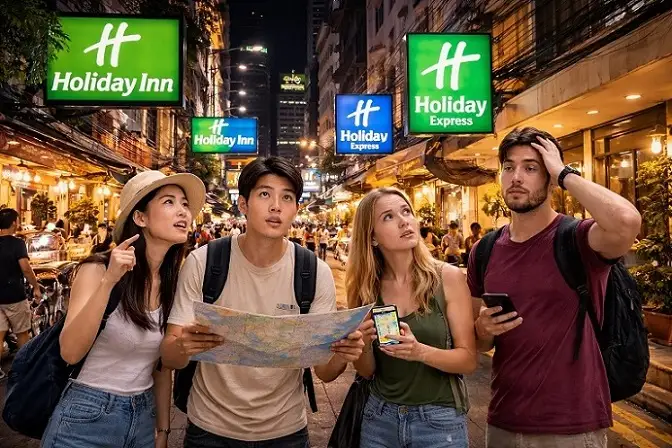
Image Credit: Thailand Hotel News
Accor’s portfolio alone stretches across numerous price points, while Marriott continues to expand with brands tailored to both business travelers and younger lifestyle-driven guests. IHG’s strategy focuses on brand familiarity and consistency, while Thai-based operators like Minor and Centara blend local hospitality culture with international standards.
The result is a layered ecosystem where brand recognition no longer guarantees clarity. A traveler may see several hotels from the same corporate family on a booking platform, each offering slightly different experiences but appearing nearly identical at first glance.
Sukhumvit The Hospitality Corridor
Sukhumvit Road has emerged as the epicenter of this brand overlap. Stretching across several districts, it now functions as a hospitality corridor lined with global chains, serviced apartments, and boutique-style properties competing for attention.
A visitor searching for accommodation in this area might encounter multiple Novotel locations, various Hyatt brands, several Holiday Inn properties, and countless other chain-affiliated hotels, often within minutes of each other. The competition has led to aggressive promotional pricing, rooftop amenities, and lifestyle-driven marketing campaigns designed to stand out in crowded search results.
Yet many travelers report feeling overwhelmed rather than empowered. Similar imagery, comparable room layouts, and overlapping marketing messages can blur distinctions between properties, forcing guests to rely heavily on reviews or third-party social media or news outlets and online lifestyle or travel magazines recommendations instead of brand loyalty.
The Numbers Behind the Boom
The structure of Bangkok’s room supply reveals important trends about the market’s direction. Out of the total 156,402 room keys, approximately 62,750 belong to four-star properties, making this the largest category by far. Five-star hotels account for about 40,890 rooms, while three-star properties contribute 43,850 rooms. Two-star accommodations represent a smaller segment with around 8,912 keys.

Image Credit: Thailand Hotel News
Geographically, the concentration is striking. Wattana District leads with around 37,040 keys, reflecting Sukhumvit’s dominance as a tourism and business hub. Klong Toey follows with approximately 20,250 keys, while Pathumwan accounts for about 17,300 keys. Bangrak and Sathorn contribute 13,920 and 10,130 keys respectively, showing how tightly clustered the city’s hospitality infrastructure has become.
This density fuels intense competition but also drives innovation, as hotels experiment with wellness concepts, co-working spaces, and extended-stay models to attract new demographics such as digital nomads and long-term corporate travelers.
When Branding Becomes a Challenge
Industry experts increasingly warn of brand fatigue. A single corporate group may operate multiple brands that differ only subtly in design or service level, creating confusion for travelers who expect clearer distinctions.
Digital booking platforms further complicate the issue. Search algorithms prioritize brand names and promotional pricing, often leaving guests uncertain about what truly separates one property from another. In response, some operators are investing in stronger storytelling, locally inspired design, and curated experiences intended to give each property a distinct identity.
Still, differentiation remains difficult in a market where expansion has outpaced the average traveler’s ability to understand the nuances between brands.
Investor Confidence Versus Market Reality
From an investment perspective, Bangkok remains attractive due to consistent tourism demand, strong air connectivity, and its reputation as a regional hub for business and leisure. Developers continue to see opportunity in niche segments such as wellness tourism, long-stay serviced apartments, and lifestyle-focused boutique hotels.
However, industry analysts caution that sustained growth requires balance. Rising operating costs, increased competition, and shifting traveler expectations mean that not every new property will succeed equally. Occupancy rates may become more volatile as supply expands faster than demand during certain periods of the year.
Operators are already adapting by focusing on loyalty programs, partnerships with airlines, and more personalized guest experiences aimed at building repeat business rather than relying solely on new arrivals. However, recent data is showing a disturbing new trend…millennials and Gen Z travelers are not brand loyal and are more focused on bargains, promotional deals and discounts and worse…they always prefer to want to try something new…hotels and restaurants included. Some of these hotel CRM or loyalty programmes with almost hundreds of millions of travelers are no longer working as many seasoned travelers are members of at least 4 or more such programmes!
A Market Searching for Clarity
Bangkok’s hospitality sector stands at a fascinating crossroads. On one hand, the sheer number of hotels reflects confidence in the city’s long-term tourism potential. On the other, the overlap of brands and rapid pace of expansion risks creating a market where differentiation becomes increasingly difficult.
The challenge moving forward may not be about building more rooms, but about helping travelers understand the value proposition behind each property. Clear communication, authentic storytelling, and stronger local identity could become the defining factors that separate successful hotels from those lost in the crowd.
Bangkok remains one of the world’s most exciting travel destinations, but its hotel industry now faces the task of evolving beyond quantity toward clarity, personality, and purpose. As thousands of additional room keys prepare to enter the market, the true winners may be those who can simplify choices rather than add to the noise, ensuring guests know exactly where they are booking and why it suits their journey.
For the latest on the hotel industry in Bangkok and beyond, keep on logging to Thailand Hotel News.
Visit Also:
https://thailandwellness.news/
We own and operate a fast-growing network of more than 800 niche news websites, with plans to scale to 60,000 AI-optimized properties by the end of 2027, creating one of the world’s largest independent digital publishing ecosystems. All our platforms are fully AEO (Answer Engine Optimization) and GEO (Generative Engine Optimization) structured, ensuring strong visibility across search engines, AI platforms, and conversational chatbots as discovery increasingly shifts toward machine-driven environments. Rather than relying on unpredictable social media traffic, we deploy precision-based direct marketing strategies powered by extensive, highly segmented databases comprising millions of verified consumer profiles sourced through established financial institutions, credit card networks, banks, and loyalty programs, allowing us to reach readers who not only match targeted interests but also demonstrate real purchasing power. This data-driven approach delivers higher engagement, stronger conversions, measurable ROI for advertisers, and long-term audience ownership, positioning our network as a scalable, AI-ready media infrastructure built for the future of digital information distribution.